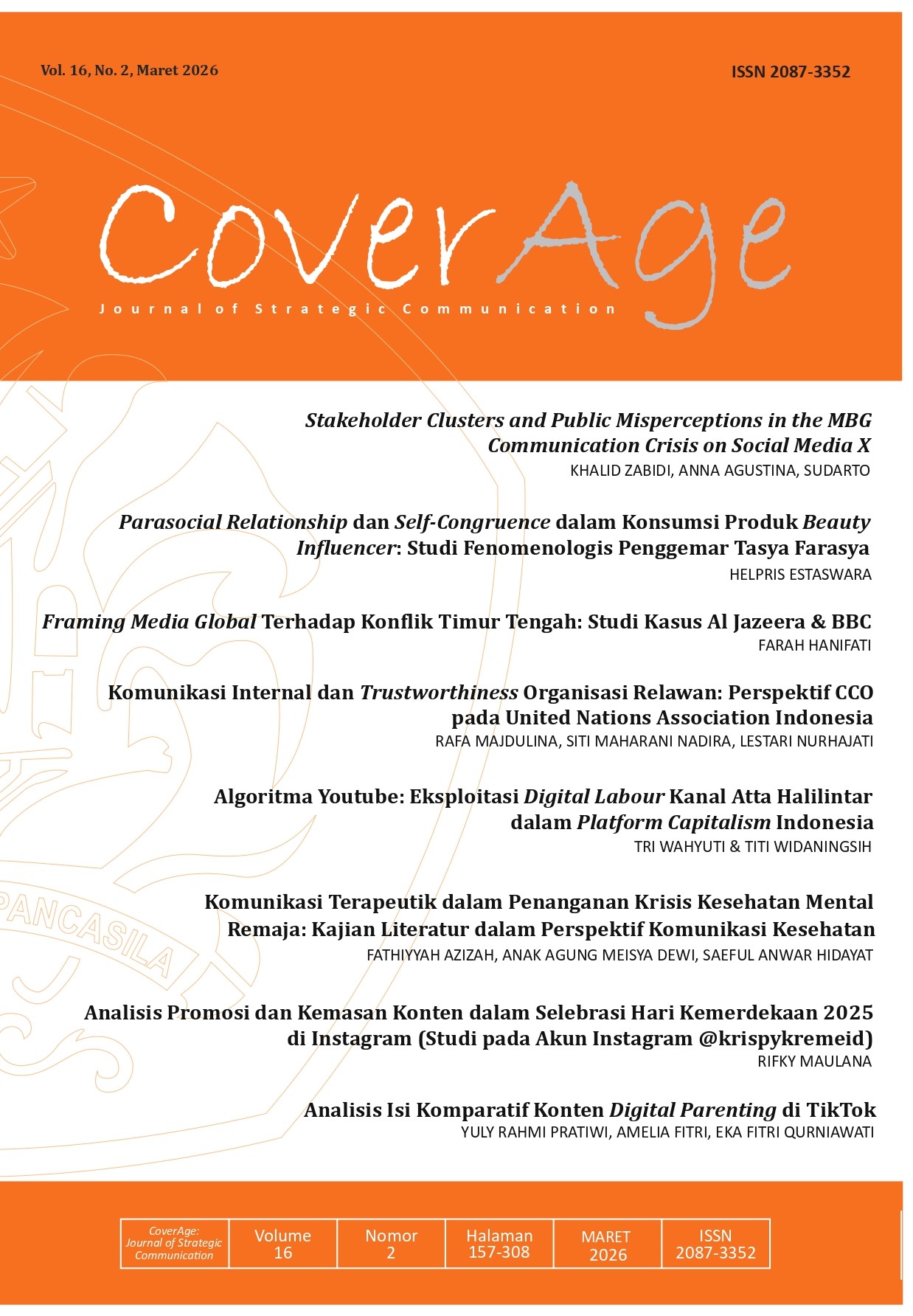
Stakeholder Clusters and Public Misperceptions in the MBG Communication Crisis on Social Media X
DOI:
https://doi.org/10.35814/mbkn8174Keywords:
Crisis Communication, Free Nutritious Meal Program, Misperceptions, Social Media X, Social Network AnalysisAbstract
The Free Nutritious Meal Program (MBG) is a national public policy aimed at improving nutritional access for students and priority groups. However, reported food poisoning cases associated with its implementation triggered a policy communication crisis in the digital public sphere. This study maps clusters of public misperception related to the MBG food poisoning issue on social media X using Stakeholder Theory and Social Network Analysis (SNA). Public conversation data were collected through Drone Emprit Academic from August 1 to November 13, 2025, focusing on discussions of MBG food poisoning. The analysis identifies relational patterns, key actors, sentiments, emotions, and network cluster structures. Findings reveal stakeholder fragmentation into four dominant clusters: mainstream media, activists and alternative media, pro-policy buzzers, and bots. Each cluster produces and reproduces distinct forms of misperception, including perceived health risks, responsibility attribution, governance transparency, and program legitimacy. The study confirms that public misperceptions in policy crises are structurally networked rather than merely individual cognitive errors. It contributes to stakeholder-based crisis communication studies by highlighting the importance of network-cluster-based message segmentation to reduce misperception escalation and restore public trust in public policy.
References
Arianto, B. (2020). Pemanfaatan Aplikasi Drone Emprit Academic dalam Menganalisis Opini Publik di Media Sosial. JSPG: Journal of Social Politics and Governance, 2(2), 177–191. https://doi.org/10.24076/JSPG.2020v2i2.4
15
Barberá, P., Jost, J. T., Nagler, J., Tucker, J. A., & Bonneau, R. (2015). Tweeting From Left to Right: Is Online Political Communication More Than an Echo Chamber? Psychological Science, 26(10), 1531–1542. https://doi.org/10.1177/0956797615594620
Bennett, A., & Checkel, J. T. (2014). Process tracing and the social sciences: From metaphor to analytic tool. Cambridge University Press. https://doi.org/10.1017/CBO9781139858472
Bradshaw, S., & Howard, P. N. (2017). Troops, Trolls and Troublemakers: A Global Inventory of Organized Social Media Manipulation. Computational Propaganda Research Project Working Paper No. 2017.12.
Bruns, A., & Burgess, J. (2015). Twitter hashtags from ad hoc to calculated publics. In N, Rambukkana (Ed.). Hashtag publics: The power and politics of discursive networks (pp. 13–28). Peter Lang.
Bruns, A., & Weller, K. (2016). Twitter as a First Draft of the Present – and the Challenges of Preserving It for the Future. WebSci ’16: Proceedings of the 8th ACM Conference on Web Science, 183–189. https://doi.org/10.1145/2908131.2908174
Bundy, J., Pfarrer, M. D., Short, C. E., & Coombs, W. T. (2017). Crises and Crisis Management: Integration, Interpretation, and Research Development. Journal of Management, 43(6), 1661–1692. https://doi.org/10.1177/0149206316680030
Chadwick, A. (2017). The Hybrid Media System: Politics and Power (2 ed.). Oxford University Press.
Christensen, T., & Lægreid, P. (2020). Balancing Governance Capacity and Legitimacy: How the Norwegian Government Handled the COVID-19 Crisis as a High Performer. Public Administration Review, 80(5), 774–779. https://doi.org/10.1111/puar.13241
Cinelli, M., Morales, G. D. F., Galeazzi, A., Quattrociocchi, W., & Starnini, M. (2021). The echo chamber effect on social media. Proceedings of the National Academy of Sciences, 118(9), e2023301118. https://doi.org/10.1073/pnas.2023301118
Coombs, W. T. (2015). Ongoing crisis communication: Planning, managing, and responding (4 ed.). Sage Publication.
Coombs, W. T., & Holladay, S. J. (2023). Crisis communication and the fragmented public sphere: Implications of algorithmic clustering for organizational response strategies. Journal of Contingencies and Crisis Management, 31(2), 145–158. https://doi.org/10.1111/1468-5973.12442
Del Vicario, M. Del, Bessi, A., Zollo, F., Petroni, F., Scala, A., Caldarelli, G., Stanley, H. E., & Quattrociocchi, W. (2016). The spreading of misinformation online. Proceedings of the National Academy of Sciences, 113(3), 554–559. https://doi.org/10.1073/pnas.1517441113
Drone Emprit Academic. (2025). Laporan analisis percakapan publik Program Makan Bergizi Gratis di media sosial X [Unpublished research report]. Drone Emprit.
Entman, R. M. (2007). Framing Bias: Media in the Distribution of Power. Journal of Communication, 57(1), 163–173. https://doi.org/10.1111/j.1460-2466.2006.00336.x
Fauziah, R. (2025). Analisis Jaringan Komunikasi (Social Network Analysis) Program MBG Indonesia. Journal of Science and Social Research, 8(3), 3556–3561.
https://doi.org/10.54314/jssr.v8i3.4007
Ferrara, B. Y. E., Varol, O., Davis, C., Menczer, F., & Flammini, A. (2016). The Rise of Social Bots. Communications of the ACM, 59(7), 96–104. https://doi.org/10.1145/2818717
Frandsen, F., & Johansen, W. (2017). Organizational Crisis Communication: A Multivocal Approach. Sage Publication.
Freeman, R. E. (1984). Strategic Management: A Stakeholder Approach. Pitman.
Gregory, R. (2003). Accountability in Modern Government. In B. G. Peters & J. Pierre (Ed.), Handbook of Public Administration. Sage Publication. https://doi.org/10.4135/9781848608214.n45
Guo, C., & Saxton, G. D. (2018). Speaking and Being Heard: How Nonprofit Advocacy Organizations Gain Attention on Social Media. Nonprofit and Voluntary Sector Quarterly, 47(1), 5–26. https://doi.org/10.1177/0899764017713724
Himelboim, I., Smith, M. A., Rainie, L., Shneiderman, B., & Espina, C. (2017). Classifying Twitter Topic-Networks Using Social Network Analysis. Social Media + Society, 3(1), 1–13. https://doi.org/10.1177/2056305117691545
Imran, M., Gogali, V. A., & Syarief, F. (2025). Media dan Komunikasi Kebijakan Publik: Analisis Frekuensi dan Sentimen Pemberitaan Program Makan Bergizi Gratis (MBG). Jurnal Ilmu Multidisiplin, 4(5), 3444–3452. https://doi.org/10.38035/jim.v4i5.1438
Jin, Y., Pang, A., & Cameron, G. T. (2012). Toward a publics-driven, emotion-based conceptualization in crisis communication: Unearthing dominant emotions in multi-staged testing of the Integrated Crisis Mapping (ICM) Model. Journal of Public Relations Research, 24(3), 266–298. https://doi.org/10.1080/1062726X.2012.676747
Keller, T. R., & Klinger, U. (2019). Social Bots in Election Campaigns: Theoretical, Empirical, and Methodological Implications. Political Communication, 36(1), 171–189. https://doi.org/10.1080/10584609.2018.1526238
Kietzmann, J., Paschen, J., & Treen, E. (2018). Artificial Intelligence in Advertising: How Marketers Can Leverage Artificial Intelligence Along the Consumer Journey. Journal of Advertising Research, 58(3), 263–267. https://doi.org/10.2501/JAR-2018-035
Lewandowsky, S., Ecker, U. K. H., Seifert, C. M., Schwarz, N., & Cook, J. (2012). Misinformation and Its Correction: Continued Influence and Successful Debiasing. Psychological Science in the Public Interest, 13(3), 106–131. https://doi.org/10.1177/1529100612451018
Luoma-aho, V., & Vos, M. (2009). Monitoring the complexities: Nuclear power and public opinion. Public Relations Review, 35(2), 120–122. https://doi.org/10.1016/j.pubrev.2009.01.013
Meraz, S., & Papacharissi, Z. (2013). Networked Gatekeeping and Networked Framing on #Egypt. The International Journal of Press/Politics, 18(2), 138–166. https://doi.org/10.1177/1940161212474472
Mitchell, R. K., Agle, B. R., & Wood, D. J. (1997). Toward a Theory of Stakeholder Identification and Salience: Defining the Principle of Who and What Really Counts. The Academy of Management Review, 22(4), 853–886. https://doi.org/10.5465/amr.1997.9711022105
Pranandana, V. A. K., Haryanti, N., & Meifilina,
A. (2025). Analisis Framing Pemberitaan Program Makan Bergizi Gratis (MBG) Pada Media Online Kompas.Com Dan Kumparan.Com. Jurnal Media Akademik (JMA), 3(9). https://doi.org/0.62281/t7gs9540
Priyantomo, B. A. (2025). Critical Discourse Analysis of Free Nutritious Meal Policy: A Study Social Media X. International Conference Proceedings Universitas Islam Balitar Blitar, 1, 459–482.
Rahma, A. A., Ranto, S., Febrianti, D. D., & Hayat, M. A. (2025). Strategi Komunikasi Kepala Badan Gizi Nasional (BGN) Dalam Menyikapi Kasus Keracunan Makanan Bergizi Gratis (MBG) Di Berbagai Daerah. Nusantara Journal of Multidisciplinary Science, 3(5), 564–571.
Rowley, T. J. (1997). Moving beyond Dyadic Ties: A Network Theory of Stakeholder Influences. The Academy of Management Review, 22(4), 887–910. https://doi.org/10.2307/259248
Sellnow, T. L., & Seeger, M. W. (2018). Theorizing Crisis Communication (2 ed.). Wiley-Blackwell.
Shao, C., Ciampaglia, G. L., Varol, O., Yang, K.-C., Flammini, A., & Menczer, F. (2018). The spread of low-credibility content by social bots. Nature Communications, 9, 4787. https://doi.org/10.1038/s41467-018-06930-7
Sharma, K., Qian, F., Jiang, H., Ruchansky, N., Zhang, M., & Liu, Y. (2023). Combating misinformation in the age of LLMs: Opportunities and challenges. AI Magazine, 44(3), 291–304. https://doi.org/10.1002/aaai.12131
Slovic, P. (2000). The Perception of Risk. Earthscan.
Van Der Meer, T. G. L. A., & Jin, Y. (2020). Seeking Formula for Misinformation Treatment in Public Health Crises: The Effects of Corrective Information Type and Source. Health Communication, 35(5), 560–575. https://doi.org/10.1080/10410236.2019.1573295
Walter, N., Brooks, J. J., Saucier, C. J., & Suresh, S. (2020). Evaluating the Impact of Attempts to Correct Health Misinformation on Social Media: A Meta-Analysis. Health Communication, 36(13), 1776–1784. https://doi.org/10.1080/10410236.2020.1794553
Wasserman, S., & Faust, K. (1994). Social network analysis: Methods and applications. Cambridge University Press.
Vraga, E. K., Kim, S. C., & Cook, J. (2022). Testing the effectiveness of corrections in networked environments: The role of source credibility and network centrality. Misinformation Review, 3(1), 1–19. https://doi.org/10.37016/mr-2020-91