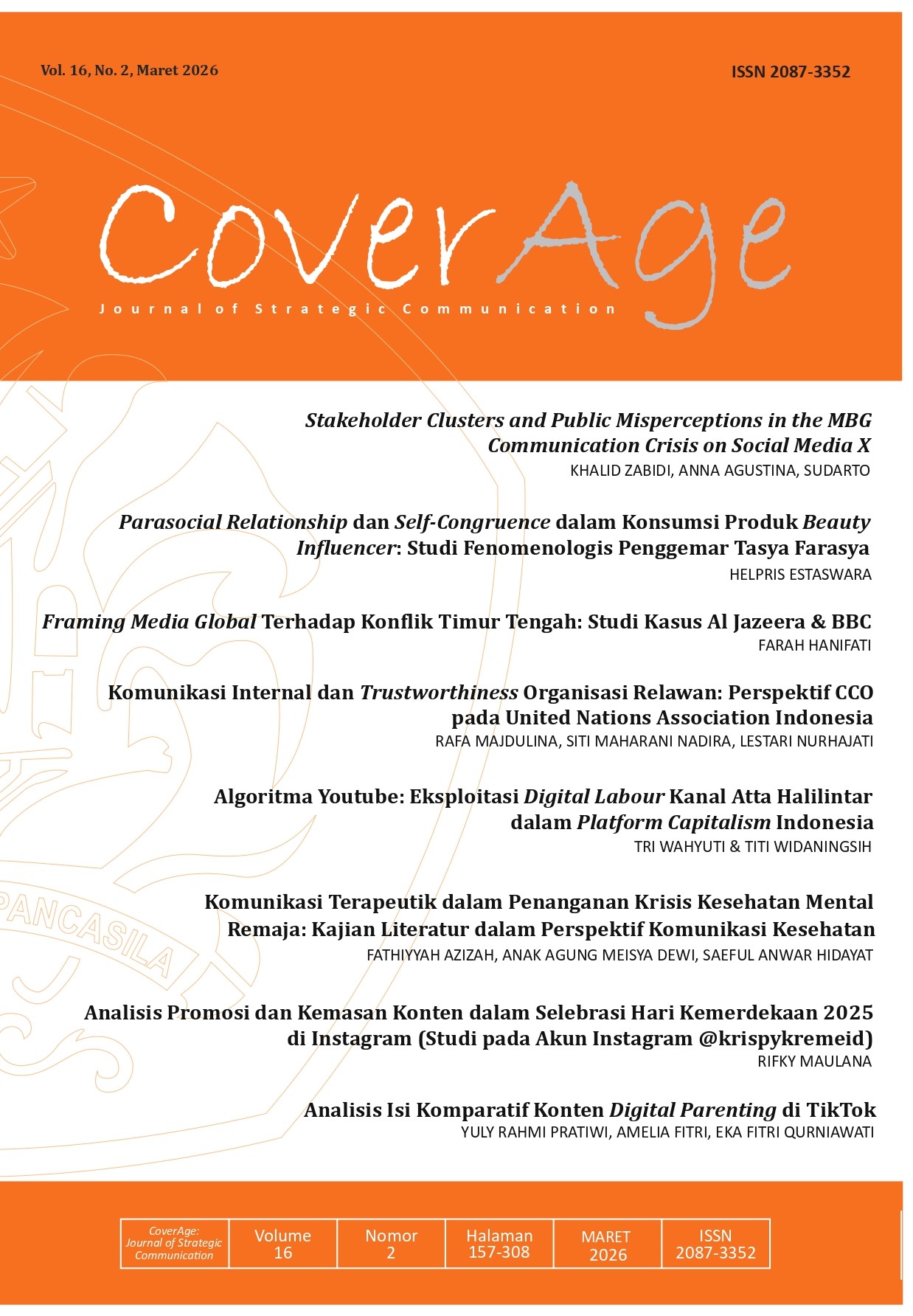
Komunikasi Internal dan Trustworthiness Organisasi Relawan: Perspektif CCO pada United Nations Association Indonesia
DOI:
https://doi.org/10.35814/9xgmcx89Keywords:
CCO, Organisasi Relawan, Komunikasi Internal, Koordinasi Kerja, TrustworthinessAbstract
Penelitian ini bertujuan untuk menentukan bagaimana komunikasi internal berkontribusi pada pembentukan kepercayaan dan koordinasi pekerjaan dalam organisasi relawan United Nations Association Indonesia (UNA Indonesia). Penelitian ini melakukan wawancara dengan tujuh narasumber ahli, peserta program, dan pengurus internal organisasi menggunakan pendekatan kualitatif yang menggunakan paradigma interpretif. Untuk menganalisis data, Perspektif Komunikasi Konstitusi Organisasi (CCO) digunakan. Perspektif ini menekankan empat arus komunikasi konstitutif: persetujuan anggota, pengorganisasian aktif, koordinasi kegiatan, dan penempatan institusional. Penelitian menunjukkan bahwa komunikasi internal di UNA Indonesia sangat penting untuk membentuk struktur organisasi, legitimasi peran, metode koordinasi kerja, dan kepercayaan internal dan eksternal, selain berfungsi sebagai cara untuk menyampaikan informasi. Transparansi komunikasi mencakup semua aspek, termasuk waktu penyampaian yang tepat, ketersediaan kanal komunikasi yang konsisten, dan kejelasan dokumentasi keputusan, terutama dalam situasi perubahan mendadak. Ini tidak hanya berarti keterbukaan informasi. Hasilnya menunjukkan bahwa komunikasi yang konsisten, dapat dipertanggungjawabkan, dan keterlibatan relawan dalam aktivitas sehari-hari organisasi dapat membangun kepercayaan organisasi.
References
Abdussamad, Z., & Rapanna, P. (2021). Metode penelitian kualitatif. Syakir Media Press. Ahmed, S. K., et al. (2024). The pillars of trustworthiness in qualitative research: Credibility, transferability, dependability, confirmability. Journal of Medicine, Surgery, and Public Health.
Alkandari, A., Alqudaihi, K., & Alnajdi, F. (2025). Examining the spiral of silence in offline and online contexts: A cross-setting study. Frontiers in Sociology. https://www.frontiersin.org/articles/10.3389/fsoc.2025.1558439/full,
Alfansyur, M., & Mariyani, F. (2020). Triangulation in Qualitative Research: A Critical Review. International Journal of Research in Business and Social Science, 9(4), 51- 58.
Amaliadanti, A., Ayunarendra, V. K., Wijaya, L., Rahma, H. M., & Irwansyah, I. (2024). Mobile apps WhatsApp sebagai media komunikasi dan informasi: Studi literatur sistematik. CoverAge: Journal of Strategic Communication, 15(1), 1–114. https://doi.org/10.35814/coverage.v15i1.6238
Anggito, A., & Setiawan, H. (2018). Sampling Techniques in Qualitative Research: A Review. Journal of Social Research Methodology, 21(4), 507-521.
Bryman, A. (2021). Social research methods (6th ed.). Oxford University Press.
Bunkar, R. C., Chauhan, L., & Verma, A. (2024). Case study research: A method of qualitative research. In Exploring Narratives: A Guide to Qualitative Research Methods.
Creswell, J. W., & Poth, C. N. (2021). Qualitative inquiry and research design: Choosing among five approaches (4th ed.). Thousand Oaks, CA: SAGE Publications
Daft, R. L. (2021). Organization theory and design (13th ed.). Cengage Learning
Denzin, N. K., & Lincoln, Y. S. (Eds.).(2023).The SAGE handbook of qualitative research (6th ed.). Thousand Oaks, CA: SAGE Publications.
Estaswara, H. (2021). Strategic communication dalam perspektif ilmu komunikasi. CoverAge: Journal of Strategic Communication, 11(2), 77–87. https://doi.org/10.35814/coverage.v11i2.2028
Felixstowe Level Two Youth Project. (2022). Communications policy. https://www.leveltwo.org/wordpress/wpcontent/uploads/2022/11/Communications_Policy_No._39_September_20221-1.docx
Forde, C. (2023). Virtual working in a voluntary youth organisation during the pandemic: Internal communication issues and opportunities. Voluntary Sector Review. https://bristoluniversitypressdigital.com/view/journals/vsr/14/3/article-p531.xml
Korstjens, I., & Moser, A. (2017). Practical guidance to qualitative research: Part 4 — Trustworthiness and triangulation. International Journal of Qualitative Methods. https://doi.org/10.1080/13814788.2017.1375092
Lubis, M. S. (2018). Metodologi Penelitian. Sleman: CV BUDI UTAMA.
Luthfiyah, M. F. (2017). METODOLOGI PENELITIAN KUALITATIF, TINDAKAN KELAS& STUDI KASUS. Kota Bima: CV Jejak.
Lincoln, N. K. (2017). THE SAGE HANDBOOK of QUALILATIVE RESEARCH (Vol. 15). (H.Salmon, Penyunt.) California: SAGE Publications, Inc.
Lewis, J., & Thornhill, A. (2023). Research Methods for Business Students.Pearson Education.
Miles, M. B., & Huberman, A. M. (2014). Qualitative Data Analysis: A Methods Sourcebook.SAGE Publications.
Mariyani, A. A. (2020, Desember). SENI MENGELOLA DATA: PENERAPAN TRIANGULASI TEKNIK, SUMBER DAN WAKTU PADA PENELITIAN PENDIDIKAN SOSIAL. HISTORI: Jurnal Kajian, Penelitian & Pengembangan Pendidikan Sejarah, V, 146-150. http://journal.ummat.ac.id/index.php/historis/article/view/3432/pdf
Maguregi, L., García, R., & Zubia, K. (2025). A stakeholder approach in Spanish non-profit organisations. Journal of the Knowledge Economy. https://doi.org/10.1007/s13132-025-02780-z
Manullang, M. E. I., Elfani, E., Dewi, I., & Surya, E. (2025). PARADIGMA INTERPRETIF DAN PENDEKATAN KUALITATIF DALAM PENDIDIKAN MATEMATIKA. Pendas: Jurnal Ilmiah Pendidikan Dasar,
10(01) 237-248. https://doi.org/10.23969/jp.v10i02.26168
McPhee, R. D., & Zaug, P. (2009). The communicative constitution of organizations: A framework for explanation. Annals of the International Communication Association, 33(1), 1–38. https://doi.org/10.1080/23808985.2009.11679008
Molina Rodríguez-Navas, P., Medranda Morales, N., & Muñoz Lalinde, J. (2021). Transparency for participation through the communication approach. ISPRS International Journal of Geo-Information, 10(9), 586. https://doi.org/10.3390/ijgi10090586
Putnam, L. L., Nicotera, A. M., & McPhee, R. D. (2016). Organizing in the communication field: An introduction to the Communication Constitutes Organization (CCO) perspective. Routledge.
Rathi, D., & Given, L. M. (2023). Document analysis and desk research in qualitative inquiry: Evolving practices in the digital era. Qualitative Research Journal, 23(3), 220–235.
Reig, M., & Gasco-Hernandez, M. (2021). Internal and external transparency in public- private partnerships: The case of Barcelona’s water provision. Sustainability, 13(4), 1777. https://doi.org/10.3390/su13041777
Robbins, S. P., & Judge, T. A. (2020). Organizational behavior (18th ed.). Pearson Education.
Romero-Rodríguez, L. M., Gómez-García, G., & Contreras-Pulido, P. (2024). Internal communication from a happiness management perspective: A literature review and meta-analysis. International Journal of Environmental Research and Public Health. https://pmc.ncbi.nlm.nih.gov/articles/PMC11550556/
Saunders, M., Lewis, P., & Thornhill, A. (2023). Research methods for business students (8th ed.). Pearson.
Saville-Troike, M., & Barto, K. (2021). Ethnography and Communication: A Handbook.John Wiley & Sons.
Suratmoko, B., & Adnan, I. Z. (2024). Strategic internal communication in organizational change: A narrative review of practices and barriers. Communica: Journal of Communication. https://journal.idscipub.com/communica/article/view/650
Setiawan, A. A. (2018). METODOLOGI PENELITIAN KUALITATIF. Yogyakarta: CV Jejak.
Sugiyono. (2022). Metode Penelitian Kualitatif.
Thelwell, M., & Nevill, T. (n.d.). Is research with qualitative data more prevalent and impactful now? Interviews, case studies, focus groups and ethnographies. arxiv (Cornell University).
https://arxiv.org/abs/2104.11943
Wang, R., Xu, K., & Huang, X. (2021). Organizational commitment in the nonprofit sector and communication implications. Frontiers in Psychology. https://pmc.ncbi.nlm.nih.gov/articles/PMC7928174/
Wasko, M. M., & Sahay, S. (2024). Using secondary data for organizational analysis: Strengths, limitations, and best practices in desk research. International Journal of Qualitative Methods, 23(1), 1–15.
Yuan, X., Ma, L., Wang, C., Yan, H., & Chen, Y. (2024). The internal organizational performance influence factors study: An empirical test. PLoS ONE, 19 (4), e0298595. https://doi.org/10.1371/journal.pone.0298595.pdf