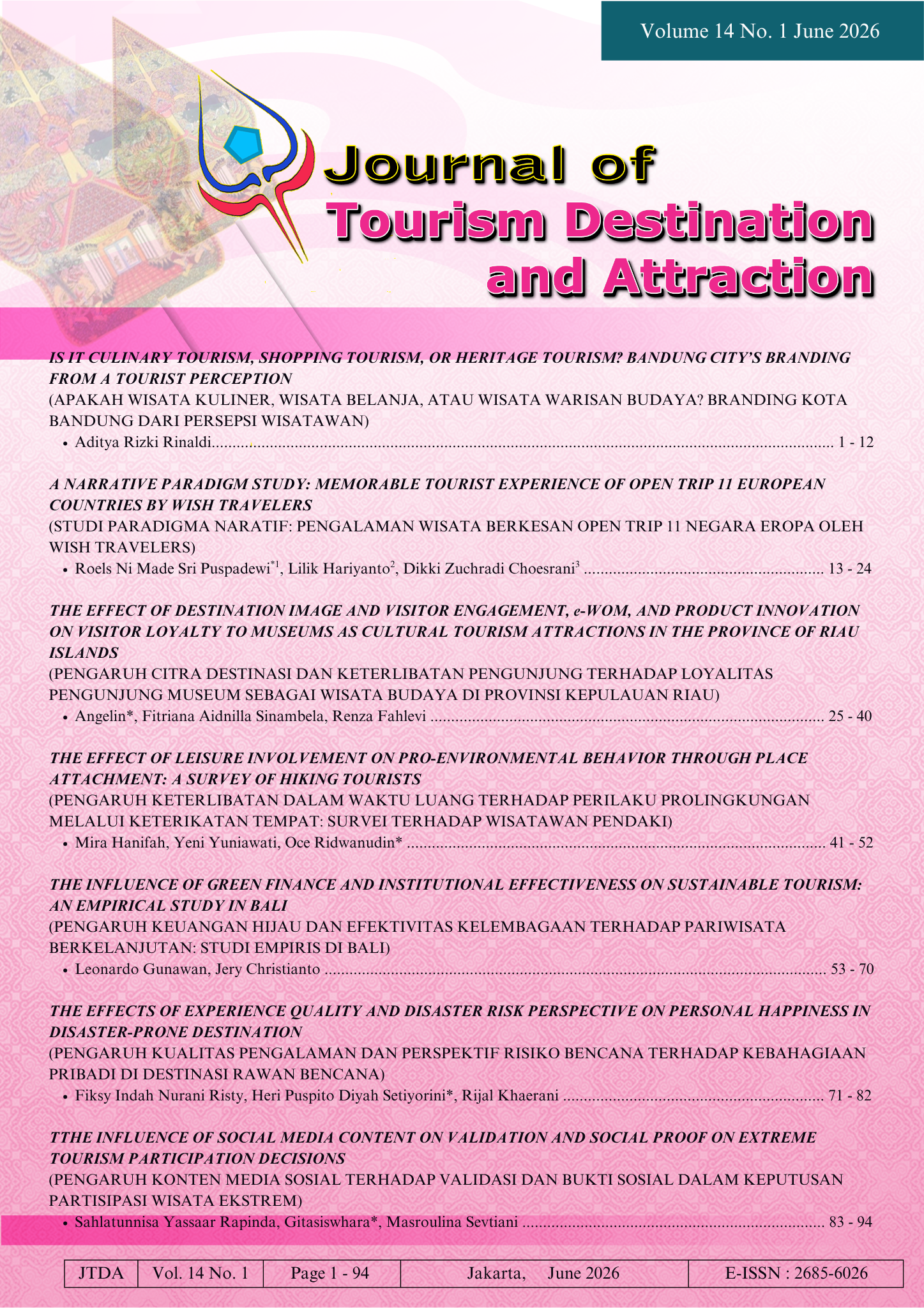
IS IT CULINARY TOURISM, SHOPPING TOURISM, OR HERITAGE TOURISM? BANDUNG CITY’S BRANDING FROM A TOURIST PERCEPTION
DOI:
https://doi.org/10.35814/rvadnw67Keywords:
Customer-Based Brand Equity, Destination Branding, Analytic Hierarchy Process, Culinary Tourism, Bandung CityAbstract
Destination branding is a critical component of urban tourism marketing, yet scholarly consensus on the dominant brand identity of multifaceted destinations remains limited. Bandung City, Indonesia, presents a compelling case: the city is simultaneously perceived by tourists as a culinary tourism destination, a shopping tourism destination, and a heritage tourism destination, yet no study has systematically prioritized these competing identities using a consumer-based framework. This study addresses that gap by applying Customer-Based Brand Equity (CBBE) theory (Konecnik & Gartner, 2007) integrated with the Analytic Hierarchy Process (AHP) to determine which destination branding alternative—culinary, shopping, or heritage tourism—best reflects tourist perceptions of Bandung City. Data were collected via a structured questionnaire administered to 100 purposively sampled tourists who had visited Bandung City within the preceding two years. CBBE was operationalized through four dimensions: destination awareness, destination image, destination quality, and destination loyalty. AHP pairwise comparisons were processed using Expert Choice 11 software, with all consistency ratios confirmed at ≤ 0.1. Results reveal that culinary tourism emerged as the highest-ranked branding alternative, scoring highest on destination image, quality, and loyalty, while shopping tourism led on destination awareness. Heritage tourism demonstrated the most consistent performance across all CBBE dimensions. These findings offer evidence-based recommendations for destination management organizations and city governments seeking to develop targeted, equity-driven tourism marketing strategies.
References
Abdillah, D., Ardiwidjaja, R., Marhanani Tri Astuti, & Putranto, D. (2022). Development of Eco-Friendly Travel Patterns based on Cultural Heritage Attractions in the City of Bandung. East Asian Journal of Multidisciplinary Research, 1(11), 2507–2520. https://doi.org/10.55927/eajmr.v1i11.2132
Astuti, M. T. (2017a). Strategi Komunikasi Kota Bandung Dalam Membentuk City Branding Sebagai Destinasi Wisata Belanja. Jurnal Kepariwisataan Indonesia, 12, 111–128.
Astuti, M. T. (2017b). Strengthening the identity of tourism destination in bandung city with city branding. International Journal of Development Research, 7(12), 17692–17698.
Auliana, L., Arifianti, R., & Taryana, A. (2023). Branding Model of Bandung City. Russian Journal of Agricultural and Socio-Economic Sciences, 144(12), 112–117. https://doi.org/10.18551/rjoas.2023-12.13
Barkhordari, M., Shirmohammadi, Y., & Hashemnia, S. (2023). Destination brand brilliance as a differential advantage for a tourist destinatio. Turyzm/Tourism, 33(2), 55–69. https://doi.org/10.18778/0867-5856.33.2.05
Božić, S., Vujičić, M. D., Kennell, J., Besermenji, S., & Solarević, M. (2018). Sun, sea and shrines: Application of analytic hierarchy process (AHP) to assess the attractiveness of six cultural heritage sites in Phuket (Thailand). Geographica Pannonica, 22(2), 121–137. https://doi.org/10.5937/22-16983
Bustomi, T., & Avianto, B. N. (2022). City branding of the “music-design-culinary” as urban tourism of Bandung, West Java. International Journal of Tourism Cities, 8(1), 53–69. https://doi.org/10.1108/IJTC-06-2020-0123
Chi, H. K., Huang, K. C., & Nguyen, H. M. (2020). Elements of destination brand equity and destination familiarity regarding travel intention. Journal of Retailing and Consumer Services, 52(November 2018). https://doi.org/10.1016/j.jretconser.2018.12.012
Choi, S. S. (2016). A study on effect of tourism storytelling of tourism destination brand value and tourist behavioral intentions. Indian Journal of Science and Technology, 9(46), 1–6. https://doi.org/10.17485/ijst/2016/v9i46/107387
Çınar, K., & Weiss, D. (2020). Digital marketing and virtual tourism to enhance destination accessibility. In Sustainable destination branding and marketing: strategies for tourism development. https://doi.org/10.1079/9781786394286.0198
Crespo, Á. H., Gutiérrez, H. S. M., Sánchez, M. del M. G. de los S., & Agudo, J. C. (2017). Examining the hierarchy of destination brands and the chain of effects between brand equity dimensions. Journal of Destination Marketing and Management, 6(4), 353–362.
Dam, D. X. (2017). Factors Affecting Tourist Destination Choice: A Survey of International Travelers to Hanoi, Vietnam. Journal of Economics and Development, 19(1), 77–92. https://doi.org/10.33301/2017.19.01.06
Danudara, A. B. (2017). Perencanaan Produk Paket Wisata Heritage di Paguyuban Pelestarian Budaya Bandung. Jurnal Kepariwisataan: Destinasi, Hospitalitas Dan Perjalanan, 1(1), 10–24. https://doi.org/10.34013/jk.v1i1.3
Dedeoğlu, B. B., van Niekerk, M., Küçükergin, K. G., De Martino, M., & Okumuş, F. (2020). Effect of social media sharing on destination brand awareness and destination quality. Journal of Vacation Marketing, 26(1), 33–56. https://doi.org/10.1177/1356766719858644
Dey, B., Mathew, J., & Chee-Hua, C. (2020). Influence of destination attractiveness factors and travel motivations on rural homestay choice: the moderating role of need for uniqueness. International Journal of Culture, Tourism, and Hospitality Research, 14(4), 639–666. https://doi.org/10.1108/IJCTHR-08-2019-0138
Dinas Kebudayaan dan Pariwisata. (2023). Kajian Pemetaan Potensi Ekonomi Kreatif pada Lokasi Kampung Wisata Rintisan. In Pemerintah Kota Bandung.
Februadi, A., Wibisono, N., & Purnamasari, D. (2019). Bandung’s Image as a Tourist Destination: An Application of Quantitative and Qualitative Approach. International Journal of Applied Business Research, 1(01), 58–69. https://doi.org/10.35313/ijabr.v1i01.41
Ferns, B. H., & Walls, A. (2012). Enduring travel involvement, destination brand equity, and travelers’ visit intentions: A structural model analysis. Journal of Destination Marketing and Management, 1(1–2), 27–35. https://doi.org/10.1016/j.jdmm.2012.07.002
Gaffar, V., Hendrayati, H., & Bahtiar, V. P. (2019). Factors Influencing Restaurant Selection in Bandung Culinary City. 1st International Conference on Economics, Business, Entrepreneurship, and Finance (ICEBEF 2018), 65(May 2018), 123–127. https://doi.org/10.2991/icebef-18.2019.30
Gusnadi, D. (2019). Komodifikasi Seni Tradisional Sunda sebagai Daya Tarik Wisata Budaya di Kota Bandung. Jurnal AKRAB JUARA, 4(3), 14–55.
Hadianfar, N. (2021). Impact of Social Media Marketing on Consumer-Based Brand Equity for Tourism Destination. International Journal of Digital Content Management, 1(2), 150–170.
Hysa, B., Karasek, A., & Zdonek, I. (2021). Social media usage by different generations as a tool for sustainable tourism marketing in society 5.0 idea. Sustainability (Switzerland), 13(3), 1–27. https://doi.org/10.3390/su13031018
Hysa, B., Zdonek, I., & Karasek, A. (2022). Social Media in Sustainable Tourism Recovery. Sustainability (Switzerland), 14(2). https://doi.org/10.3390/su14020760
Jian-Fen, M. (2015). Literature Review of Overseas Tourism Destination Brand Research. Journal of Chongqing Technology and Business University.
Jiménez-Barreto, J., Rubio, N., Campo, S., & Molinillo, S. (2020). Linking the online destination brand experience and brand credibility with tourists’ behavioral intentions toward a destination. Tourism Management, 79(February 2019). https://doi.org/10.1016/j.tourman.2020.104101
Jinghuan, N., & Zhen, W. (2020). Research on function optimization design of public products in Tourist Attractions Based on AHP. Proceedings - 2020 13th International Conference on Intelligent Computation Technology and Automation, ICICTA 2020, 173–177. https://doi.org/10.1109/ICICTA51737.2020.00044
Kegoro, H. O., & Justus, M. (2020). Critical Review of Literature on Brand Equity and Customer Loyalty. International Journal of Business, Economics and Management, 7(3), 146–165. https://doi.org/10.18488/journal.62.2020.73.146.165
Keller, K. L. (2013). Strategic Brand Management: Building Measuring, and Managing Equity. Pearson.
Kim, S. H., Han, H. S., Holland, S., & Byon, K. K. (2009). Structural relationships among involvement, destination brand equity, satisfaction and destination visit intentions: The case of Japanese outbound travelers. Journal of Vacation Marketing, 15(4), 349–365. https://doi.org/10.1177/1356766709335835
Komaladewi, R. (2017). The Representation of Culinary Experience as the Future of Indonesian Tourism Cases in Bandung City, West Java. International Journal of Business and Economic Affairs, 2(5), 268–275. https://doi.org/10.24088/ijbea-2017-25001
Konecnik, M., & Gartner, W. C. (2007). Customer-based brand equity for a destination. Annals of Tourism Research, 34(2), 400–421. https://doi.org/10.1016/j.annals.2006.10.005
Kotler, K. (2016). Marketing Management (15th ed.). Global Edition.
Kumail, T., Qeed, M. A. Al, Aburumman, A., Abbas, S. M., & Sadiq, F. (2022). How Destination Brand Equity and Destination Brand Authenticity Influence Destination Visit Intention: Evidence from the United Arab Emirates. Journal of Promotion Management, 28(3), 332–358. https://doi.org/10.1080/10496491.2021.1989540
Kusumawardani, K. A., & Putri, F. R. (2020). Exploring the Behavioural Intention in Culinary Tourism: A Study on Bandung Tourist Destination. Global Research on Tourism Development and Advancement, 2(1), 63–81. https://doi.org/10.21632/garuda.2.1.63-81
Lee, H. M., Lee, C. C., & Wu, C. C. (2011). Brand image strategy affects brand equity after M&A. European Journal of Marketing, 45(7), 1091–1111. https://doi.org/10.1108/03090561111137624
Lu, H., de Jong, M., Yun, S., & Zhao, M. (2020). The multi-level governance of formulating regional brand identities: Evidence from three Mega City Regions in China. Cities, 100(July 2019), 102668. https://doi.org/10.1016/j.cities.2020.102668
Malhotra, N. K., & Birks, D. S. (2013). Marketing Research : An Applied Approach.
Maria, T., & Mutiara Lemy, D. (2018). The Local Tourist Interest on Museum: A Study in Bandung, West Java. 2nd International Conference on Tourism, Gastronomy, and Tourist Destinastion (ICTGTD 2018), 52, 332–343. https://doi.org/10.2991/ictgtd-18.2018.39
Marine-Roig, E. (2019). Destination image analytics through traveller-generated content. Sustainability (Switzerland), 11(12). https://doi.org/10.3390/su11123392
Maryani, E., & Logayah, D. S. (n.d.). Pengembangan Bandung sebagai Kota Wisata Warisan Budaya (Cultural Heritage). 2014.
Nugroho, F. A., Handizar, D. H., & Furqan, A. (2023). Tracing the Remains of the Dutch Colonialism Period and Its Influence on Heritage Tourism Resources in Bandung City, Indonesia. Archives of Business Research, 11(5), 99–109. https://doi.org/10.14738/abr.115.14704
Nugroho, I. W., Rahayu, S., & Andajani, E. (2020). Pengaruh Experiential Value dan Place Food Image Behavioral Intention Wisata Kuliner Bandung. Ekonomi Dan Bisnis, 24(2), 34–40.
Papadimitriou, D., Apostolopoulou, A., & Kaplanidou, K. K. (2015). Destination Personality, Affective Image, and Behavioral Intentions in Domestic Urban Tourism. Journal of Travel Research, 54(3), 302–315. https://doi.org/10.1177/0047287513516389
Pike, S. (2008). Destination Mareketing.
Pratminingsih, S. A., & Puspitasari, D. M. (2015). Developing Bandung as Culinary Destination. The Fourth International Conference on Entrepreneurship and Business Management (ICEBM 2015), November.
Priyanto, R., & Suryana. (2019). Membangun brand destination Kampung Rajut Binong Jati sebagai tujuan wisata belanja produk rajutan di Kota Bandung. Jurnal Kajian Pariwisata, 1(1), 31–43.
Purike, E., Azizah, N., Ajibroto, K., Kesumah, P., & Sujana, N. (2023). Wisata Heritage Dan Kalangan Milenial Muda Di Kota Bandung. Jurnal Ilmu Komunikasi, Sosial Dan Humaniora, 1(1), 1–13.
Rahman, M. S., Abdel Fattah, F. A. M., Hussain, B., & Hossain, M. A. (2021). An integrative model of consumer-based heritage destination brand equity. Tourism Review, 76(2), 358–373. https://doi.org/10.1108/TR-12-2019-0505
Rahmiati, F., & Amin, G. (2019). Factors of Tourist Perceived Value of Indonesia Shopping Tourism. Firm Journal of Management Studies, 4(1), 1. https://doi.org/10.33021/firm.v4i1.680
Raji, R. A., Mohd Rashid, S., & Mohd Ishak, S. (2019). Consumer-based brand equity (CBBE) and the role of social media communications: Qualitative findings from the Malaysian automotive industry. Journal of Marketing Communications, 25(5), 511–534. https://doi.org/10.1080/13527266.2018.1455066
Ray, N., Das, D. K., & Kumar, R. (2018). Tourism Marketing: A Strategic Approach. CRC Press.
Resmi, I. C., Dhewanto, W., & Dellyana, D. (2024). Gastronomy Tourism: Local Food and Tourism Experience in Bandung. 7th Global Conference on Business, Management, and Entrepreneurship (GCBME 2022), 10, 1804–1810. https://doi.org/10.2991/978-94-6463-234-7_190
Roostika, R. (2012). Destination Branding and Its Influence on Tourist’s Satisfaction and Loyalty. Journal of Technology Management, 11(1), 113808.
Ruiz-Real, J. L., Uribe-Toril, J., & Gázquez-Abad, J. C. (2020). Destination branding: Opportunities and new challenges. Journal of Destination Marketing and Management, 17(July 2019). https://doi.org/10.1016/j.jdmm.2020.100453
Saeedi, H., & Heidarzadeh Hanzaee, K. (2018). The effects of heritage image on destination branding: an Iranian perspective. Journal of Heritage Tourism, 13(2), 152–166. https://doi.org/10.1080/1743873X.2016.1264958
San Martín, H., Herrero, A., & García de los Salmones, M. D. M. (2019). An integrative model of destination brand equity and tourist satisfaction. Current Issues in Tourism, 22(16), 1992–2013.
Sekaran, U., & Bougie, R. (2016). Research Methods for Business: A Skill-Building Approach. John Wiley and Sons Inc. https://doi.org/10.1108/lodj-06-2013-0079
Semian, M., Chromý, P., & Kučera, Z. (2016). Name as a regional brand. Journal of Language and Politics, 15(6), 768–789. https://doi.org/10.1075/jlp.15.6.06sem
Setiawan, D., & Wulandari, S. (2020). Perancangan Desain User Interface Aplikasi Kabita. ARTCOMM, 03(01), 26–40.
Singh, R., Mehraj, N., & Roostika, R. (Ratna). (2018). Destination brand experience and its relationship with tourists satisfaction and intention to recommend: A conceptual model. African Journal of Hospitality, Tourism and Leisure, 7(1), 113808.
Stevanie, I. R., & Wulandari, A. A. A. (2021). West Java culinary tourism center. IOP Conference Series: Earth and Environmental Science, 729(1). https://doi.org/10.1088/1755-1315/729/1/012060
Susano, A., Sutrisno, S., Darmawan, A., Pujiastuti, P., Novita, D., Syamsiyah, S., & Mufti, A. (2019). Determination system of designing the best beach object in bali by using AHP method. Journal of Physics: Conference Series, 1175(1). https://doi.org/10.1088/1742-6596/1175/1/012053
Toan, L. D., Phu, N. H., Hai, P. T., Yen, H. T. P., & Son, P. X. (2019). Applying theory of planned behaviour in researching tourists’ behaviour: The case of Hoi An World Cultural Heritage site, Vietnam. African Journal of Hospitality, Tourism and Leisure, 8(5).
Turgarini, D. (2020). Bandung City as A Sundanese Gastronomy Foodscape. Digital Press Social Sciences and Humanities, 4(Ihtf), 00004. https://doi.org/10.29037/digitalpress.44351
Turgarini, D., Fajri, I., Pratiwi, M., & Ridwanudin, O. (2021). Android Application as a Information System of Sunda Gastronomic for Tourism Attraction in Bandung City. Ntf 2019, 84–93. https://doi.org/10.5220/0009785600840093
Vila, N. A., Brea, J. A. F., & de Carlos, P. (2021). Film tourism in Spain: Destination awareness and visit motivation as determinants to visit places seen in TV series. European Research on Management and Business Economics, 27(1), 100135. https://doi.org/10.1016/j.iedeen.2020.100135
Wang, H., & Yan, J. (2022). Effects of social media tourism information quality on destination travel intention: Mediation effect of self-congruity and trust. Frontiers in Psychology, 13(December), 1–14. https://doi.org/10.3389/fpsyg.2022.1049149
Wang, Y., & Pizam, A. (2017). Destination Marketing and Management: Theories and Applications. In CABI (Vol. 01).
Welthagen, L., Slabbert, E., & Plessis, E. du. (2022). Conference tourism competitiveness: An applied AHP framework. In Journal of Convention and Event Tourism (Vol. 23, Issue 5, pp. 435–459). Routledge. https://doi.org/10.1080/15470148.2022.2095316
Yuwo, H., Ford, J. B., & Purwanegara, M. S. (2019). Customer-based Brand Equity for a Tourism Destination (CBBETD): the Specific Case of Bandung City, Indonesia. Organizations and Markets in Emerging Economies, 4(1), 8–22. https://doi.org/10.15388/omee.2013.4.1.14255
Zhang, Y. (2023). Study on the Method and System of Rural Tourism Recommendation based on Seasonal Characteristics and Location Characteristics Under AHP Algorithm. 2023 4th IEEE Global Conference for Advancement in Technology, GCAT 2023, 1–6. https://doi.org/10.1109/GCAT59970.2023.10353522