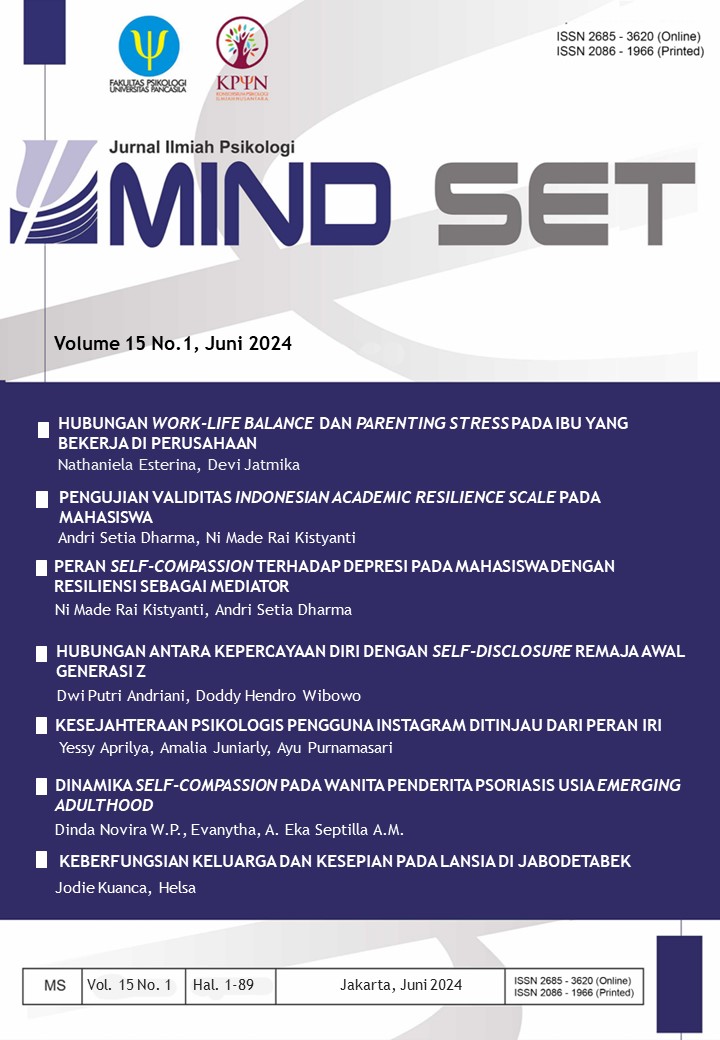
Dinamika Self-Compassion pada Wanita Penderita Psoriasis Usia Emerging Adulthood
DOI:
https://doi.org/10.35814/mindset.v15i01.5792Kata Kunci:
emerging adulthood, penelitian kualitatif, psoriasis, self-compassionAbstrak
Psoriasis adalah penyakit autoimun yang menyebabkan peradangan kronis pada kulit dan persendian yang mempengaruhi individu secara genetik dan tidak dapat disembuhkan secara total. Penelitian ini penting dilakukan karena self-compassion dapat berperan dalam penyesuaian diri terhadap kondisi kulit yang kronis sehingga dapat menjadi terapi untuk mengurangi tekanan psikologis pada penderita. Self-compassion mengacu pada bagaimana individu berhubungan dengan diri mereka sendiri dalam menghadapi kegagalan, ketidakmampuan, tantangan hidup, atau penderitaan, merasa terhubung dengan orang lain yang juga menderita, dan memahami serta mendukung diri mereka sendiri selama masa-masa sulit. Tujuan dari penelitian kualitatif generik ini adalah untuk mendapatkan gambaran umum tentang dinamika self-compassion pada wanita yang menderita psoriasis dan berada di masa dewasa awal. Dilakukan wawancara mendalam dengan tiga orang wanita penderita psoriasis berusia 18-29 tahun tentang pengalaman mereka dengan psoriasis. Kesimpulan: seluruh subjek penelitian ini, yaitu wanita emerging adulthood yang mengalami psoriasis, telah menunjukkan self-compassion dengan gambaran perilaku positif dan negatif, yang sesuai dengan dimensi self-compassion menurut Neff (2003), yaitu self-kindness; self-judgement; common humanity; isolation; mindfulness; overidentification/avoidance. Mereka selalu berusaha untuk membuat kemajuan ke arah yang lebih positif. Temuan penelitian: adanya peran dukungan sosial, penerimaan diri, emosi negatif, gangguan kecemasan. Implikasi dan keterbatasan penelitian, saran teoritis dan praktis juga dibahas.
Referensi
Arnett, J., Zukauskiene, & Sugimura, K. (2014). The new life stage of emerging adulthood at ages 18-29 years: implication for mental health. Lancet Psychiatry, 1.
Bundy, C., Pinder, B., Bucci, S., Reeves, D., Griffiths, C. E. M., & Tarrier, N. (2013). A novel, web-based, psychological intervention for people with psoriasis: the electronic Targeted Intervention for Psoriasis (eTIPs) study. British Journal of Dermatology, 169(2), 329–336. http://10.1111/bjd.12350
Clarke, E, N. (2020). Depression in People with Skin Conditions: The Role of Self Compassion as an Adaptive Response. The University of Sheffield Faculty of Science, Department of Psychology
Clarke, E, N., Norman, P., Thompson, A, R. (2022). How does self-compassion help people adjust to chronic skin conditions? A template analysis study. Frontiers in Medicines.9:974816. http://10.3389/fmed.2022.974816
Charmaz, K. (2014). Constructing grounded theory. Sage.
Dahmardeh, H.. Sadooghiasl, A., Mohammadi, E., Kazemnejad, A. (2021). The experiences of the patients with multiple sclerosis of self- compassion: A qualitative content analysis. BioMedicine,11.http:// 10.37796/2211-8039.1211
Ferreira, B. I. R. C., Abreu, J. L. P. D. C., Dos Reis, J. P. G., & Figueiredo, A. M. D. C. (2016). Psoriasis and associated psychiatric disorders: a systematic review on etiopathogenesis and clinical correlation. The Journal of Clinical and Aesthetic Dermatology, 9(6), 36–43.
Kotrulja, L., Tadinac, M., Joki-Begi, N., & Gregurek, R. (2010). A multivariate analysis of clinical severity, psychological distress and psychopatho-logical traits in psoriatic Patients. Acta Dermato Venereologica, 90(3), 251–256. http://10.2340/00015555-0838
Krisnarto E, Novitasari A, Aulirahma DM. (2016). Faktor prediktor kualitas hidup pasien psoriasis: studi cross sectional. Jurnal Kedokteran Muhammadiyah, 5(1).
Lim, D., Bewley, A., &Oon, H, H. (2018). Psychological profile of patients with psoriasis. E-Journal of Annals Academy of Medicine. 47(12)
Meneo, D, M., Martoni, A., Giannandrea, V., Tengattini & C. (2022). Mindfulness and self compassion in dermatologic-al conditions: a systematic narrative review. E-Journal of Psychology and Health, http://10.1080/08870446.2022.2070619
Muftin, Z., Gilbert, P., Thompson, A, R. (2022). A randomize controlled feasibility trial of online compassion-focused self-help for psoriasis. British Journal of Dermatology, 186, pp955–962, http://10.1111/bjd.21020
Neff, K, D. (2021). Fierce Self-Compassion: How Women Can Harness Kindess to Speak Up, Claim Their Power, and Thrive. Harper Wave
Neff, K. D. (2003). The development and validation of a scale to measure self- compassion. Self and Identity, 2(3), 223–250. http://10.1080/15298860309027
Neff, K. D. (2022). Self-compassion: theory, method, research, and intervention. Annual Review of Psychology. 74:193- 218.https://doi.org/10.1146/annurev- psych-032420-031047
Neff, K. D., Kirkpatrick, K, L., Rude, S. S. (2007b). An examination of self-compassion in relation to positive psychological functioning and persona-lity traits. Journal of Research in Personality, 41(4), 908–916. http://10.1016/j.jrp.2006.08.002
Nguyen, C., Beroukhim, K., Danesh, M., Babikian, A., Koo, J., & Leon, A. (2016). The psychosocial impact of acne, vitiligo, and psoriasis: a review. Clinical, Cosmetic and Investigational Dermatology, 9, 383–392. http://10.2147/ccid.s76088
Pepe, F, K, O., Valentina, T, D. (2023). Self- compassion pada perempuan pengidap kanker payudara. Jurnal Pemikiran dan Penelitian Psikologi, 8(1)
Remrod C, Sjostrom K, Svensson A. (2013). Psychological differences between early- and late-onset psoriasis: a study of personality traits, anxiety and depression in psoriasis. Br J Dermatol; 169, 344-50.
Roosta, N., Black, D. S., Peng, D., & Riley, L. W. (2010). Skin Disease and Stigma in Emerging Adulthood: Impact on Healthy Development. Journal of Cutaneous Medicine and Surgery, 14(6), 285- 290. http://10.2310/7750.2010.09053
Rumsey, N. (2018). Psychosocial adjustment to skin conditions resulting in visible difference (disfigurement): What do we know? Why don’t we know more? How shall we move forward?. International Journal of Women’s Dermatology, 4(1), 2–7. http://10.1016/j.ijwd.2017.09.005
Samantha, N, T, A. (2021). Self-Compassion Pada Perempuan yang Pernah Menjadi Korban Bullying: Studi Kasus. Jurnal Penelitian Psikologi, 8(8).
Sherman, K. A., Roper, T., & Kilby, C. J. (2019). Enhancing self-compassion in individuals with visible skin conditions: randomised pilot of the “My Changed Body” self- compassion writing intervention. Health Psychology and Behavioral Medicine, 7(1), 62- 77. http://10.1080/21642850.2019.1587298
Silva, N., Stulpnagel, C., Langenbruch, A., Danckworth, A., Augustin, M., Sommer, R. (2020). Disease burden and patient needs and benefits in anogenital psoriasis: developmental specificities for person-centred healthcare of emerging adults and adults. Journal of the European Academy of Dermatology and Venereology, 34.
Sinaga, D. (2013). Pengaruh Stress Psikologis Terhadap Pasien Psoriasis. Jurnal Ilmiah Widya, 1(2).
Susanti, R., Adi, M, S., Susanto, H, S., Sutingsih, D. (2020). Gambaran Kualitas Hidup Penderita Psoriasis di Komunitas Psobat Jawa Tengah. Jurnal Kesehatan Masyarakat, 8(3), e-ISSN: 2356-3346
Trense, Y., & Thaçi, D. (2019). Biological treatment in psoriasis. Avoxa – Mediengruppe Deutscher Apotheker. GmbH. Vol. 7
Vlierberghe, M, V. (2019). Self-critic and self-compassion among cancer patients: A qualitative study. Behavior, Management and Social Sciences.
WHO. Global Report on Psoriasis. (2016). WorldHealth Organization. https://apps.who.int/iris/bitstream/handle/10665/204417/9789241565189_eng.pdf.psoriasis?sequence=1
Willig, Carla. (2013). Introducing Qualitative Research in Psychology (3rd Edition). McGraw-Hill
Yarnell, L. M., Stafford, R. E., Neff, K. D., Reilly, E. D., Knox, M. C., & Mullarkey, M. (2015). Meta-Analysis of Gender Differences in Self-Compassion. Self and Identity, 14(5), 499–520. http://10.1080/15298868.2015.1029966
Zalewska, A., Miniszewska, J., Chodkiewicz, J., Narbutt, J. (2006). Acceptance of chronic illness in psoriasis vulgaris patient. Europe Dermatology and Venereology Academy. 21, 235-242. http://10.1111/j.14683083.2006.01912