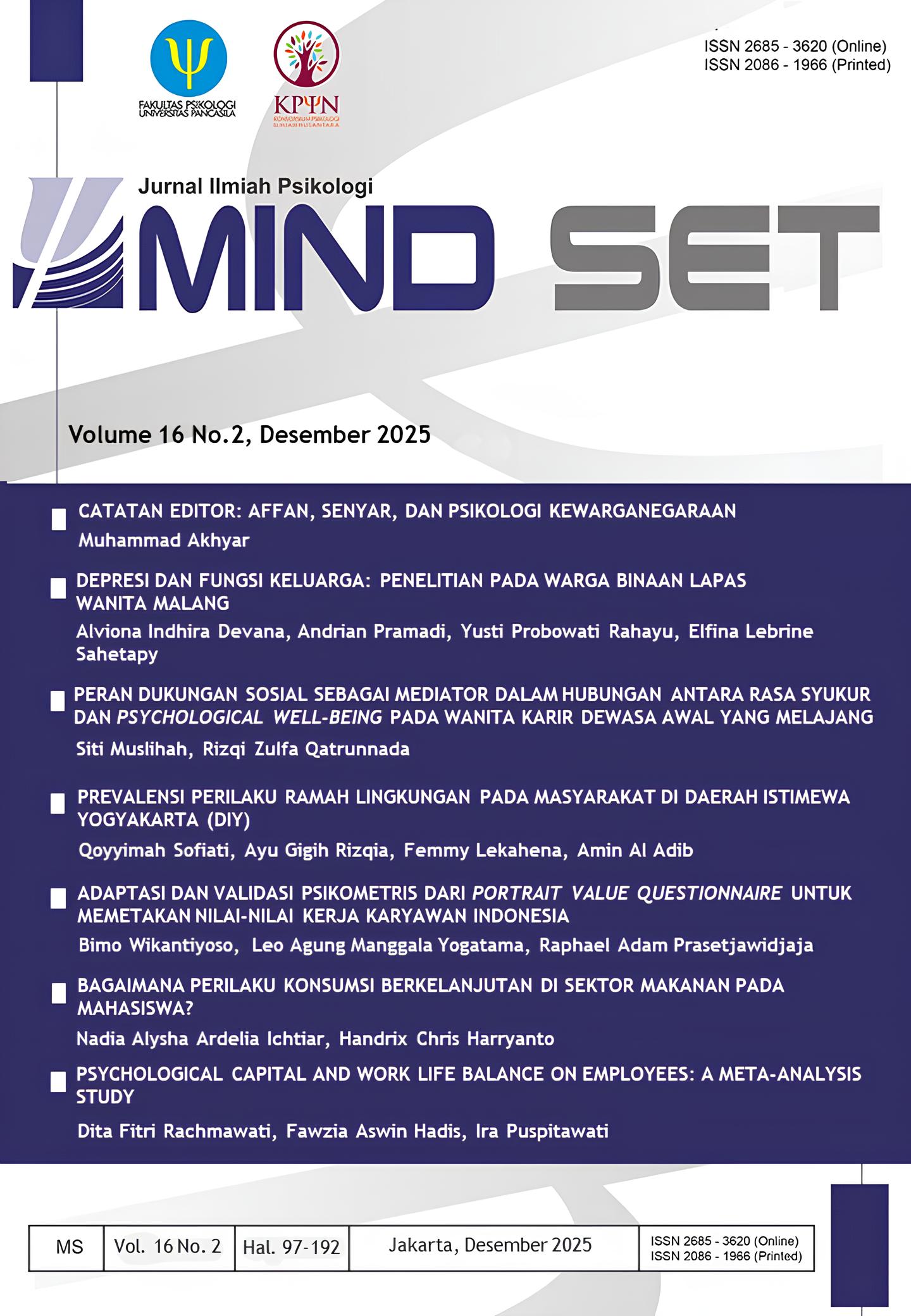
Bagaimana Perilaku Konsumsi Berkelanjutan di Sektor Makanan pada Mahasiswa?
DOI:
https://doi.org/10.64228/ba3tpx40Keywords:
college students, food consumption, sustainable consumption behavior, qualitative phenomenological researchAbstract
The lifestyle phenomenon related to food consumption is crucial in addressing the impact of food consumption on sustainability. Sustainable consumption behavior in the food sector among students exhibits diverse forms and motives. This research aims to provide an overview of student behaviors in consuming food sustainably. The methodology employed is qualitative phenomenology using the cube model, involving 9 active student respondents aged 19-21 years. Data collection was conducted through Focus Group Discussion (FGD) to gain real insights into sustainable consumption across consumption phases (acquisition, usage, disposal) and dimensions supported by driving factors. Phenomenological data analysis was performed through thematic coding (open, axial, selective coding) to identify the essence of respondents' experiences (Creswell, 2014). Findings indicate that respondents' sustainable consumption behavior primarily leans toward the social dimension (health), followed by environmental and economic dimensions. These supporting factors influence respondent behavior. Detailed results are discussed in the results and discussion sections.
References
Akenji, L., & Chen, H. (2016). A Framework For Shaping Sustainable Lifestyles: Determinants and Strategies. United Nations Environment Programme. https://www.iges.or.jp/en/pub/framework-shaping-sustainable-lifestyles/en
Bappenas, K. P. P. N. (2021). Laporan Kajian Food Loss and Waste di Indonesia dalam Rangka Mendukung Penerapan Ekonomi Sirkular dan Pembangunan Rendah Karbon. Kementerian Perencanaan Pembangunan Nasional. https://lcdi-indonesia.id/wp-content/uploads/2021/06/Report-Kajian-FLW-FINAL-4.pdf
Creswell, J. W. (2014). Research Design: Qualitative, Quantitative and Mixed Methods Approaches (4th ed.). Thousand Oaks, CA: Sage. English Language Teaching, 12(5), 40. https://doi.org/10.5539/ELT.V12N5P40
Creswell, J. W. (2018). Key Point Chapter Summaries for John Creswell’s Research Design Textbook on Qualitative, Quantitative, & Mixed Methods Approach. Research Design, 1–40.
Department of Climate Change, Energy, the Environment and Water. (2025, Desember 19). Reducing Australia’s food waste. Australian Government. https://www.dcceew.gov.au/environment/protection/waste/food-waste#:~:text=The%202021%20National%20Food%20Waste,30%25%20of%20all%20food%20waste
European Commission. (2020). For Europe to Achieve it’s Health and Sustainability Goals, The Way We Produce and Consume Food Has to Change. Scientific Advoce Mechanism. https://scientificadvice.eu/advice/towards-sustainable-food-consumption/
Fischer, D., Böhme, T., & Geiger, S. M. (2017). Measuring Young Consumers’ Sustainable Consumption Behavior: Development and Validation of the YCSCB Scale. Young Consumers: Insight and Ideas for Responsible Marketers, 18(3), 312–326. https://doi.org/10.1108/YC-03-2017-00671
Fischer, D., Michelsen, G., Blättel-Mink, B., & Giulio, A. Di. (2012). Sustainable Consumption: How to Evaluate Sustainability in Consumption Acts. München, 67–80. https://www.researchgate.net/publication/287456039_Sustainable_consumption_how_to_evaluate_sustainability_in_consumption_acts
Geiger, S. M., Fischer, D., & Schrader, U. (2017). Measuring What Matters in Sustainable Consumption: An Integrative Framework for the Selection of Relevant Behaviors. Sustainable Development, 26(1), 18–33. https://doi.org/10.1002/sd.1688
Geuens, M. (2023). Research on Influencing Factors of Food Choice and Food Consumption. MDPI, 12(6), 1306. https://doi.org/10.3390/FOODS12061306
KLHK. (2022). Sistem Informasi Pengelolaan Sampah Nasional (SIPSN) – Kementerian Lingkungan Hidup Republik Indonesia. SIPSN. https://sipsn.kemenlh.go.id/sipsn/
Kreuzer, C., Weber, S., Off, M., Hackenberg, T., & Birk, C. (2019). Shedding Light on Realized Sustainable Consumption Behavior and Perceived Barriers of Young Adults for Creating Stimulating Teaching–Learning Situations. Sustainability, 11(9), 2587. https://doi.org/10.3390/SU11092587
Sánchez, A. L., Roa-Díaz, Z. M., Gamba, M., Grisotto, G., Moreno Londoño, A. M., Mantilla-Uribe, B. P., Rincón Méndez, A. Y., Ballesteros, M., Kopp-Heim, D., Minder, B., Suggs, L. S., & Franco, O. H. (2021). What Influences the Sustainable Food Consumption Behaviours of University Students? A Systematic Review. International Journal of Public Health, 66. https://doi.org/10.3389/IJPH.2021.1604149
Sidiq, D. U. S. M. A., & Choiri, M. M. C. M. (2019). Metode Penelitian Kualitatif di Bidang Pendidikan. In Journal of Chemical Information and Modeling (Vol. 53, Issue 9). http://repository.iainponorogo.ac.id/484/1/METODE PENELITIAN KUALITATIF DI BIDANG PENDIDIKAN.pdf
Welch, D., & Southerton, D. (2019). After Paris: Transitions for Sustainable Consumption. Sustainability: Science, Practice, and Policy, 15(1), 31–44. https://doi.org/10.1080/15487733.2018.1560861
Downloads
Published
Issue
Section
License
Copyright (c) 2025 Jurnal Ilmiah Psikologi MIND SET

This work is licensed under a Creative Commons Attribution 4.0 International License.