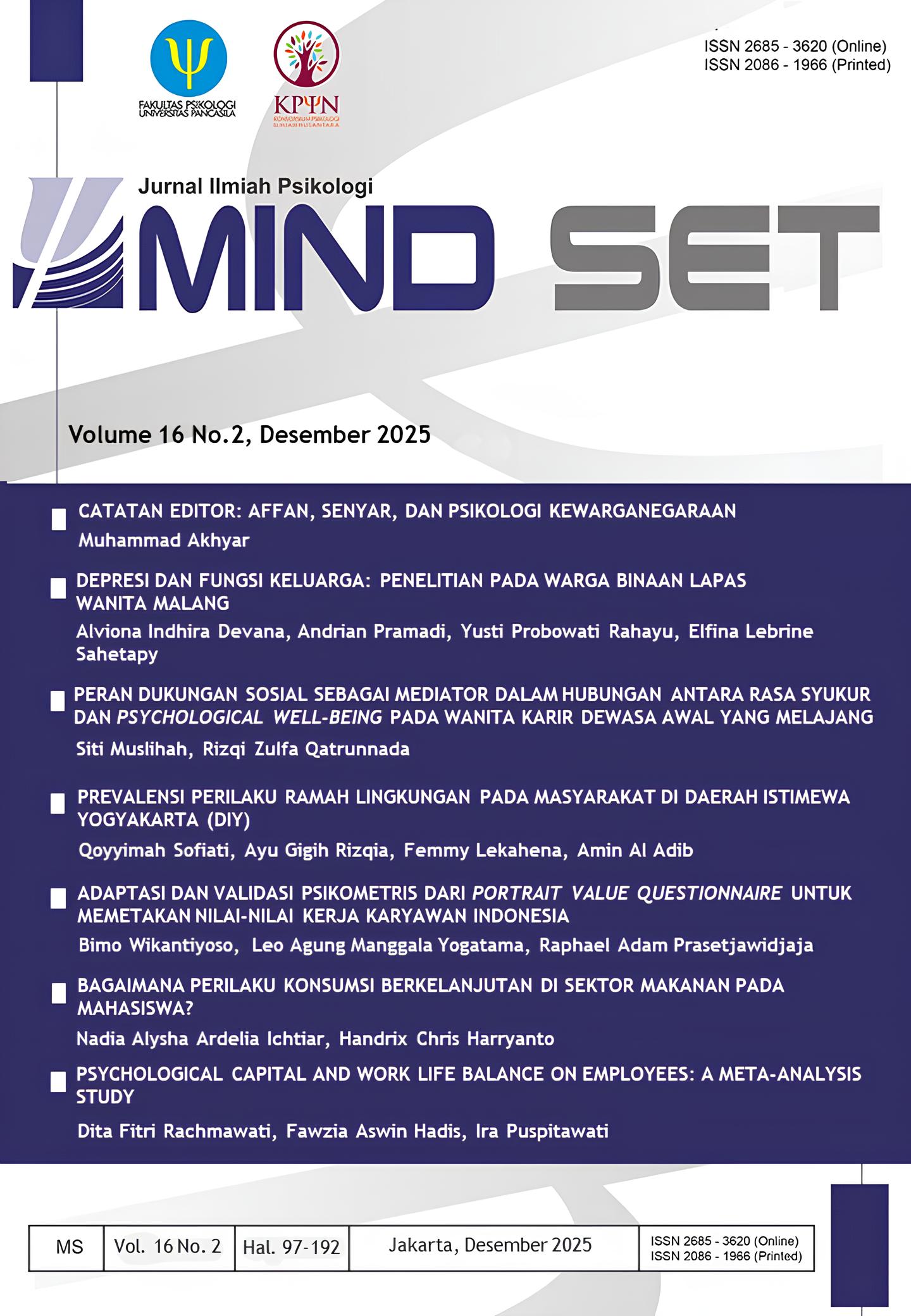
Adaptasi dan Validasi Psikometris dari Portrait Value Questionnaire untuk Memetakan Nilai-Nilai Kerja Karyawan Indonesia
DOI:
https://doi.org/10.64228/mve6h018Keywords:
Cultural adaptation, Indonesian employees, potrait value questionnaire, work valuesAbstract
Work values play a crucial role in understanding individual behavior in the workplace as it is serving as the foundation for one’s decision-making at work. However, cross-cultural research indicates that the structure of work values may vary depending on the socio-cultural context of the worker lives in. Therefore, this study aims to explore the structure of work values among Indonesian employees based on Schwartz’s theory of universal human values through an empirical examination using Exploratory Factor Analysis (EFA) on the dataset collected from 519 employees aged 27-55 years old residing on Java Island using Portrait Value Questionnaire combined with PVQ-RR. Based on the analysis, the data met the assumptions for EFA (KMO = 0.911; Bartlett’s χ² (78) = 3353.020, p < .001). PCA with Varimax rotation identified a more interpretable three-factor solution (EV = 6.184, 1.547, 0.808, explaining 65.69% of the total variance. We then construct three new higher-order factors were identified as (1) relational harmony and social security, (2) self-determination grounded in socio-cultural values, and (3) achievement and status as work identity. Adapting terminology and clustering value indicators into higher-order factors can yield a blueprint that is more sensitive to Indonesian culture without obscuring the meaning of the constructs, thereby providing an initial blueprint for developing a more context-sensitive Indonesian-version of PVQ (Portrait Values Questionnaire).
References
Work values play a crucial role in understanding individual behavior in the workplace as it is serving as the foundation for one’s decision-making at work. However, cross-cultural research indicates that the structure of work values may vary depending on the socio-cultural context of the worker lives in. Therefore, this study aims to explore the structure of work values among Indonesian employees based on Schwartz’s theory of universal human values through an empirical examination using Exploratory Factor Analysis (EFA) on the dataset collected from 519 employees aged 27-55 years old residing on Java Island using Portrait Value Questionnaire combined with PVQ-RR. Based on the analysis, the data met the assumptions for EFA (KMO = 0.911; Bartlett’s χ² (78) = 3353.020, p < .001). PCA with Varimax rotation identified a more interpretable three-factor solution (EV = 6.184, 1.547, 0.808, explaining 65.69% of the total variance. We then construct three new higher-order factors were identified as (1) relational harmony and social security, (2) self-determination grounded in socio-cultural values, and (3) achievement and status as work identity. Adapting terminology and clustering value indicators into higher-order factors can yield a blueprint that is more sensitive to Indonesian culture without obscuring the meaning of the constructs, thereby providing an initial blueprint for developing a more context-sensitive Indonesian-version of PVQ (Portrait Values Questionnaire).
Downloads
Published
Issue
Section
License
Copyright (c) 2025 Jurnal Ilmiah Psikologi MIND SET

This work is licensed under a Creative Commons Attribution 4.0 International License.