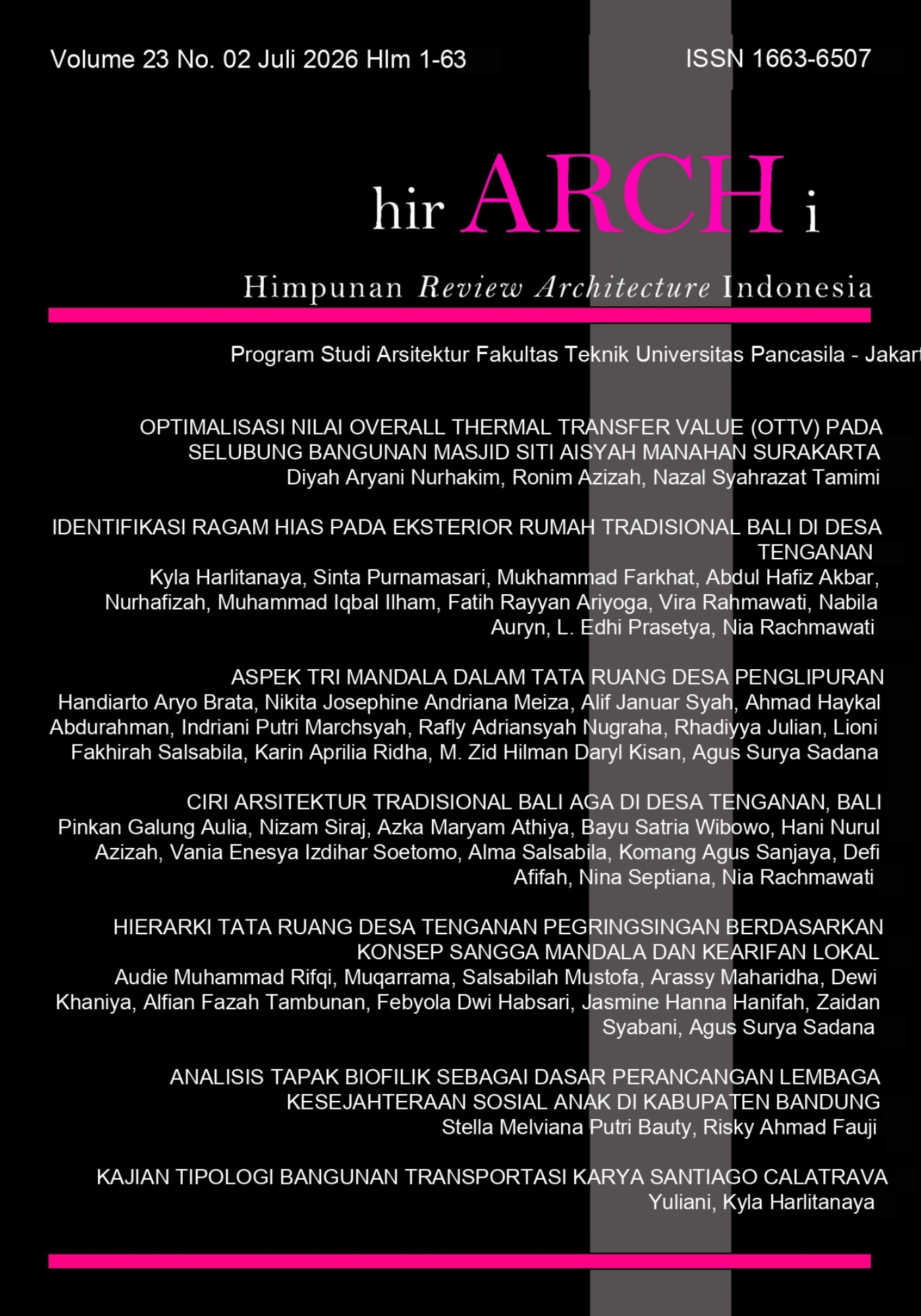
CHARACTERISTICS OF TRADITIONAL BALI AGA ARCHITECTURE IN TENGANAN VILLAGE, BALI
Keywords:
architecture, bali aga, tenganan village, traditional, tri anggaAbstract
Tenganan Village is one of the Bali Aga (Original Balinese) villages that still maintains its social order, customs, and traditional architecture, which are unaffected by the Majapahit culture. This study aims to identify and describe the characteristics of traditional Balinese architecture in Tenganan Village by dissecting the building based on the Tri Angga concept. This research uses a descriptive analysis method, combining primary data from field observations and secondary data from a literature review. The observation and analysis results show that traditional architecture in Tenganan Village consistently applies the Tri Angga concept. This concept adopts the human body analogy which divides the building into three hierarchies: Utama Angga (head/roof), Madya Angga (body/wall and column), and Nista Angga (feet/foundation). Its architectural characteristics emphasize simplicity and purity of materials. The roof shape is dominated by limasan and saddle models which have unique characteristics in the form of kampiah elements. The building structure uses local wood with peg joints, namely purus (tenon), lubang (mortise), and lait (locking peg) techniques. Building facades expose the natural textures of batu padas (parasite stone) and bricks without plaster. The foundation construction in Tenganan Village shows local wisdom through the dry construction technique. Overall, the architectural characteristics of Tenganan Village reflect the traditional values and harmony of the Bali Aga culture, blending seamlessly with nature.
Downloads
References
[1] I. N. G. I. W. M. I. M. Y. N. I. M. S. I. N. Surata, Arsitektur Tradisional Daerah Bali. Bali: Departemen Pendidikan dan Kebudayaan, 2002. [Online]. Available: https://repositori.kemendikdasmen.go.id/27005/
[2] I. B. M. Astawa, “Orientasi Ruang Tradisional Bali dalam Perspektif Geografi,” 2023.
[3] S. E. E. H. Harisun, “Preserving Cultural Identity through Architecture: A Case Study of Traditional Tenganan Village (Desa Adat),” Tech. Rom. J. Appl. Sci. Technol., vol. 17, pp. 218–224, 2023.
[4] N. K. A. Dwijendra, Arsitektur & Kebudayaan Bali Kuno. Bali: Udayana University Press, 2009.
[5] A. A. Ngurah Aritama, “Faktor-Faktor Yang Berpengaruh Terhadap Kenyamanan Termal Rumah Tradisional Desa Tenganan Pegringsingan,” J. PATRA, vol. 5, no. 1, pp. 28–36, 2023, doi: 10.35886/patra.v5i1.461.
[6] F. Maidarina, “Desa Adat Tenganan, Bali,” fifinmaidarina.com. [Online]. Available: https://fifinmaidarina.com/desa-adat-tenganan-bali/
[7] Udaya Bali, “The Religious System of Tenganan Village: Preserving Bali Aga Tradition Without the Influence of Majapahit,” Udaya Bali. [Online]. Available: https://budayabali.com/the-religious-system-of-tenganan-village-preserving-bali-aga-tradition-without-the-influence-of-majapahit
[8] I. G. A. B. S. Kadek Agus Surya Darma, “Bale Buga Desa Adat Tenganan Pegringsingan - Sebuah Eksplorasi Tektonika Bangunan,” SPACE, vol. 10, 2023.
[9] S. Sumarjo, “Eksistensi Awig-Awig dalam Menjaga Harmonisasi Desa Adat Tenganan Pegringsingan, Kabupaten Karangasem, Bali,” Habitus J. Pendidikan, Sosiologi, Antropol., vol. 2, no. 1, p. 27, 2018, doi: 10.20961/habitus.v2i1.20222.
[10] I. G. B. R. Indra, “Pengaruh Modernisasi Terhadap Material Bangunan Rumah Tinggal Tradisional Di Desa Adat Tenganan,” Pros. Semin. Nas. Arsitektur, Budaya, dan Lingkung. Binaan, pp. 167–176, 2019, [Online]. Available: https://eproceeding.undwi.ac.id/index.php/semarayana/article/view/25/29
[11] A. Hidayah, “Desa Tenganan Pegringsingan, Desa Tradisional di Ujung Timur Pulau Bali,” anishidayah.com. [Online]. Available: http://www.anishidayah.com/2016/11/desa-tenganan-pegringsingan-desa.html
[12] R. Hasudungan Irianto Sitinjak, L. Kusuma Wardani, and P. Firtatwentyna Nilasari, “Traditional Balinese Architecture: From Cosmic to Modern,” SHS Web Conf., vol. 76, p. 01047, 2020, doi: 10.1051/shsconf/20207601047.