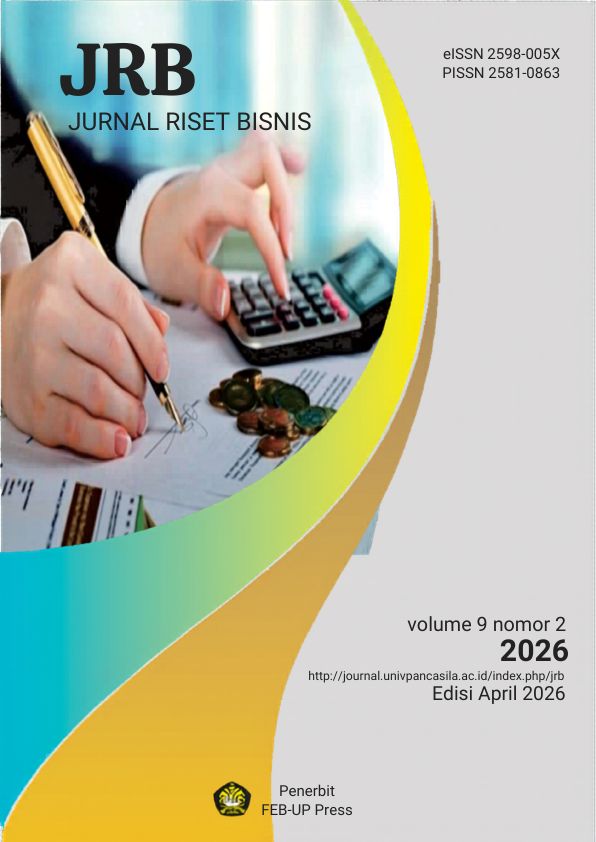
E-GOVERNMENT DAN SUSTAINABILITY PERFORMANCE: MEDIASI PERSEPSI ANTIKORUPSI DAN MODERASI GOOD PUBLIK GOVERNANCE NEGARA DI ASIA PASIFIK
DOI:
https://doi.org/10.65179/jrb.2026.9831Keywords:
e-government, governance , corruption , sustainability performance , sustainable development goalsAbstract
This study investigates the function of e-government and effective public governance in improving governmental sustainability performance to attain the Sustainable Development Goals (SDGs). A public-sector–adapted Balanced Scorecard (BSC) framework is used to measure how well the government does its job which indicate by results of citizen and public service, internal procedures, learning and growth, financial stewardship, and public impact. This study utilizes balanced panel data from 61 Asia-Pacific nations spanning 2020 to 2023, comprising 305 observations, to conduct panel regression analysis for testing both mediating and moderating mechanisms. The findings show that the adoption of e-government is linked to a decrease in perceived corruption and has a positif significant impact on sustainability performance. The relationship between e-government and sustainability performance is found mediated by corruption, emphasizing the need of institutional integrity as a transmission channel. Additionally, strong public governance increases e-government's ability to combat corruption, indicating that digital transformation only produces the best results under a strong governance framework. By including corruption, governance quality, and e-government into a national-level Balanced Scorecard framework for cross-country analysis, this study adds to the academic literature. In practice, the results emphasis how important it is for policymakers to make sure that digital transformation projects are in line with governance changes to make progress on the 2030 SDGs agenda.
Downloads
Published
Issue
Section
License
Copyright (c) 2026 Rafrini Amyulianthy, Harnovinsah, Ameilia Damayanti, Fazlida Mohd Razali

This work is licensed under a Creative Commons Attribution-ShareAlike 4.0 International License.
.gif)