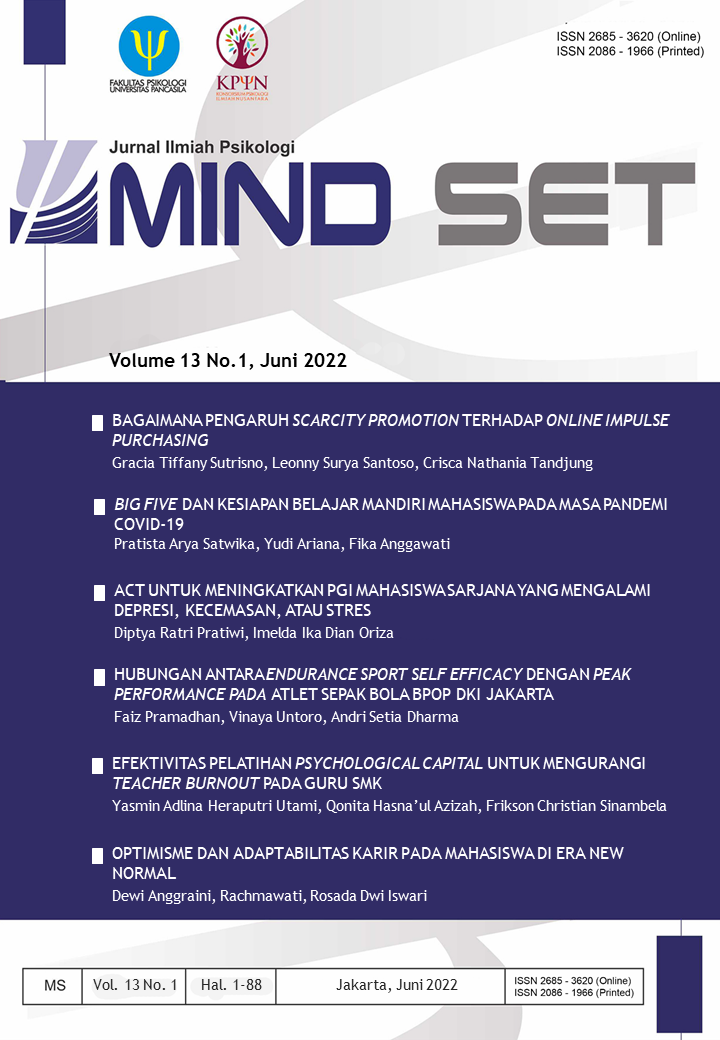
Optimisme dan Adaptabilitas Karir pada Mahasiswa di Era New Normal
DOI:
https://doi.org/10.35814/mindset.v13i01.3313Kata Kunci:
Career adaptability, new normal era, optimismAbstrak
The demand for ability and competence in the world of work in the new normal era after the COVID-19 pandemic is increasing. Graduates are expected to have knowledge and skills, because the world of work and careers undergoes changes that cannot be avoided, which are now increasingly diverse, flexible, global and without boundaries. One of the competencies that must be possessed by students in the new normal era is career adaptability, where individuals are able to face the transition period. Career adaptability is related to optimism, if optimism in students is high, it will have high adaptability as well, and vice versa. The subjects in this study were students in all universities in Indonesia, both public and private universities. The research method used to test the hypothesis is Pearson's product moment, but previously tested assumptions using normality and linearity tests. The data obtained from each normal variable with a significance value for the career adaptability variable is 0.735 (P>0.05) and 0.819 (p>0.05) for the optimism variable. The results of the linearity test showed a linear relationship with a significance value of 0.000 (p<0.05). The hypothesis in this study is accepted that there is a relationship between optimism and career adaptability in students in the new normal era. Students who have optimism will have good career adaptability in the current new normal era.
Referensi
Bocciardi, F., Caputo, A., Fregonese, C., Langher, V., Sartori, R. (2017). Career adaptability as a strategic competence for career development: An exploratory study of its key predictors. European Journal of Training and Development, 41(1), 67-82. Doi: 10.1108/EJTD-07-2016-0049.
Carver, C. S., Scheier, M.F., & Segerstrom, S.C. (2010). Optimism. Clinical Psychology Review, 30, 879-889. Retrieved from https://doi.org/10.1016/j.cpr.2010.01.006
Coetzee, M., Ferreira, N., Potgieter, I. L. (2015). Assessing employability capacities and career adaptability in a sample of human resource professionals. SA Journal of Human Resource Management, 13(1), 9 pages. Doi: 10.4102/sajhrm.v13i1.682
Fang, W., Zhang, Y., Mei, J., Chai, X., & Fan, X. (2018). Relationship between optimism, educational environment, career adaptability and career motivation in nursing undergraduates: a cross-sectional study. Nurse Education Today, 68, 33-39. Retrieved from https://doi.org/10.1016/j.nedt.2018.05.025
Fatmawiyati, J., Wicaksono, I, A., Muqoddam, F., Shaumia, R. (2018). Adaptabilitas karir. Interact website: https://www.researchgate.net/publication/329139758.
Hirschi, A., Hermann, A., & Keller, A, C. (2015). Career adaptivity, adaptability and adapting a conceptual and empirical investigation. Journal of Vocational Behavior, 87, 1-10. Retrieved from https://doi.org/10.1016/j.jvb.2014.11.008
Nurtjahjanti, H., Ratnaningsih, I, Z. (2011). Hubungan kepribadian hardiness dengan optimisme pada calon tenaga kerja Indonesia (CTKI) wanita di BLKLN DISNAKERTRANS Jawa Tengah. Jurnal Psikologi Undip. Vol.10, No.2.
Rottinghaus, P.J., Day, S.X., & Borgen, F.H. (2005). The career future inventory: a measure of career-related adaptability and optimism. Journal of Career Assessment, 13, 3-24. Retrieved from https://doi.org/10.1177%2F1069072704270271
Savickas, M.L., & Porfeli, E.J. (2012). Career adapt-abilities scale: Construction, reliability and measurement equivalence across 13 countries. Journal of Vocational Behavior, 80, 661-673. Retrieved from https://doi.org/10.1016/j.jvb.2012.01.011
Seligman. M.E.P. (2006). Learned Optimism: How to Change Your Mind and Your Life. New York: A Division of Random House, Inc.
Seligman, M.E.P. (2008). Menginstal optimisme (terjemahan: Budy Yogapranata). Bandung: PT Karya Kita.
Sugiyono. (2016). Metode Penelitian Kuantitatif, Kualitatif, dan R&D. Bandung: Alfabeta.
Tolentino, L.R., Garcia, P.R.J.M., Lu, V.N., Restubog, S.L.D., Bordia, P., & Plewa, C. (2014). Career adaptation: the relation of adaptability to goal orientation, proactive personality and career optimism. Journal of Vocational Behavior, 84, 39-48. Retrieved from https://doi.org/10.1016/j.jvb.2013.11.004
Vos, K, G. (2019). Career Adaptability, Sense of Coherence and Career Self-Efficacy of Students At A Residental University. University of South Africa.
Wang, Z., & Fu, Y. (2015). Social Support, Social Comparison, and Career Adaptability A Moderated Mediation Model. Social Behavior and Personality: An International Journal, 43(4), 649-659. Retrieved from https://doi.org/10.2224/sbp.2015.43.4.649
Wilkins, K.G., Santilli, S., Ferrari, L., Nota, L., Tracey, T.J.G., & Soresi, S. (2014). The relationship among positive emotional dispositions, career adaptability, and satisfaction in Italian high school students. Journal of Vocational Behavior, 85, 329-338. Retrieved from https://doi.org/10.1016/j.jvb.2014.08.004