About the Journal

International Journal of Environmental Communication (ENVICOMM) is a scientific Journal published by the Faculty of Communication Sciences of Pancasila University, Jakarta and has been published since 2023, twice a year, in June and December. International Journal of Environmental Communication is an international, peer-reviewed forum for multidisciplinary research and analysis assessing the intersections among communication, media, society, and environmental issues. Published articles contribute to our understanding of scientific controversies, political developments, policy solutions, institutional change, cultural trends, media portrayals, public opinion and participation, and/or professional decisions. Articles often bridge gaps between theory and practice and are written in a style that is broadly accessible and engaging.

Announcements

Permohonan Maaf Pada Gangguan OJS ENVICOMM

2025-07-23

Kepada Yth Bapak/Ibu Penulis Artikel ENVICOMM, 
Kami menyampaikan permohonan maaf atas ketidaknyamanan yang terjadi akibat insiden peretasan pada situs Jurnal ENVICOMM yang berlangsung sejak Bulan April 2025. Saat ini, OJS masih dalam proses pemulihan dari versi lama ke versi terbaru. Jika Bapak/Ibu Penulis ENVICOMM mengalami kendala dalam pengiriman artikel, silakan dapat menghubungi email kami: envicomm.fikomup@univpancasila.ac.id.


Read more about Permohonan Maaf Pada Gangguan OJS ENVICOMM
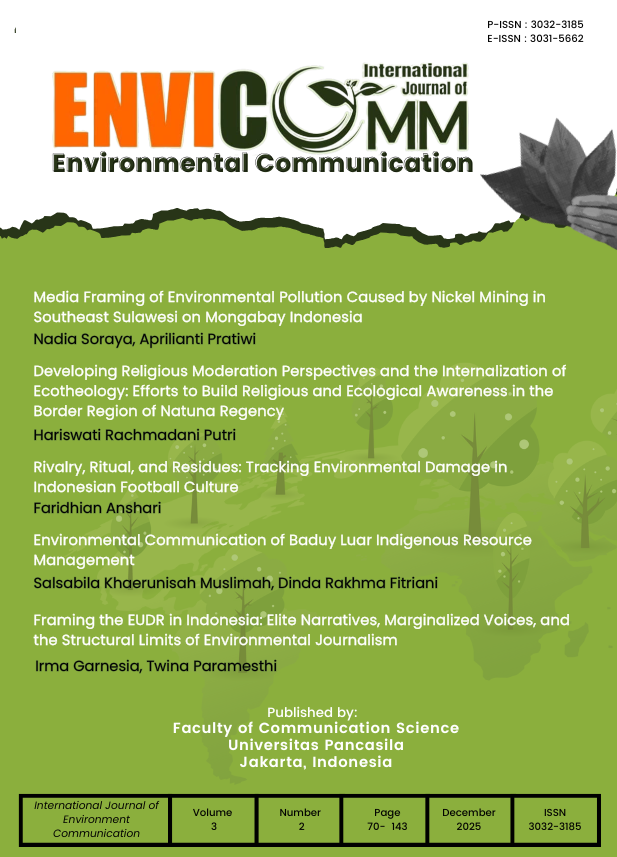
Current Issue

Vol. 3 No. 2 (2025)
					View Vol. 3 No. 2 (2025)

International Journal of Environmental Communication (ENVICOMM) is a scientific Journal published by the Faculty of Communication Sciences of Pancasila University, Jakarta and has been published since 2023, twice a year, in June and December. International Journal of Environmental Communication is an international, peer-reviewed forum for multidisciplinary research and analysis assessing the intersections among communication, media, society, and environmental issues. Published articles contribute to our understanding of scientific controversies, political developments, policy solutions, institutional change, cultural trends, media portrayals, public opinion and participation, and/or professional decisions. Articles often bridge gaps between theory and practice and are written in a style that is broadly accessible and engaging. 

Published: 2025-12-29
View All Issues