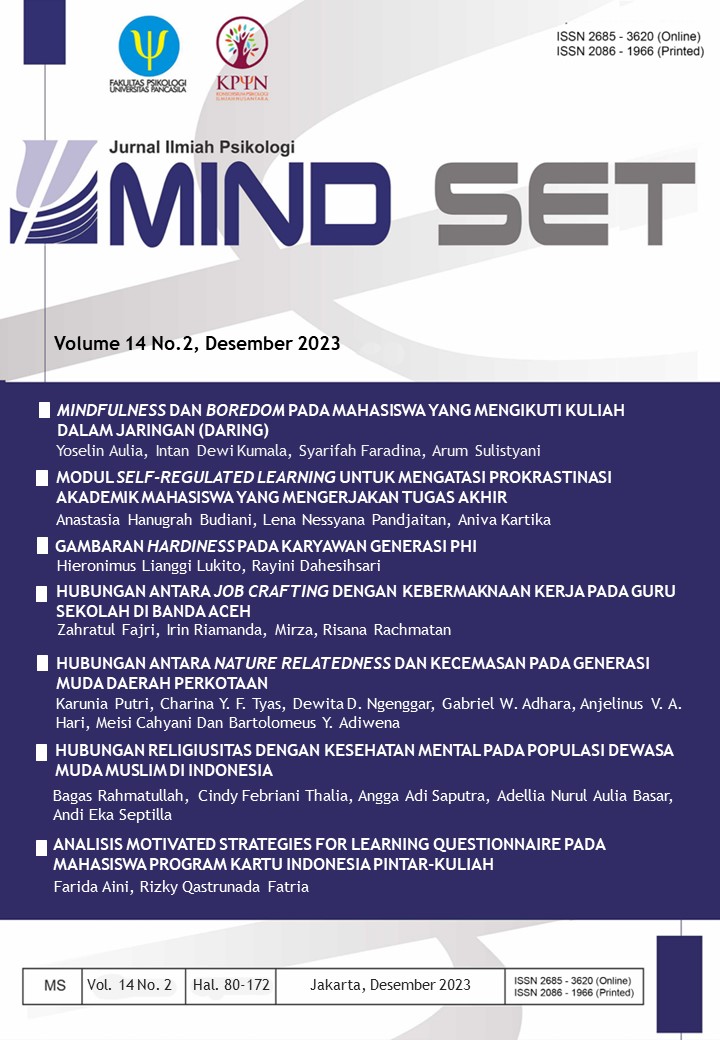
Hubungan antara Nature Relatedness dan Kecemasan pada Generasi Muda Daerah Perkotaan
DOI:
https://doi.org/10.35814/mindset.v14i02.4643Kata Kunci:
generasi muda, kecemasan, lingkungan alam, nature relatedness, perkotaanAbstrak
Kesehatan mental yang buruk merupakan masalah yang signifikan di seluruh dunia, termasuk di Indonesia. Sekitar 15,5 juta remaja Indonesia (34.9%) memiliki masalah kesehatan mental, dan gangguan kecemasan menjadi gangguan mental yang paling banyak dialami remaja. Daerah perkotaan yang minim lingkungan hijau dan tuntutan kerja yang tinggi juga berimplikasi membuat generasi muda tidak dapat berinteraksi langsung dengan alam. Selain itu, kehidupan urban yang ditandai dengan kepraktisan membuat banyak remaja yang lebih suka menghabiskan waktu luang di dalam ruangan dengan hiburan-hiburan berteknologi dan enggan untuk beraktivitas di luar ruangan. Penelitian ini bertujuan untuk mengukur hubungan antara Nature Relatedness dan kecemasan pada generasi muda perkotaan. Metode penelitian yang digunakan adalah kuantitatif-korelasional. Pengukuran menggunakan Nature Relatedness Scale dan State-Trait Inventory for Cognitive and Somatic Anxiety (STICSA). Pada penelitian ini, terdapat 93 partisipan memenuhi kriteria partisipan dan bersedia untuk mengisi kuesioner. Data dianalisis menggunakan teknik korelasi Product Moment. Hasil penelitian menunjukan tidak ada hubungan antara nature relatedness dan kecemasan. Peneliti menduga bahwa NR memiliki manfaat utama terhadap peningkatan emosi positif dan bukan untuk mengurangi kondisi emosi yang negatif seperti depresi. Selain itu, masyarakat perkotaan tetap dapat menikmati alam dengan lingkungan buatan seperti, mengunjungi taman hijau dan melihat pemandangan langit. Adanya lingkungan buatan menjadikan masyarakat perkotaan tetap berdekatan dengan alam tanpa menunjukkan rasa cemas.
Referensi
Adiwena, B. Y., & Djuwita, R. (2022). Manusia dan lingkungan alam: Analisis faktor konfirmatori terhadap Nature Relatedness Scale Bahasa Indonesia. Jurnal Psikologi Sosial,20(1),57–71. https://doi.org/10.7454/jps.2022.08
APA. (2023). APA Dictionary of Psychology. https://dictionary.apa.org/anxiety
Barton, J., & Pretty, J. (2010). What is the Best Dose of Nature and Green Exercise for Improving Mental Health? A Multi-Study Analysis. Environmental Science & Technology, 44(10), 3947–3955. https://doi.org/10.1021/es903183r
Capaldi, C. A., Dopko, R. L., & Zelenski, J. M. (2014). The relationship between nature connectedness and happiness: a meta-analysis. Frontiers in Psychology, 5. https://doi.org/10.3389/fpsyg.2014.00976
Cervinka, R., Röderer, K., & Hefler, E. (2012). Are nature lovers happy? On various indicators of well-being and connectedness with nature. Journal of Health Psychology, 17(3), 379–388. https://doi.org/10.1177/1359105311416873
Fisher, J. C., Bicknell, J. E., Irvine, K. N., Fernandes, D., Mistry, J., & Davies, Z. G. (2021). Exploring how urban nature is associated with human wellbeing in a neotropical city. Landscape and Urban Planning, 212, 104119. https://doi.org/10.1016/j.landurbplan.2021.104119
Cole, D. N., & Hall, T. E. (2010). Experiencing the Restorative Components of Wilderness Environments: Does Congestion Interfere and Does Length of Exposure Matter? Environment and Behavior, 42(6), 806–823. https://doi.org/10.1177/0013916509347248
Cox, D. T. C., Shanahan, D. F., Hudson, H. L., Fuller, R. A., & Gaston, K. J. (2018). The impact of urbanisation on nature dose and the implications for human health. Landscape and Urban Planning, 179, 72–80. https://doi.org/10.1016/j.landurbplan.2018.07.013
Dean, J., Shanahan, D., Bush, R., Gaston, K., Lin, B., Barber, E., Franco, L., & Fuller, R. (2018). Is Nature Relatedness Associated with Better Mental and Physical Health? International Journal of Environmental Research and Public Health, 15(7), 1371. https://doi.org/10.3390/ijerph15071371
Niman, E. M. (2019). Kearifan lokal dan upaya pelestarian lingkungan alam. Jurnal Pendidikan dan Kebudayaan Missio, 11(1), 91–106. https://doi.org/10.36928/jpkm.v11i1.139
Folke, C., Jansson, Å., Rockström, J., Olsson, P., Carpenter, S. R., Chapin, F. S., Crépin, A.-S., Daily, G., Danell, K., Ebbesson, J., Elmqvist, T., Galaz, V., Moberg, F., Nilsson, M., Österblom, H., Ostrom, E., Persson, Å., Peterson, G., Polasky, S., … Westley, F. (2011). Reconnecting to the Biosphere. AMBIO, 40(7), 719. https://doi.org/10.1007/s13280-011-0184-y
Harmuningsih, D., & Saleky, S. R. J. (2019). Pengetahuan, Persepsi dan Sikap Generasi Muda Tentang Perubahan Iklim dan Pengaruhnya Terhadap Niat Perilaku Pro-Lingkungan. SPECTA Journal of Technology, 1(3), 27–36. https://doi.org/10.35718/specta.v1i3.84
Hurly, J., & Walker, G. J. (2019). Nature in our lives: Examining the human need for nature relatedness as a basic psychological need. Journal of Leisure Research, 50(4), 290–310. https://doi.org/10.1080/00222216.2019.1578939
Iqrimah, A. N. (2023, Februari 9). Tinggal Di Kota Besar Rentan Mental Illness, Benarkah? Pahami Penyebab Dan Cara Mengatasinya. https://www.akurat.co/health/1302403707/Tinggal-Di-Kota-Besar-Rentan-Mental-Illness-Benarkah-Pahami-Penyebab-Dan-Cara-Mengatasinya
Juanda, J. (2018). Fenomena eksploitasi lingkungandalam cerpen koran minggu indonesia pendekatan ekokritik. Aksis: Jurnal Pendidikan Bahasa dan Sastra Indonesia, 2(2), 165–189. https://doi.org/10.21009/AKSIS.020203
Kellert, S. R., & Wilson, E. O. (1993). The Biophilia Hypothesis. Island Press.
Kettner, H., Gandy, S., Haijen, E. C. H. M., & Carhart-Harris, R. L. (2019). From Egoism to Ecoism: Psychedelics Increase Nature Relatedness in a State-Mediated and Context-Dependent Manner. International Journal of Environmental Research and Public Health, 16(24), 5147. https://doi.org/10.3390/ijerph16245147
Lawton, E., Brymer, E., Clough, P., & Denovan, A. (2017). The Relationship between the Physical Activity Environment, Nature Relatedness, Anxiety, and the Psychological Well-being Benefits of Regular Exercisers. Frontiers in Psychology, 8. https://doi.org/10.3389/fpsyg.2017.01058
Lee, J., Park, B.-J., Tsunetsugu, Y., Ohira, T., Kagawa, T., & Miyazaki, Y. (2011). Effect of forest bathing on physiological and psychological responses in young Japanese male subjects. Public Health, 125(2), 93–100. https://doi.org/10.1016/j.puhe.2010.09.005
Martyn, P., & Brymer, E. (2016). The relationship between nature relatedness and anxiety. Journal of Health Psychology, 21(7), 1436–1445. https://doi.org/10.1177/1359105314555169
Mayer, F. S., & Frantz, C. M. (2004). The connectedness to nature scale: A measure of individuals’ feeling in community with nature. Journal of Environmental Psychology, 24(4), 503–515. https://doi.org/10.1016/j.jenvp.2004.10.001
McKenzie, K., Murray, A., & Booth, T. (2013). Do urban environments increase the risk of anxiety, depression and psychosis? An epidemiological study. Journal of Affective Disorders, 150(3), 1019–1024. https://doi.org/10.1016/j.jad.2013.05.032
Muhamad, N. (2023, Oktober 18). Ada 971 Kasus Bunuh Diri sampai Oktober 2023, Terbanyak di Jawa Tengah. https://databoks.katadata.co.id/datapublish/2023/10/18/ada-971-kasus-bunuh-diri-sampai-oktober-2023-terbanyak-di-jawa-tengah#:~:text=Berdasarkan%20data%20Pusat%20Informasi%20Kriminal,2022%20yang%20jumlahnya%20900%20kasus.
Nisbet, E. K., & Zelenski, J. M. (2011). Underestimating Nearby Nature: Affective Forecasting Errors Obscure the Happy Path to Sustainability. Psychological Science, 22(9), 1101–1106. http://www.jstor.org/stable/41319995
Nisbet, E. K., Zelenski, J. M., & Murphy, S. A. (2009). The Nature Relatedness Scale. Environment and Behavior, 41(5), 715–740. https://doi.org/10.1177/0013916508318748
Nisbet, E. K., Zelenski, J. M., & Murphy, S. A. (2011). Happiness is in our Nature: Exploring Nature Relatedness as a Contributor to Subjective Well-Being. Journal of Happiness Studies, 12(2), 303–322. https://doi.org/10.1007/s10902-010-9197-7
Nguyen, C. T. P., & Nguyen, Q.-A. N. (2022). Is nature relatedness associated with better mental health? An exploratory study on Vietnamese university students. Journal of American College Health, 1–8. https://doi.org/10.1080/07448481.2022.2089847
Prasetyo, D. T., Djuwita, R., & Ariyanto, A. (2018). Who is more related to the nature? A study from Indonesia. E3S Web of Conferences, 74, 08009. https://doi.org/10.1051/e3sconf/20187408009
Ree, M. J., French, D., MacLeod, C., & Locke, V. (2008). Distinguishing Cognitive and Somatic Dimensions of State and Trait Anxiety: Development and Validation of the State-Trait Inventory for Cognitive and Somatic Anxiety (STICSA). Behavioural and Cognitive Psychotherapy, 36(03). https://doi.org/10.1017/S1352465808004232
Roe, J., Thompson, C., Aspinall, P., Brewer, M., Duff, E., Miller, D., Mitchell, R., & Clow, A. (2013). Green Space and Stress: Evidence from Cortisol Measures in Deprived Urban Communities. International Journal of Environmental Research and Public Health, 10(9), 4086–4103. https://doi.org/10.3390/ijerph10094086
Spielberger, C. D., & Reheiser, E. C. (2009). Assessment of Emotions: Anxiety, Anger, Depression, and Curiosity. Applied Psychology: Health and Well-Being, 1(3), 271–302. https://doi.org/10.1111/j.1758-0854.2009.01017.x
Sugiyono. (2014). Metode Penelitian kuantitatif, kualitatif dan R & D. Alfabeta.
Tam, K.-P. (2013). Concepts and measures related to connection to nature: Similarities and differences. Journal of Environmental Psychology, 34, 64–78. https://doi.org/https://doi.org/10.1016/j.jenvp.2013.01.004
Wahdi, A. E., Setyawan, A., Putri, Y. A., Wilopo, S. A., Erskine, H. E., Wallis, K., McGrath, C., Blondell, S. J., Whiteford, H. A., Scott, J. G., Blum, R., Fine, S., Li, M., & Ramaiya, A. (2022). Indonesia National Adolescent Mental Health Survey .
Weinstein, N., Balmford, A., DeHaan, C. R., Gladwell, V., Bradbury, R. B., & Amano, T. (2015). Seeing Community for the Trees: The Links among Contact with Natural Environments, Community Cohesion, and Crime. BioScience, 65(12), 1141–1153. https://doi.org/10.1093/biosci/biv151