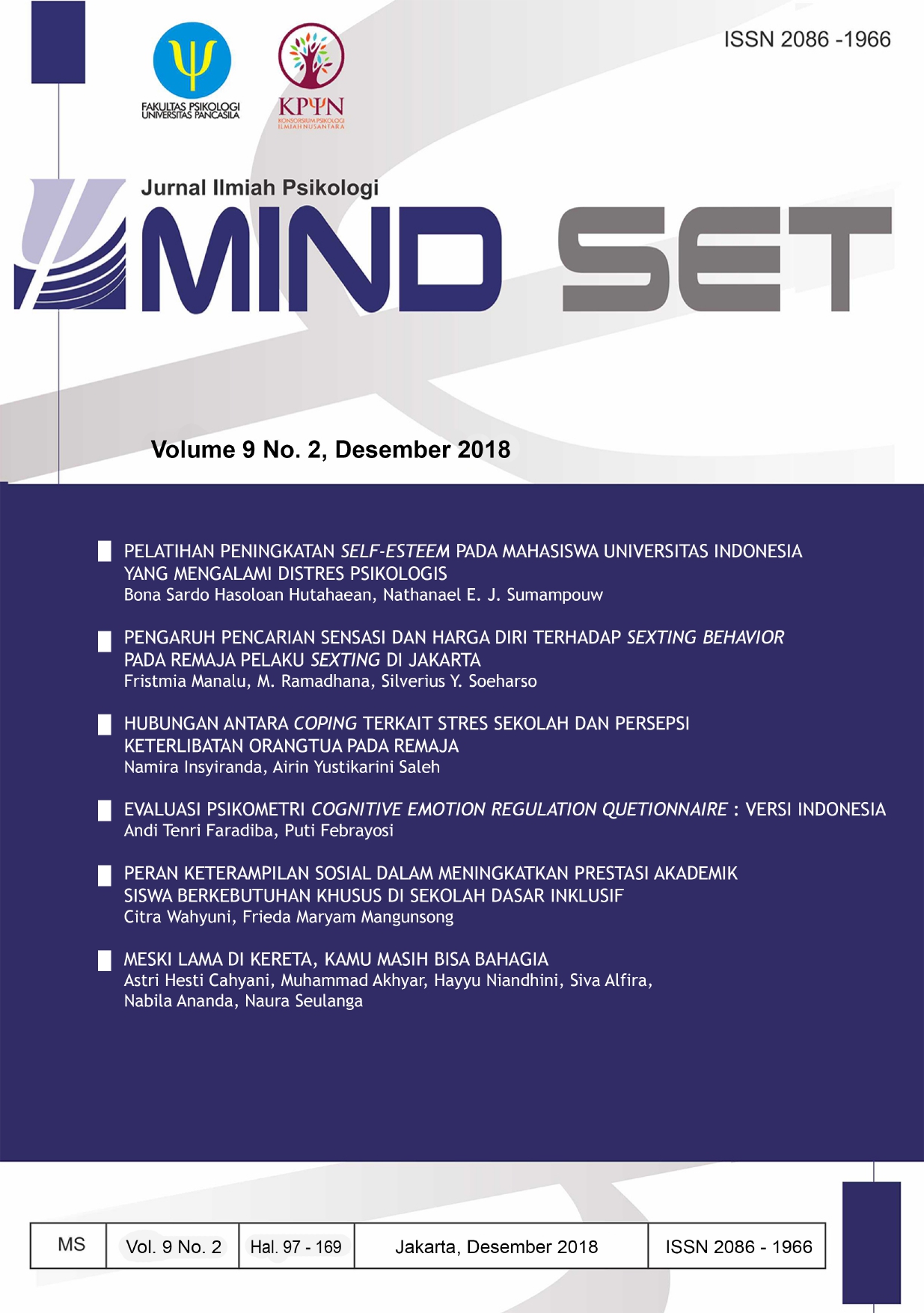
Pengaruh Pencarian Sensasi dan Harga Diri terhadap Sexting Behavior pada Remaja Pelaku Sexting di Jakarta
DOI:
https://doi.org/10.35814/mindset.v9i02.729Kata Kunci:
perilaku sexting, pencarian sensasi, harga diri, remajaAbstrak
Sexting behavior merupakan kegiatan yang lazim dilakukan para remaja sekarang ini. Pada penelitian ini, sexting behavior diartikan sebagai kegiatan menerima, mengirim, serta menerima sekaligus mengirim konten berkonotasi seksual berupa pesan teks, gambar atau foto dan video melalui ponsel. Penelitian ini bertujuan untuk mengetahui pengaruh pencarian sensasi dan harga diri terhadap sexting behavior pada remaja pelaku sexting di Jakarta. Penelitian ini melibatkan 370 responden laki-laki dan perempuan dengan latar belakang yang berbeda-beda. Teknik analisis yang digunakan dalam penelitian ini adalah regresi berganda dan uji beda dengan independent sample t-test maupun ANOVA. Beberapa hasil penelitian yang ditemukan adalah (1) pencarian sensasi dan harga diri berpengaruh secara signifikan terhadap sexting behavior, (2) pencarian sensasi berpengaruh terhadap sexting behavior, (3) harga diri tidak berpengaruh terhadap sexting behavior, (4) terhadap perbedaan sexting behavior ditinjau dari usia, pendidikan, dan orientasi seksual. Hasil penelitian juga menyiratkan bahwa sexting behavior merupakan perilaku yang biasa dilakukan oleh remaja, apapun orientasi seksual, latar belakang pendidikan, dan status responden. Sementara itu juga diketahui bahwa figur yang paling banyak disebut sebagai tujuan sexting behavior adalah teman sebaya. Adapun motivasi melakukan sexting behavior yang paling sering disebut adalah sekedar berbagi dan usaha untuk menggoda teman atau pasangan.
Referensi
Abeele, M. V., Scott W. C., Steven, E., &Keith, R. (2014). Sexting, mobile porn use, & peer group dynamics: boys and girls’ self-perceived popularity, need for popularity, and perceived peer pressure. Media Psychology, 17, 6-33. doi: 10.1080/15213269.2013.801725
Akers, R. L., & Jennings, W.G. (2009). The social learning theory of crime and deviance. In M. Krohn, A. Lizotte, & G. Hall (Eds.). Handbook on Criminology and Deviance, 103–120. New York: Springer.
Albury, K., & Crawford, K. (2012). Sexting, consent and young people's ethics: Beyond Megan's Story. Continuum: Journal of Media & Cultural Studies, 26(3), 463-473. doi:10.1080/10304312.2012.665840
Asyari, Y. (2017). 2017, Polda Metro tangkap 8 tersangka kasus pornografi anak. Jawapos.com. Diakses dari https://www.jawapos.com/read/2017/09/28/159792/2017-polda-metro-tangkap-8-tersangka-kasus-pornografi-anak.
Baumgartner, S. E., Sumter, S. R., Peter, J., Valkenburg, P. M., & Livingstone, S. (2014). Does country context matter? Investigating the predictors of teen sexting across Europe. Computers in Human Behavior, 34, 157-164. doi: 10.1016/j.chb.2014.01.041
Bunardi, M. O. (2015). Perancangan komunikasi visual kampanye anti sexting “rethink” (Master’s thesis). Universitas Bina Nusantara, Jakarta.
Crofts, T., Lee, M., McGovern, A., Milivojevic, S. (2017). Sexting pleasures: young people, romance and child pornography (Forthcoming). In C. Driscol, L. Grealy (Eds.). Youth and technology: Pleasure and governance. United Kingdom: Routledge.
Delevi, R., & Weisskirch, R. S. (2013). Personality factors as predictors of sexting. Computers in Human Behavior, 29, 2589–2594.
Dir, A. L., Ayca, C., Jennifer, L. S., & Melissa, A. C. (2013). Understanding differences in sexting behaviors across gender, relationship status, and sexual identity, and the role of expectancies in sexting. Cyberpsychology, Behavior, and Social Networking, 16(8), 568-574. doi:10.1089/cyber.2012.0545
Dir, A. L., Cyders, M. A., & Coskunpinar, A. (2013). From the bar to the bed via mobile phone: A fi rst test of the role of problematic alcohol use, sexting, and impulsivity-relad traits in sexual hookups. Computers in Human Behavior, 29(4), 1664-1670.
Duncan, S. (2010). A legal response is necessary for self-produced child pornography: A legislator’s checklist for drafting the Bill. Oregon Law Review, 89(2), 645-699.
Gordon-Messer, D., Bauermeister, J. A., Grodzinski & Zimmerman, M. (2013). Sexting among young adults. Journal of Adolescent Health, 52, 301–306.
Guindon, M. H. (2010). Self-esteem across the lifespan: Issues and interventions. USA: Taylor and Francis Group, LLC.
Guindon, M. H. (2010). What is self-esteem. Dalam M.H. Guindon, (Ed.), Self-esteem across the lifespan: Issues and interventions. New York: Routledge.
Hudson, H. K. & Fetro, J. V. (2015). Sextual activity: Predictors of sexting behaviors and intentions to sext among selected undergraduate students. Computers in Human Behavior, 49, 615-622. doi: 10.1016/j/chb.2015.03.048
Jenaro, C., Flores, N., Gómez-Vela, M., González-Gil, F., & Caballo, C. (2007). Problematic internet and cell-phone use: Psychological behavioral, and health correlates. Addiction Research & Theory, 15, 309–320. doi:10.1080/16066350701350247
Lee, C., Moak, S., & Walker, J. T. (2016). Effect of self-control, social control, and social learning on sexting behavior among South Korean Youths. Youth & Society, 48(2), 242-264. doi:10.1177/0044118X13490762
Lee, M., & Crofts, T. (2015). Gender, pressure, coercion and pleasure: untangling motivations for sexting between young people. The British Journal of Criminology, 55(3), 454-473.
Lee, M., & Crofts, T. (2013). Gender, pressure, coercion and pleasure: untangling motivations for sexting between young people. Brit. J. Criminology, 55, 454-473. doi: 10.1093/bjc/azu075
Lenhart, A. (2009). Teens and sexting: how and why minor teens are sending sexually suggestive nude or nearly nude images via text messaging. Pew Internet & American Life Project, 1-16.
Leung. (2007). Leisure boredom, sensation seeking, self-esteem, addiction symptoms, and patterns of mobile phone use. Mediated Interpersonal Communication, 1-36.
Leung, L. (2008). Linking psychological attributes to addiction and improper use of the mobile phone among adolescents in Hong Kong. Journal of Children and Media, 2(2), 93–113. doi:10.1080/17482790802078565
Lippman, J. R., & Campbell, S. W. (2012). Teenagers and sexting: perceived norms and sexual double standard. ICA Conference, 24–28 May 2012, Phoenix, AZ.
Lippman, J. L., & Campbell, S. W. (2014). Damned if you do, damned if you don't…if you're a girl: Relational and normative contexts of adolescent sexting in the United States. Journal of Children and Media, 8(4), 371-386. doi:10.1080/17482798.2014.923009
Papalia, D. E., & Martorell, G. (Eds.13). (2017). Experience human development. New York: McGraw-Hill.
Parker, T. S., Kristyn, M. B., Martha, S. P., & Jillian, M. H. (2012). Sexting as an intervention: Relationship satisfaction and motivation considerations. The American Journal of Family Therapy 41(1), 1–12. doi:10.1080/01926187.2011.635134
Rahardjo, W., Hapsari, I., & Saputra, M. (2014). Kecenderungan mencari sensasi seksual, sexting, dan perilaku seks berisiko pada pelaku sexting tipe two-way sexters. Jurnal Psikologi Indonesia, 11(1), 66-75.
Rahardjo, W., Maizar, S., & Indria, H. (2015). Harga diri, sexting dan jumlah pasangan seks yang dimiliki oleh pria lajang pelaku perilaku seks beresiko. Jurnal Psikologi, 42(2), 101-114.
Renfrow, D. G., & Rollo, E. A. (2014). Sexting on campus: Minimizing perceived risks and neutralizing behaviors. Deviant Behavior, 35, 903-920. doi: 10.1080/01639625.2014.897122
Rice, P. (1981). The adolescence development. Boston: Allyn and Bacon.
Ricketts, M. L., Maloney, C., Marcum, C. D., & Higgins, G. E. (2014). The effect of internet related problems on the sexting behaviors of juveniles. American Journal of Criminal Justice, 40(2), 9-15. doi: 10.1007/s12103-014-9247-5
Ringrose, J., Harvey, L., Gill, R., & Livingstone, S. (2013). Teen girls, sexual double standards and 'sexting': gendered value in digital image exchange. Feminist Theory, 14, 19.
Santrock, J. W. (Eds.13). (2012). Life-span development. University of Texas: Mc Graw-Hill.
Scholes-Balog, K., Francke, N., & Hemphill, S. (2016). Relationships between sexting, self-esteem, and sensation seeking among Australian young adults. Sexualization, Media, & Society, 1-8. doi: 10.1177/2374623815627790
Shaughnessy, K., Byers, E. S., & Walsh, L. (2011). Online sexual activity experience in heterosexual students: Gender similarities and differences. Archives of Sexual Behavior, 40, 419–427.
The National Campaign to Prevent Teen and Unplanned Pregnancy. (2008). Sex and Tech: Results from a Survey of Teens and Young Adults. Washington, DC: Author.
Vanden Abeele, M., Roe, K., & Eggermont, S. (2012). An exploration of adolescents’ sexual contact and conduct risks through mobile phone use. Communications, 37, 55–77.
Van Ouytsel, J., Ponnet, K., & Walrave, M. (2014a). The associations between adolescents' consumption of pornography and music videos and their sexting behavior. Cyberpsychology, Behavior, and Social Networking, 17, 772-778.
Van Ouytsel, J., Van Gool, E., Ponnet, K., & Walrave, M. (2014). Brief report: The association between adolescents’ characteristics and engagement in sexting. Journal of Adolescence, 37, 1387–1391.
Van Ouytsel, J., Van Gool, E., Ponnet, K., & Walrave, M. (2014b). Brief report: The association between adolescents' characteristics and engagement in sexting. Journal of Adolescence, 37, 1387-1391.
Van Ouytsel, J., Van Gool, E., Walrave, M., Ponnet, K., & Peeters, E. (2016). Sexting: adolescents’ perceptions of the applications used for, motives for, and consequences of sexting. Journal of Youth Studies, 1-26. doi: 10.1080/13676261.2016.1241865
Van Ouytsel, J., Walrave, M., Ponnet, K., & Heirman, W. (2014c). The association between adolescent sexting, psycho-social difficulties, and risk behavior: Integrative review. The Journal of School Nursing, 1, 1-16.
Van Ouytsel, J., Walrave, M., & Van Gool, E. (2014d). Sexting: between thrill and fear—How schools can respond. The Clearing House: A Journal of Educational Strategies, Issues and Ideas, 87, 204-212.
Wachs, S., Wright, M. F., & Wolf, K. D. (2017). Psychological correlates of teen sexting in three countries: Direct and indirect associations between self-control, self-esteem, and sexting, International Journal of Development Science, 11, 109-120.
Walker, S., Sanci, L., & Temple-Smith, M. (2013). Sexting: young women's and men's views on its nature and origins. The Journal of adolescent health: official publication of the society for adolescent medicine, 52, 697-701.
Walrave, M., Wanness, H., & Lara, H. (2014). Under pressure to sext? Applying the theory of planned behavior to adolescent sexting. Behaviour & Information Technology, 33(1), 86-98.doi: 10.1080/0144929X.2013.837099
Weisskrich, R., & Delevi, R. (2011). ‘‘Sexting’’ and adult romantic attachment. Computers in Human Behavior, 27, 1697-1701.
Yeung, T. H., Horyniak, D. R., Vella, A. M., Hellard, M. E., & Lim, M. S. C. (2014). Prevalence, correlates and attitude towards sexting among young people in Melbourne, Australia. Sexual Health, 11, 332-339. doi: 10.1071/SH14032
Zuckerman, M. (1979). Sensation seeking: Beyond the optimum level of arousal. Hillsdale, NJ: Lawrence Erlbaum Associates.
Zuckerman, M. (1991). Psychobiology of personality. Cambridge: Cambridge University Press.
Zuckerman, M. (1994). Behavioral expressions and biosocial bases of sensation seeking. New York: Cambridge Press.