

Menu
In Collaboration with:


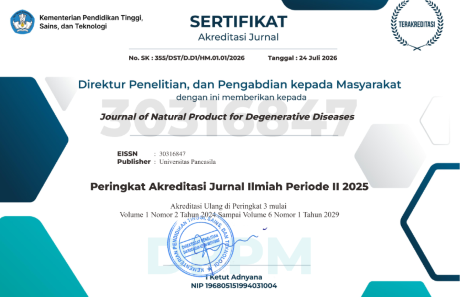
ISSN


Authors from around the world are welcome to contribute to the journal. All manuscripts must be submitted via the journal’s submission site at https://journal.univpancasila.ac.id/index.php/Natural/
Manuscripts must be prepared using the official JNPDD Template (Microsoft Word format). Download the JNPDD Template here: template file.
Original and revised manuscript texts may be uploaded as an OpenOffice, Microsoft Word, or RTF document file, but a Word file is preferable and is required for the final manuscript text. Figures can be incorporated in the Word file, or submitted separately as high-quality PNG or JPEG files; the ChemDraw format is not accepted. These files are automatically incorporated into a single PDF that the system creates for review.
If you encounter any problems with your submission, please contact the Editorial Office at jnpdd@univpancasila.ac.id
The Journal publishes Original Research Articles and Review Articles.
Original Research Articles present original research performed by the authors and must include new data, analyses, or information that is of significance and interest to a broad audience.
Review Articles are critical overviews of scientific discoveries in areas of the authors’ expertise. These reviews are expected to include the author’s own recent interesting and significant results.
A cover letter must be included and should provide a brief overview of the work, its significance, and the justification for publishing it. Authors who suggest potential referees should declare any relevant former or ongoing relationships in their cover letter.
Authors must use the JNPDD Template and must not change its layout or numbering style. The page and font specifications of the template are as follows:
JNPDD uses double-blind peer review, in which the identities of the authors and the referees are concealed from each other. Authors are therefore responsible for preparing the manuscript so that their identity is not revealed to the referees:
The first page of the full manuscript follows the template and contains, in this order: the manuscript title; the author names and affiliations; the corresponding author’s contact line; the “Received / Accepted” line; and the Abstract with Keywords.
Title. Write the title in sentence case: capitalize only the first word and proper nouns. Keep abbreviations in the title to a minimum.
Authors. Give author names in full, with surnames. Place a superscript number after each author’s name to indicate his or her affiliation, and add an asterisk (*) to the corresponding author’s name. For example:
Deni Rahmat1*, Yesi Desmiaty2, and Syamsuddin Abdillah3
Affiliations. Give affiliations in English in the following order: Department, Faculty, University, City, Country. Do not use footnotes for the addresses. For example:
1Department of Pharmaceutics, Faculty of Pharmacy, Universitas Pancasila, Jakarta, Indonesia.
2Department of Natural Product, Faculty of Pharmacy, Universitas Pancasila, Jakarta, Indonesia.
3Department of Pharmacology, Faculty of Pharmacy, Universitas Pancasila, Jakarta, Indonesia.
Corresponding author. The e-mail address and telephone/contact number (and fax number, if available) of the corresponding author must be clearly given, marked with an asterisk, on the line below the affiliations, in the form: “*Corresponding Author: e-mail / Contact: +62xxxxxxx”.
Received / Accepted. Keep the line “Received: date / Accepted: date” as in the template; the dates are completed by the Editorial Office.
The Abstract (not “Summary”) is placed on the first page, directly below the author information, in the boxed layout of the template. It must not be longer than 250 words (for both research and review articles), must clearly state the purpose and the results of the study, and must not contain any reference citations. Please limit the use of abbreviations in the Abstract and the title to a minimum.
Keywords follow the Abstract and are separated by semicolons (;). Provide 3 to 6 keywords in decreasing order of importance. Because keywords are used in combination to construct a rich and comprehensive index, they should be conceptually unrelated and should not repeat words or phrases (for example, “protein”, “protein synthesis”, and “synthesis” should not be used together). Acronyms and abbreviations should not be used as keywords.
Headings and numbering. Use the following heading styles and do not change the numbering style of the journal:
1.1. Subheading
1.1.1. Another subheading
Do not use subheadings beyond the third order (for example, 1.1.1.1.). Only the Introduction, Materials and Methods, Results, Discussion, and Conclusion sections are numbered. The remaining headings, such as Abstract, Acknowledgements, and References, are not numbered.
The main text is organized in the following order:
State the objectives of the work, define the scope of the paper, summarize the work relevant to the study being reported, and provide adequate background. A detailed literature survey or a summary of the results should be avoided. The Introduction should not be a review of the subject area, but should finish with a clear statement of the question being addressed, so that the reader understands the rationale and significance of the study.
2.1. Material. Names of products and manufacturers (with locations) should be supplied for all equipment, instruments, chemicals, and other materials mentioned. Brand names may be used only once in the manuscript. For example, “XYZ® tablets containing Esomeprazole (Formulation A) were generously provided by ABC Pharmaceuticals” may be written in Materials and Methods; elsewhere in the manuscript, refer to “commercial tablets containing Esomeprazole” or Formulation A, not XYZ® tablets.
2.2. Procedure. The experimental procedures should be described in sufficient detail to enable others to repeat the experiments. Declarations on human or animal experimentation (see Scientific and Editorial Policies) must be stated in this section.
Results should be clear and concise. Text, tables, and figures must show minimal overlap and must be internally consistent. Tables and figures should be designed to maximize the presentation and comprehension of the experimental data. Attention should be paid to significant figures (usually no more than three). The same data should not be presented in more than one figure or in both a figure and a table. As a rule, interpretation of the results is reserved for the Discussion, but under some circumstances it may be desirable to combine Results and Discussion in a single section.
The purpose of the Discussion is to interpret the significance of the results and relate them to existing knowledge in the field as clearly and briefly as possible. Information given elsewhere in the manuscript should not be repeated, and extensive reviews of the literature should be avoided.
The main conclusions of the study should be presented in a short Conclusion section, which stands alone. Explain whether the findings supported the hypothesis. Avoid using references in the Conclusion.
Acknowledgements, Author Contributions, and Conflict of Interest Statement
After the Conclusion, and before the References, provide the following unnumbered items in the boxed layout of the template:
Other data necessary for peer review, including related manuscripts submitted elsewhere, should be submitted as additional information in separate documents, labeled “Additional Information”. These materials will not be published in the journal.
A reference is any article or chapter published in journals, books, and other outlets such as technical reports, patents, and lectures. References to any other materials or personal communications should be described in the text.
The journal uses the IEEE citation style. We recommend preparing the references with the bibliography software Mendeley using the IEEE style (see https://pitt.libguides.com/citationhelp/ieee for guidance).
Examples:
Journal article
[1] S. Ozgen, O. K. Kilinc, and Z. Selamoglu, “Antioxidant activity of quercetin: A mechanistic review,” Turkish Journal of Agriculture - Food Science and Technology, vol. 4, no. 12, pp. 1134–1138, 2016.
Book
[2] D. Sarunyagate, Ed., Lasers. New York: McGraw-Hill, 1996.
Conference proceeding
[3] T. J. van Weert and R. K. Munro, Eds., Informatics and the Digital Society: Social, ethical and cognitive issues: IFIP TC3/WG3.1&3.2 Open Conference on Social, Ethical and Cognitive Issues of Informatics and ICT, July 22-26, 2002, Dortmund, Germany. Boston: Kluwer Academic, 2003.
Thesis or dissertation
[4] J. O. Williams, “Narrow-band analyzer,” Ph.D. dissertation, Dept. Elect. Eng., Harvard Univ., Cambridge, MA, 1993.
e-journal (from the internet)
[5] A. Altun, “Understanding hypertext in the context of reading on the web: Language learners’ experience,” Current Issues in Education, vol. 6, no. 12, July, 2005. [Online serial]. Available: http://cie.ed.asu.edu/volume6/number12/. [Accessed Dec. 2, 2007].
The nomenclature used for chemical compounds must be in accordance with IUPAC’s published guidelines. Alternatively, naming may conform to the nomenclature in the index of Chemical Abstracts or the Ring Index. The nomenclature style must be internally consistent within the manuscript.
Abbreviations must be spelled out in full and followed by the abbreviation in parentheses when first used in the Abstract and in the main text. Thereafter, the abbreviation only should be used. Please limit to a minimum the use of abbreviations in the Abstract and the title.
Note that the following common abbreviations do not need to be defined:
|
Abbreviation |
Meaning |
|
ADP |
adenosine 5′-diphosphate |
|
AIDS |
acquired immunodeficiency syndrome |
|
AMP |
adenosine 5′-monophosphate or adenylic acid |
|
ANOVA |
analysis of variance |
|
ATP |
adenosine 5′-triphosphate |
|
cAMP |
adenosine 3′,5′-cyclic monophosphate |
|
cDNA |
complementary DNA |
|
CoA |
coenzyme A |
|
CYP |
cytochrome P450 |
|
DNA |
deoxyribonucleic acid |
|
ED50 |
50% effective dose |
|
ESR |
electron spin resonance |
|
FAB-MS |
fast atom bombardment mass spectrometry |
|
FAD |
flavin adenine dinucleotide |
|
GC-MS |
gas chromatography-mass spectrometry |
|
GLC |
gas-liquid chromatography |
|
GMP |
guanosine 5′-monophosphate |
|
HPLC |
high-performance liquid chromatography, high-pressure liquid chromatography |
|
IC50 |
inhibitory concentration, 50% |
|
IR |
infrared |
|
LC |
liquid chromatography |
|
LC/MS |
liquid chromatography/mass spectrometry |
|
LD50 |
50% lethal dose |
|
mRNA |
messenger RNA |
|
MS |
mass spectrum |
|
NMR |
nuclear magnetic resonance |
|
OTC |
over the counter |
|
PCR |
polymerase chain reaction |
|
QOL |
quality of life |
|
RNA |
ribonucleic acid |
|
RT-PCR |
reverse transcription polymerase chain reaction |
|
TLC |
thin-layer chromatography |
|
tRNA |
transfer RNA |
|
UV |
ultraviolet |
|
WHO |
World Health Organization |
The following units should be used:
|
Quantity |
Units |
|
length |
m, cm, mm, μm, nm, Å |
|
volume |
L, mL, μL |
|
time |
s, min, h, d |
|
temperature |
°C, K |
|
radiation |
Bq, dpm, Gy, Sv |
|
concentration |
M, mM, mol/L, mmol/L, mg/mL, μg/mL, %, % (v/v), % (w/v), ppm, ppb |
Authors should carefully read the journal policies below, as submission to the Journal of Natural Product for Degenerative Diseases implies that all authors have read and approved these policies.
Authors are encouraged to consult commonly accepted policy standards, which the journal supports, such as those presented by the Council of Science Editors or the International Committee of Medical Journal Editors (ICMJE).
Submission to the Journal of Natural Product for Degenerative Diseases also implies that all authors have seen and approved the manuscript, agree to its submission, and have the right to publish the work and that it is not defamatory or libelous. All authors also undertake that the manuscript is original and has not been published elsewhere in any language, nor is it otherwise under consideration at another journal. Authors must inform the editors if any related publications have been submitted or are in press elsewhere.
The Instructions to Authors refer to various basic acceptance criteria, including that manuscripts must fall within the journal’s scope, as well as requirements for ethical behavior, compliance with human or animal experimentation policies, data policies, various technical requirements, English standards, copyright provisions, and so forth. In addition, articles in the journal must also be:
Contributors to the Journal of Natural Product for Degenerative Diseases should meet the following criteria for authorship. All authors must:
By submitting to the journal, the authors undertake that they have agreed to the author list and its order. Any changes to the author list (such as author order, or adding or removing authors) after peer review will rarely be approved by the journal. If requests are made, they must have strong justification and be approved by all the listed authors.
For submissions that include investigations with human subjects and/or human tissues, the authors must declare that the work was performed in accordance with the ethical principles for medical research outlined in the Declaration of Helsinki 1964 and per subsequent revisions (https://www.wma.net/). In addition, relevant manuscripts must contain a statement confirming that approval was received prior to the study’s commencement from the appropriate ethics committees. The declaration should be clearly stated in Materials and Methods.
For submissions that include animal experimentation, the authors must declare within the manuscript that the work was performed in accordance with the experimental animal guidelines of the authors’ institutions. In addition, appropriate government guidelines should be followed and these should be cited in the declaration. (The previous text cited the Japanese Ministry of Education, Culture, Sports, Science and Technology as an example; replace with the national or institutional standard preferred by JNPDD.) The declaration should be clearly stated in Materials and Methods.
Authors warrant that their submissions are original works. The journal uses iThenticate software to screen submitted manuscripts for unoriginal material, and submission to the journal implies that authors agree to this process. The journal reserves the right to return a manuscript for no further consideration if it is found to contain an unacceptable amount of unoriginal material. Resubmitted manuscripts will be considered only if the unoriginal material has been removed.
The journal conforms to high standards in the presentation of images. Digital manipulation or processing of images is permitted, but all figures must accurately reflect the underlying data. The editors may request original data and images from the authors either before or after publication, as necessary.
Use of any figures or other previously published material for which the authors do not own or have rights is only possible if the authors obtain permission from the copyright owner and provide relevant documentation stating this upon submission of the manuscript.
The journal supports initiatives that improve the undertaking and outcomes of research. By submitting to the journal, authors agree to make their submission’s materials, data, and any protocols available in response to reasonable requests for it.
The journal supports the use of Supplementary Materials for data and relevant materials, or the use of relevant and accepted public repositories. (The previous text referred readers to a “Supplementary Materials section” that does not exist on this page; add a short section on the format of supplementary files if the journal accepts them.) Please also refer to the relevant parts of the Scientific Policies section within this document.
A conflict of interest exists when someone has financial or personal relationships that could inappropriately influence (bias) the consideration or publication of a submitted manuscript. The journal has strong policies for conflicts of interest among editors, referees, editorial board members and staff, and authors.
Authors should refer to and comply with the Council of Science Editors’ policies, which cover personal, financial, and non-financial conflicts of interest. Further, any relevant financial relationship of any author with any company or institution that might benefit from the publication of the manuscript must be disclosed.
Authors should consider the following as a guide for financial disclosures:
A disclosure must be included in the main text of the manuscript in the Conflict of interest statement, completed according to the signed conflict of interest statement submitted with the article. If the authors have no conflict of interest, they must state as much:
“The authors declared no conflict of interest.”
If one or more authors have a conflict of interest, it must be stated, for example:
A (author name) received a research grant from O (entire company, institute, or personal name); B received non-financial support from P; C serves as a consultant to Q; D received honoraria for writing promotional material for R; E has a patent (No. 12345) licensed to S; F is President of T; G has been reimbursed by U for attending conferences; H and I are employees of X; J has no conflict of interest.
All manuscripts that are under consideration, or have been returned to authors, are kept confidential. Authors agree to keep in confidence all correspondence about their submission from the journal, editors, and Editorial Office.
The journal undertakes double-blind peer review: the identities of the authors and the referees are concealed from each other throughout the review process. Referees agree to maintain the confidentiality of submitted manuscripts as part of their agreement to review articles for the journal.
Manuscripts are first screened by the Editorial Office and the editor(s) for conformity with the journal’s scope, these Author Guidelines, and the acceptance criteria. Manuscripts clearly not conforming to the basic requirements or acceptance criteria will be returned to the authors without peer review.
Manuscripts that pass the initial screening are sent to two or more referees, who provide feedback and their opinion about the suitability of the manuscript for publication. Referees are selected on the basis of their expertise, reputation, and previous experience as peer reviewers, and are provided with a Guide to Referees that includes the journal’s acceptance criteria. Further details are given on the Peer Review Process page of the journal.
The handling editor uses the referees’ reports as the basis of the initial decision, which can be minor revision, major revision, or rejection. In the former two cases, authors are invited to re-submit a revised version together with a point-by-point response to the comments of the referees and the editor; for some manuscripts, a round of re-review may be deemed necessary. After revision, articles that are deemed to fulfill the journal’s requirements are accepted for publication.
Revised manuscripts must be re-submitted no later than two months from the date of notification of manuscript revision by the editor. Manuscripts that are not re-submitted within two months may be rejected and have to be re-submitted as new manuscripts. Authors should contact the journal if they are unable to re-submit within the required deadline.
Authors may suggest potentially suitable referees during submission. Suggestions are welcome, but the final decision on the selection of referees rests solely with the handling editor, who verifies the suitability of every suggested referee and is under no obligation to use the suggestions or to give reasons. Authors must declare any ongoing or former relationships with suggested referees in the cover letter. Authors can also request that potential referees be excluded; the journal may consider these requests but is under no obligation to honor them. If authors suggest referees, the following conditions apply:
The conditions above are taken from the journal’s Peer Review Process page; confirm that they should be repeated here.
The journal will consider appeals that provide specific evidence of misunderstanding, mistake, or error by a referee or editor. An appeal is considered by the relevant editors, whose decision is final.
The journal supports the maintenance of an accurate record of science and hence will correct any significant errors in the journal. If authors discover a significant error or inaccuracy in their published article, they should promptly notify the Editor-in-Chief. The Editor-in-Chief will also assess any third-party advice independently received and, in both cases, determine whether an Erratum or a Retraction is appropriate.
Errata describe errors that significantly affect the scientific integrity of an article or the reputation of the journal or authors. Retractions are used when the results or conclusions are found to be invalid or misleading, or when there is sufficient evidence of breaches in research or publication ethics. Minor errors that are the result of the authors’ actions will not be amended.
If the authors, or some co-authors, do not agree to a correction being published, the journal reserves the right to publish an Erratum or Retraction that will separately list the dissenting co-authors. The journal’s decision in these matters is final.
Only manuscripts written in clear, concise English will be accepted for peer review. Authors who are not native English speakers should have their manuscripts checked and edited by a native English speaker who possesses sufficient scientific knowledge. If the English standard of an accepted manuscript is judged to be inadequate by the journal, authors may utilize a trusted service provider and provide a certificate of editing. The Editorial Office coordinates this process upon acceptance of a manuscript.
The journal is freely available to anyone with an internet connection and is able to be used and re-used under standard copyright provisions. Permission for re-use must be sought from the journal by contacting the Editorial Office (see the Copyright section for more details).
The Journal of Natural Product for Degenerative Diseases does not charge any fees to authors for submission or publication of articles. The journal is a platinum open-access journal: the full text is immediately available after publication, and no author-side fee is charged at any stage, from submission and peer review to final publication. See the Article Processing Charges page for details.
Authors notified of the acceptance of their manuscript will be provided with information and forms that facilitate its publication. After an average of approximately 30 days after acceptance, authors will be provided with proof of their typeset article. No additions or revisions are allowed, except to correct typographical errors introduced during the production process.
Once published, articles are freely available online at the journal’s site at https://journal.univpancasila.ac.id/index.php/Natural/

Editorial Office:
Lenteng Agung St, Srengseng Sawah District, Jagakarsa Regency, Jakarta Selatan, Special Region of Jakarta 12640, Indonesia | e-mail: jnpdd@univpancasila.ac.id
Support Contact
Ahmad MunadiPhone 082111989075 (WA only)jnpdd@univpancasila.ac.id

Journal of Natural Product for Degenerative Diseases (ISSN: 3031-6847 (Online)) is licensed under a Creative Commons Attribution-NonCommercial-ShareAlike 4.0 International License. Preserved in LOCKSS through PKP Private LOCKSS Network program.