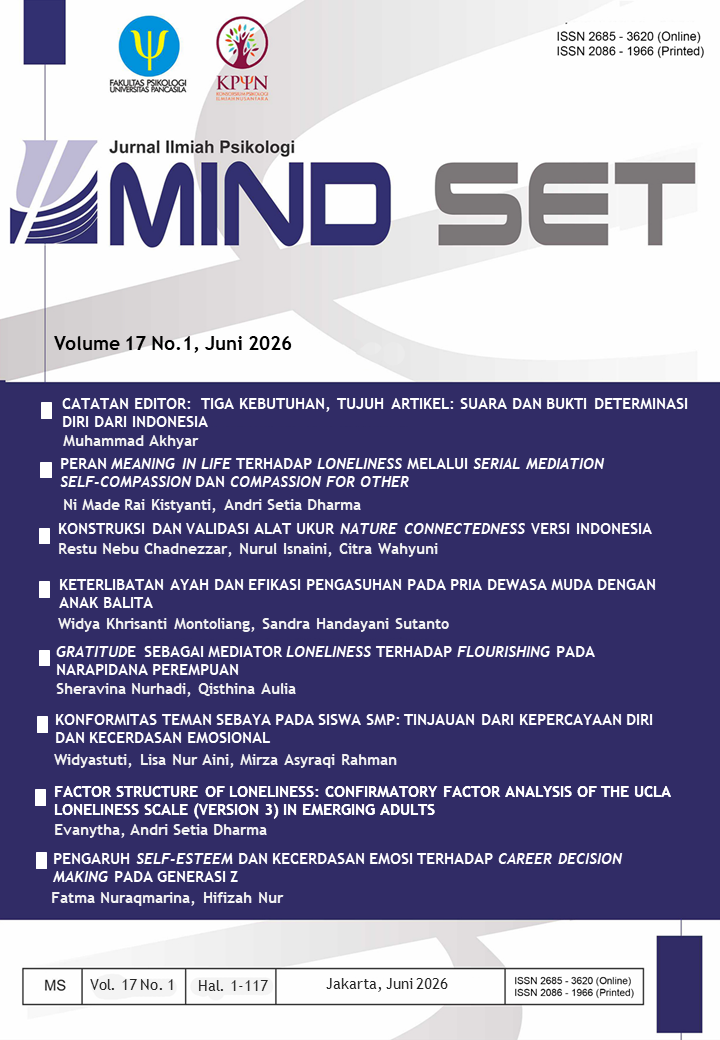
Konstruksi dan Validasi Alat Ukur Nature Connectedness Versi Indonesia
DOI:
https://doi.org/10.64228/71x1q191Keywords:
construct validity , environtmental psychology , nature connectedness, scale developmentAbstract
Environmental damage in Indonesia shows the importance of understanding the individual's connection to nature. This study aims to develop and test the psychometric properties of the Nature Connectedness Scale in the Indonesian adult population. The study participants amounted to 560 Indonesian adults aged 18–40 years old who were obtained through nonprobability sampling techniques. The development of the instrument was carried out through literature studies, expert judgment, and psychometric testing. Data analysis was conducted using Exploratory Factor Analysis (EFA) with the minimum residual extraction method and oblimin rotation using the JAMOVI 2.7 application. The results of the analysis showed a Kaiser-Meyer-Olkin (KMO) value of 0.968 and a significant Bartlett's Test of Sphericity (χ² = 9999, df = 300, p < 0.001), so the data were suitable for further analysis. The final structure of the scale consists of two factors with a total variance explained as 56.94%. Of the 25 items tested, all items were maintained and showed adequate factor loadings and good reliability. These findings show that the Nature Connectedness Scale has sufficient construct validity and reliability to measure individual connectedness to nature in the Indonesian adult population. This instrument is expected to be used in research, assessment, and the development of interventions in the field of environmental psychology.
References
Adiwena, M. A., & Djuwita, R. (2022). Manusia dan lingkungan alam: Analisis faktor konfirmatori terhadap Nature Relatedness Scale Bahasa Indonesia. Jurnal Psikologi Sosial, 20(1), 57–71.
Bandura, A. (1986). Social foundations of thought and action: A social cognitive theory. Prentice-Hall.
Badan Pusat Statistik. (2022). Statistik potensi desa Indonesia 2021. Badan Pusat Statistik
Bratman, G. N., Olvera-Alvarez, H. A., & Gross, J. J. (2021). The affective benefits of nature exposure. Social and Personality Psychology Compass, 15(8), e12630. https://doi.org/10.1111/spc3.12630
Buijs, A. E., Elands, B. H. M., & Langers, F. (2009). No wilderness for immigrants: Cultural differences in images of nature and landscape preferences. Landscape and Urban Planning, 91(3), 113–123. https://doi.org/10.1016/j.landurbplan.2008.12.003
Capaldi, C. A., Dopko, R. L., & Zelenski, J. M. (2014). The relationship between nature connectedness and happiness: A meta-analysis. Frontiers in Psychology, 5, 976. https://doi.org/10.3389/fpsyg.2014.00976
Chang, C. C., Lin, B. B., Feng, X., Andersson, E., Gardner, J., & Astell-Burt, T. (2024). A lower connection to nature is related to lower mental health benefits from nature contact. Scientific Reports, 14, Article 6705. https://doi.org/10.1038/s41598-024-56968-5
Dwidjoseputro. (1987). Manusia dengan lingkungan. Lembaga Pendidikan Tenaga Kependidikan Direktorat Jenderal Pendidikan Tinggi Departemen Pendidikan dan Kebudayaan.
Guazzini, A., Valdrighi, G., Fiorenza, M., & Duradoni, M. (2025). The relationship between connectedness to nature and pro-environmental behaviors: A systematic review. Sustainability, 17(8), 3686. https://doi.org/10.3390/su17083686
Hair, J. F., Anderson, R. E., Tatham, R. L., & Black, W. C. (1998). Multivariate data analysis (5th ed.). Prentice Hall.
Hammoud, R., Tognin, S., Smythe, M., Gibbons, J., Davidson, N., Bakolis, I., & Mechelli, A. (2024). Smartphone-based ecological momentary assessment reveals an incremental association between natural diversity and mental wellbeing. Scientific Reports, 14, 7051. https://doi.org/10.1038/s41598-024-55940-7
Hatty, M. A., Smith, L. D. G., Goodwin, D., & Mavondo, F. T. (2020). The CN-12: A brief, multidimensional connection with nature instrument. Frontiers in Psychology, 11, 1566. https://doi.org/10.3389/fpsyg.2020.01566
Kerlinger, F. N. (2006). Asas-asas penelitian behavioral (Terjemahan). Gadjah Mada University Press.
Lumber, R., Richardson, M., & Sheffield, D. (2017). Beyond knowing nature: Contact, emotion, compassion, meaning, and beauty are pathways to nature connection. PLOS ONE, 12(5), e0177186. https://doi.org/10.1371/journal.pone.0177186
Mahfud, A., Wibowo, M. E., Mulawarman, M., & Japar, M. (2023). Evidence of the validity of the fairness character scale for adolescence: A Confirmatory Factor Analysis (CFA) technique. Psikohumani-ora: Jurnal Penelitian Psikologi, 8(1), 35–50. https://doi.org/10.21580/pjpp.v8i1.13589
Martin, L., White, M. P., Hunt, A., Richardson, M., Pahl, S., & Burt, J. (2020). Nature contact, nature connectedness and associations with health, wellbeing and pro-environmental behaviours. Journal of Environmental Psychology, 68, 101389. https://doi.org/10.1016/j.jenvp.2020.101389
Mayer, F. S., & Frantz, C. M. (2004). The connectedness to nature scale: A measure of individuals’ feeling in community with nature. Journal of Environmental Psychology, 24(4), 503–515. https://doi.org/10.1016/j.jenvp.2004.10.001
Mónus, F. (2021). Environmental perceptions and pro-environmental behavior: Comparing different measuring approaches. Environmental Education Research, 27(1), 132–156. https://doi.org/10.1080/13504622.2020.1842332
Nunnally, J. C., & Bernstein, I. H. (1994). Psychometric theory (3rd ed.). McGraw-Hill.
Pratiwi, F. S. (2023, Juni 14). Sampah Plastik di Laut RI Turun Jadi 398.000 Ton pada 2022. Dataindonesia.id. https://dataindonesia.id/varia/detail/sampah-plastik-di-laut-ri-turun-jadi-398000-ton-pada-2022
Richardson, M., Passmore, H. A., Barbett, L., Lumber, R., Thomas, R., & Hunt, A. (2021). The green care code: How nature connectedness and simple activities help explain pro-nature conservation behaviours. People and Nature, 3(3), 821–839. https://doi.org/10.1002/pan3.10117
Richardson, M., Sheffield, D., Harvey, C., & Petronzi, D. (2019). The development of a brief measure of nature connectedness based on the inclusion of nature in self scale. Journal of Environmental Psychology, 63, 30–36. https://doi.org/10.1016/j.jenvp.2019.03.009
Schultz, P. W. (2002). Inclusion with nature: The psychology of human-nature relations. In P. Schmuck & W. P. Schultz (Eds.), Psychology of sustainable development (pp. 61–78). Springer.
Swami, V., Furnham, A., & Barron, D. (2024). Cross-cultural perspectives on nature connectedness and environmental attitudes. Current Opinion in Psychology, 58, 101848.
Whitburn, J., Linklater, W., & Abrahamse, W. (2020). Meta-analysis of human connection to nature and pro-environmental behavior. Conservation Biology, 34(1), 180–193. https://doi.org/10.1111/cobi.13381
Downloads
Published
Issue
Section
License
Copyright (c) 2026 Jurnal Ilmiah Psikologi MIND SET

This work is licensed under a Creative Commons Attribution 4.0 International License.