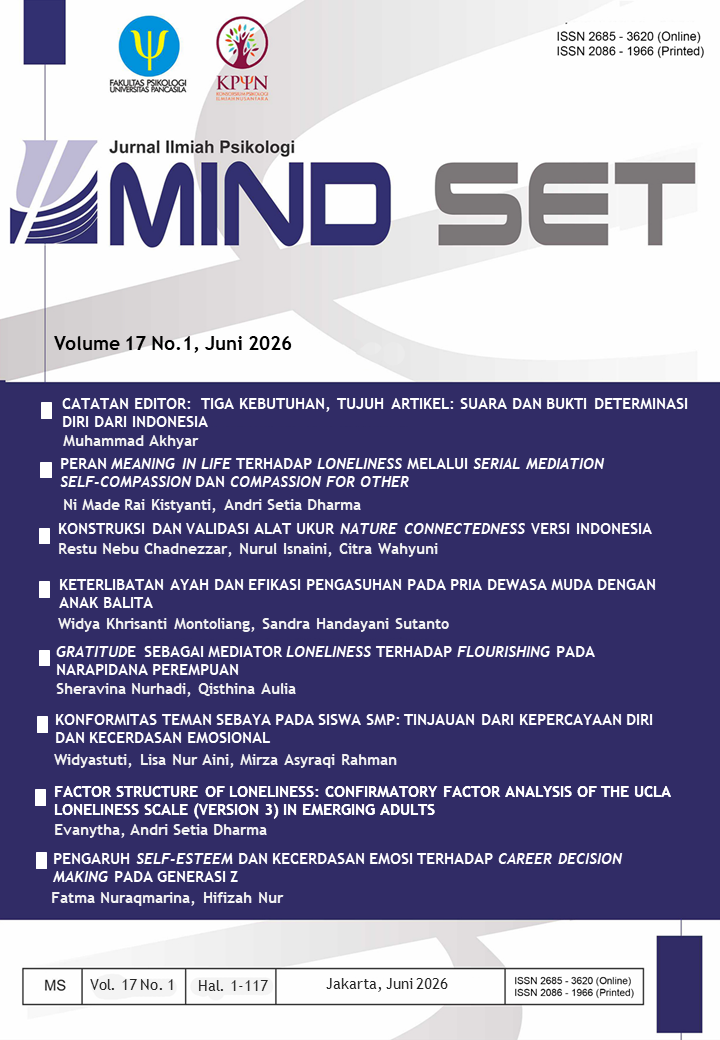
Factor Structure of Loneliness: Confirmatory Factor Analysis of the UCLA Loneliness Scale (Version 3) in Emerging Adults
DOI:
https://doi.org/10.64228/nv8sha84Keywords:
confirmatory factor analysis, loneliness, UCLA Loneliness ScaleAbstract
Loneliness negatively affects psychological health. The UCLA Loneliness Scale (Version 3; UCLA-LS-V3) is the primary global measure of loneliness. Despite inconsistent findings regarding its factor structure, currently, no research has examined the factor structure of the UCLA-LS-V3 among emerging adults in Indonesia. The objective of the present study was to address the research gap by evaluating the factor structure, construct validity, and reliability, and adapting the scale for use with Indonesian emerging adults. A total of 396 participants with an average age of 20.24 years were involved in this study. Confirmatory factor analysis generated findings that the UCLA-LS-V3 is better represented by two- and three-factor models than by a one-factor model, and that it supports the scale’s use in research and intervention programs among emerging adults in Indonesia.
References
Alsubheen, S. A., Oliveira, A., Habash, R.,
Goldstein, R., & Brooks, D. (2023). Systematic review of psychometric properties and cross-cultural adaptation of the University of California and Los Angeles loneliness scale in adults. Current Psychology, 42(14), 11819–11833. https://doi.org/10.1007/s12144-021-02494-w
Appelbaum, M., Cooper, H., Kline, R. B., Mayo-wilson, E., Nezu, A. M., Rao, S. M., & Clinic, C. (2018). Journal article reporting standards for quantitative research in psychology: The APA publications and communications board task force report. American Psychologist, 73(7), 947. https://doi.org/10.1037/amp0000191
Arimoto, A., & Tadaka, E. (2019). Reliability and validity of Japanese versions of the UCLA loneliness scale version 3 for use among mothers with infants and toddlers: A cross-sectional study. BMC Women’s Health, 19(1), 3–9. https://doi.org/10.1186/s12905-019-0792-4
Arnett, J. J. (2016). Does emerging adulthood theory apply across social classes? National data on a persistent question. Emerging Adulthood, 4(4), 227–235. https://doi.org/10.1177/2167696815613000
Barreto, M., Victor, C., Hammond, C., Eccles, A., Richins, M. T., & Qualter, P. (2021). Loneliness around the world: Age, gender, and cultural differences in loneliness. Personality and Individual Differences, 169(January), 110066. https://doi.org/10.1016/j.paid.2020.110066
Browne, M. W., & Cudeck, R. (1992). Alternative Ways of Assessing Model Fit. Sociological Methods & Research, 21(2), 230–258. https://doi.org/10.1177/0049124192021002005
Creswell, J. W., & Creswell, J. D. (2018). Research design: Qualitative, quantitative, and mixed methods approaches. In Research Design. Qualitative, Quantitative, and Mixed Methods Approaches (5th ed.). SAGE Publications, Inc.
Da Mata, L. R. F., Kuznier, T. P., Menezes, A. C., Azevedo, C., Amaral, F. M. A., & Chianca, T. C. M. (2022). Validity and reliability of the UCLA Loneliness Scale version 3 among aged Brazilians. Escola Anna Nery, 26, 1–8.
Feist, J., Feist, G. J., & Roberts, T.-A. (2018). Theories of personality (9th ed.). McGraw-Hill Companies, Inc.
Giri, S. P., & Dubey, A. (2025). Reliability and validity of the Hindi version of the UCLA Loneliness Scale Version 3. Educational Gerontology, 51(10), 1060–1067. https://doi.org/10.1080/03601277.2024.2448687
Hair, J. F., Black, W. C., Babin, B. J., & Anderson, R. E. (2019). Multivariate Data Analysis (Eighth Ed.). Cengage Learning.
Hair, J. F., Risher, J. J., Sarstedt, M., & Ringle, C. M. (2018). When to use and how to report the results of PLS-SEM. European Business Review, 31(1), 2–24.
Han, S., Mikhailova, D., Chung, K., & Verma, R. (2026). Understanding acquiescence bias: The mediating role of careless responding in demographic differences. Electronic Journal of Business Research Methods, 24(1), 13–23. https://doi.org/10.34190/ejbrm.24.1.4315
Hodgson, S., Watts, I., Fraser, S., Roderick, P., & Dambha-Miller, H. (2020). Loneliness, social isolation, cardiovascular disease and mortality: a synthesis of the literature and conceptual framework. Journal of the Royal Society of Medicine, 113(5), 185–192. https://doi.org/10.1177/0141076820918236
Hu, L. T., & Bentler, P. M. (1999). Cutoff criteria for fit indexes in covariance structure analysis: Conventional criteria versus new alternatives. Structural Equation Modeling, 6(1), 1–55. https://doi.org/10.1080/10705519909540118
Hudiyana, J., Lincoln, T. M., Hartanto, S., Shadiqi, M. A., Milla, M. N., Muluk, H., & Jaya, E. S. (2021). How universal is a construct of loneliness? Measurement invariance of the UCLA Loneliness Scale in Indonesia, Germany, and the United States. Assessment, 29(8), 1795–1805. https://doi.org/10.1177/10731911211034564
Kanougiya, S., Dhanush, M., Dharani, R., Baskarpandi, S., Surendhar, A., Vishali, B., Swetha, R., & Oviya, V. (2025). Psychometric evaluation of the UCLA-8 loneliness scale among structurally vulnerable older adults in rural India: implications for equity-oriented screening in primary health care. BMC Geriatrics, 25(1). https://doi.org/10.1186/s12877-025-06637-7
Kirwan, E. M., O’Súilleabháin, P. S., Burns, A., Ogoro, M., Allen, E., & Creaven, A. M. (2023). Exploring loneliness in emerging adulthood: A qualitative study. Emerging Adulthood, 11(6), 1433–1445. https://doi.org/10.1177/21676968231194380
Kline, R. B. (2016). Principles and Practice of Structural Equation Modeling (Fourth Ed.). The Guilford Press. https://doi.org/10.15353/cgjsc-rcessc.v1i1.25
Kwiatkowska, M. M., Rogoza, R., & Kwiatkowska, K. (2018). Analysis of the psychometric properties of the Revised UCLA Loneliness Scale in a Polish adolescent sample. Current Issues in Personality Psychology, 6(2), 164–170. https://doi.org/10.5114/cipp.2017.69681
Lee, C., Cho, B., Yang, Q., Chang, S. J., Ryu, S. I., Noh, E. Y., & Park, Y. H. (2021). A psychometric analysis of the 20-item revised University of California Los Angeles Loneliness Scale among Korean older adults living alone. Research in Gerontological Nursing, 14(6), 305–316. https://doi.org/10.3928/19404921-20210924-03
Lin, C. Y., Tsai, C. S., Fan, C. W., Griffiths, M. D., Chang, C. C., Yen, C. F., & Pakpour, A. H. (2022). Psychometric evaluation of three versions of the UCLA Loneliness Scale (full, eight-item, and three-item versions) among sexual minority men in Taiwan. International Journal of Environmental Research and Public Health, 19(13). https://doi.org/10.3390/ijerph19138095
Lindsay, E. K., Young, S., Brown, K. W., Smyth, J. M., & Creswell, J. D. (2019). Mindfulness training reduces loneliness and increases social contact in a randomized controlled trial. Proceedings of the National Academy of Sciences of the United States of America, 116(9), 3488–3493. https://doi.org/10.1073/pnas.1813588116
Maes, M., Qualter, P., Lodder, G. M. A., & Mund, M. (2022). How (not) to measure loneliness: A review of the eight most commonly used scales. International Journal of Environmental Research and Public Health, 19(17). https://doi.org/10.3390/ijerph191710816
McGee, R. E., Windle, M., Cooper, H. L. F., & Thompson, N. J. (2020). Resilience among unemployed and underemployed emerging adults: A cross-sectional study of how stress and coping relate to depressive symptoms. Emerging Adulthood, 9(4), 372–383. https://doi.org/10.1177/2167696820949401
Nurdiani, A. F. (2013). Uji validitas konstruk alat ukur ucla loneliness scale version 3. Jurnal Pengukuran Psikologi Dan Pendidikan Indonesia (JP3I), II(8), 499–504.
Ozdemir, V., & Tan, S. (2024). Meta-analytic factor analysis of the UCLA Loneliness Scale. Current Psychology, 43(20), 18307–18318. https://doi.org/10.1007/s12144-024-05681-7
Peltzer, K., & Pengpid, S. (2019). Loneliness correlates and associations with health variables in the general population in Indonesia. International Journal of Mental Health Systems, 13(1), 1–12. https://doi.org/10.1186/s13033-019-0281-z
Pérez-Lara, C., Hospinal-Zavaleta, M., Novoa-Seminario, M., Sandoval-Rosas, M., Saldaña-Bocanegra, J., Máximo-Sandoval, L., Haro-León, L., Benites-Romero, M., Cabrejo-Paredes, G., & Lara-Malca, D. (2025). Multidimensional Loneliness Scale: Development and psychometric properties of a Peruvian version. Healthcare, 13(15), 1797. https://doi.org/10.3390/healthcare13151797
Rahimmatussalisa, & Rinaldi, M. R. (2025). Validity Test of UCLA Loneliness Scale Version 3 Using the Rasch Model. Gadjah Mada Journal of Psychology, 11(1). https://doi.org/10.22146/gamajop.95060
Richardson, T., Elliott, P., & Roberts, R. (2017). Relationship between loneliness and mental health in students. Journal of Public Mental Health, 16(2), 48–54. https://doi.org/10.1108/JPMH-03-2016-0013
Robinson, O. C. (2018). A longitudinal mixed-methods case study of quarter-life crisis during the post-university transition: locked-out and locked-in forms in combination. Emerging Adulthood, 7(3), 167–179. https://doi.org/10.1177/2167696818764144
Russell, D., Peplau, L. A., & Cutrona, C. E. (1980). The revised UCLA Loneliness Scale: Concurrent and discriminant validity evidence. Journal of Personality and Social Psychology, 39(3), 472 480. https://doi.org/10.1037//0022-3514.39.3.472
Russell, D., Peplau, L. A., & Ferguson, M. L. (1978). Developing a measure of loneliness. Journal of Personality Assessment, 42(3), 290 294. https://doi.org/10.1207/s15327752jpa4203_11
Russell, D. W. (1996). UCLA Loneliness Scale (Version 3): Reliability, validity, and factor structure. Journal of Personality Assessment, 66(1), 20–40. https://doi.org/ 10.1207/s15327752jpa6601_2
Shovestul, B., Han, J., Germine, L., & Dodell-Feder, D. (2020). Risk factors for loneliness: The high relative importance of age versus other factors. PLoS ONE, 15(2), 1–18. https://doi.org/10.1371/journal.pone.0229087
Surijah, E. A., & Nanik, N. (2024). Internal structure and external relations evidence of the UCLS Loneliness Scale for application to Indonesian young women. Jurnal Psikologi, 22(2), 118–128. https://doi.org/10.14710/jp.22.2.118-128
Takács, J., Katona, Z. B., & Ihász, F. (2024). Psychometric properties of the Hungarian UCLA Loneliness Scale among adolescents: A search for the meaning of loneliness in the young population. European Journal of Mental Health, 19(e0034), 1–16. https://doi.org/10.5708/EJMH.19.2024.0034
The jamovi project. (2023). jamovi (Version 2.4) [Computer Software]. https://www.jamovi.org
Umar, J., & Nisa, Y. F. (2020). Uji validitas konstruk dengan CFA dan pelaporannya. Jurnal Pengukuran Psikologi Dan Pendidikan Indonesia, 9(2), 1–11. https://doi.org/10.15408/jp3i.v9i2.16964
Van Tilburg, T. G. (2021). Social, emotional, and existential Loneliness: A test of the multidimensional concept. Gerontologist, 61(7), E335–E344. https://doi.org/10.1093/geront/gnaa082
Wongpakaran, N., Wongpakaran, T., Pinyopornpanish, M., Simcharoen, S., Suradom, C., Varnado, P., & Kuntawong, P. (2020). Development and validation of a 6-item Revised UCLA Loneliness Scale (RULS-6) using Rasch analysis. British Journal of Health Psychology, 25(2), 233–256. https://doi.org/10.1111/bjhp.12404
Yang, B. (2023). Foreign language learning enhances cognitive flexibility, which facilitates reported perspective-taking: Evidence from PISA 2018. International Journal of Linguistics, Literature and Translation (IJLLT), 16(12), 96–107. https://doi.org/10.32996/ijllt
Zarei, S., Memari, A. H., Moshayedi, P., & Shayestehfar, M. (2016). Validity and reliability of the UCLA Loneliness Scale Version 3 in Farsi. Educational Gerontology, 42(1), 49–57. https://doi.org/10.1080/03601277.2015.1065688
Downloads
Published
Issue
Section
License
Copyright (c) 2026 Jurnal Ilmiah Psikologi MIND SET

This work is licensed under a Creative Commons Attribution 4.0 International License.