Flow Distribution Analysis in a Multi Inlet Gas Manifold Using Computational Fluid Dynamics
DOI:
https://doi.org/10.35814/asiimetrik.v8i2.10027Keywords:
flow, manifold, SST k-ω, turbulence, CFDAbstract
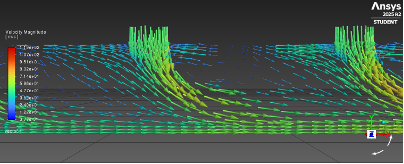
Manifolds are crucial components in various industries, particularly in oil and gas, agriculture, and energy distribution, where they function to combine fluid flow from multiple pathways into a single header pipe. Achieving uniform flow distribution is essential for maintaining system efficiency and reliability. However, non-uniform flow distribution frequently occurs due to differences in flow resistance, system geometry, and inter-stream interactions at each junction. To address the limitations of simplified analytical approaches such as the Bernoulli equation, which does not simultaneously accommodate viscosity, turbulence, and compressibility effects, a numerical approach based on Computational Fluid Dynamics was employed. This study aims to analyze the flow distribution characteristics, including velocity, pressure, and mass flow rate, in a seven inlet collector manifold, while comparing simulation results with the Bernoulli equation prediction and demonstrating consistency with the governing Navier–Stokes framework. Simulations were conducted in three dimensions using ANSYS Fluent with the SST k-ω turbulence model and the Peng–Robinson real gas model for methane at 136 bar and 70°C. Results revealed progressive flow maldistribution, with velocity increasing from 50 m/s at the inlets to 73.94 m/s at the outlet, accompanied by a total pressure drop of approximately 542 kPa. Density–velocity and density–total pressure correlations exhibited non-linear interdependencies consistent with the Navier–Stokes equations, confirming the significant roles of viscosity, turbulence, and compressibility effects within the system .Downloads
References
Abuyousseff, A.S. et al. (2026) ‘Investigation of Leaking Compressed Hydrogen in Piping Lines Using Peng-Robinson EOS.: Case Study’, Journal of Engineering Research, 9(4), pp. 1–10. Available at: https://doi.org/10.21608/jer.2026.458858.1027.
Adanta, D., Fattah, I.M.R. and Muhammad, N.M. (2020) ‘Comparison of Standard k-epsilon and SST k-omega Turbulence Model for Breastshot Waterwheel Simulation’, Journal of Mechanical Science and Engineering, 7(2), pp. 039–044. Available at: https://doi.org/10.36706/jmse.v7i2.44.
Adewumi, M. (2026) ‘Peng-Robinson EOS’. Pennsylvania, USA: The Pennsylvania State University. Available at: https://courses.ems.psu.edu/png520/m11_p2.html (Accessed: 15 May 2026).
Bridge, C. (2025) ‘Overview of Oil and Gas Production’. ResearchGate. Available at: https://doi.org/DOI:10.13140/RG.2.2.29285.31204.
Budiarso, B. et al. (2015) ‘Inverse-Turbulent Prandtl Number Effects on Reynolds Numbers of RNG k-ε Turbulence Model on Cylindrical-Curved Pipe’, Applied Mechanics and Materials, 758, pp. 35–44. Available at: https://doi.org/10.4028/www.scientific.net/AMM.758.35.
Buya, S.B. (2025) ‘Bridging the Bernoulli Equation and the Navier-Stokes Equation’. ResearchGate. Available at: https://doi.org/10.13140/RG.2.2.32966.59204.
Ganguli, A.A. and Pandit, A.B. (2022) ‘Computational Fluid Dynamics Simulations to Improve Performance Characteristics of a Manifold Having a Central Inlet and Outlet’, Frontiers in Energy Research, 10, pp. 1–20. Available at: https://doi.org/10.3389/fenrg.2022.1013540.
Garbai, L., Santa, R. and Bošnjaković, M. (2025) ‘Advanced Analytical Modeling of Polytropic Gas Flow in Pipelines: Unifying Flow Regimes for Efficient Energy Transport’, Technologies, 13(11), pp. 1–26. Available at: https://doi.org/10.3390/technologies13110482.
Herrero, R. et al. (2012) ‘About the Oscillatory Possibilities of the Dynamical Systems’, Physica D: Nonlinear Phenomena, 241(16), pp. 1358–1391. Available at: https://doi.org/10.1016/j.physd.2012.05.001.
Li, B. and Park, T.S. (2025) ‘Effects of Inlet and Outlet Layout on the Outflow Uniformity of Dividing Manifolds’, Journal of Propulsion and Energy, 5(1), pp. 33–47. Available at: https://doi.org/10.6108/JPNE.2025.5.1.033.
Li, H. et al. (2024) ‘A Coupled Modeling Framework for Investigating Flow Maldistribution in Cross-Flow-Corrugated Plate Heat Exchangers’, International Journal of Fluid Engineering, 1(3), p. 034301. Available at: https://doi.org/10.1063/5.0204274.
Luaibi, M. and Abdulwahid, M. (2022) ‘Numerical Analysis by Computational Fluid Dynamic Simulation of Fluid Flow in A T- Junction’, Proceedings of 2nd International Multi-Disciplinary Conference Theme: Integrated Sciences and Technologies. 2nd International Multi-Disciplinary Conference Theme: Integrated Sciences and Technologies (IMDC-IST 2021), Sakarya, Turkey: EAI. Available at: https://doi.org/http://dx.doi.org/10.4108/eai.7-9-2021.2314888.
Munson, B.R., Rothmayer, A.P. and Okiishi, T.H. (2012) Fundamentals of Fluid Mechanics. 7th edn. Wiley. [Print].
Nuryoto, N. et al. (2024) ‘Observasi Penurunan Tekanan (Pressure Drop) Pada Sistem Perpipaan: Pengaruh Panjang Dan Diameter Pipa, Elbow, Dan Tee’, Jurnal Rekayasa Mesin, 15(2), pp. 1023–1039. Available at: https://doi.org/10.21776/jrm.v15i2.1666.
Rachdi, Z. et al. (2025) ‘CFD Analysis of Heat Transfer Enhancement in Impinging Jet Array by Varying Number of Jets and Spacing’, Scientific Reports, 15(1), pp. 1–17. Available at: https://doi.org/10.1038/s41598-025-86360-w.
Singh, J., Gill, H.S. and Vasudev, H. (2023) ‘Computational Fluid Dynamics Analysis on Role of Particulate Shape and Size in Erosion of Pipe Bends’, International Journal on Interactive Design and Manufacturing (IJIDeM), 17(5), pp. 2631–2646. Available at: https://doi.org/10.1007/s12008-022-01094-7.
Sirignano, W.A. (2018) ‘Compressible Flow at High Pressure with Linear Equation of State’, Journal of Fluid Mechanics, 843, pp. 244–292. Available at: https://doi.org/10.1017/jfm.2018.166.
Sotoodeh, K. (2020) ‘Manifold Technology in the Offshore Industry’, American Journal of Marine Science, 8(1), pp. 14–19. Available at: https://doi.org/10.12691/marine-8-1-3.
Sparrow, E.M., Tong, J.C.K. and Abraham, J.P. (2006) ‘A Quasi-Analytical Method for Fluid Flow in a Multi-Inlet Collection Manifold’, Journal of Fluids Engineering, 129(5), pp. 579–586. Available at: https://doi.org/10.1115/1.2717620.
ToolBox, T.E. (2008) Methane (CH₄): Thermophysical Properties and Phase Diagram. Engineering ToolBox. Available at: https://www.engineeringtoolbox.com/methane-d_1420.html (Accessed: 14 May 2026).
Utama, D.W. et al. (2025) ‘A CFD Investigation of Piping System Design for a Tank Cleaning Machine’, Engineering, Technology & Applied Science Research, 15(6), pp. 29418–29427. Available at: https://doi.org/10.48084/etasr.13595.
Wang, M. et al. (2026) ‘Revisiting the Phase Diagram of Methane’, Physical Review Letters, 136(4), p. 046101. Available at: https://doi.org/10.1103/7hxd-hhjf.
Yazici, F. et al. (2024) ‘Examining the Uniformity of Flow Distribution in Manifolds’, Journal of Applied Fluid Mechanics, 17(5), pp. 989–1001. Available at: https://doi.org/10.47176/jafm.17.05.2302.
Zhang, M. et al. (2023) ‘Reducing the Flow Maldistribution in Heat Exchangers through a Novel Polymer Manifold: Numerical Evaluation’, Energies, 16(20), p. 7120. Available at: https://doi.org/10.3390/en16207120.
Zhou, J. et al. (2017) ‘CFD Simulation for Flow Distribution in Manifolds of Central-Type Compact Parallel Flow Heat Exchangers’, Applied Thermal Engineering, 126, pp. 670–677. Available at: https://doi.org/10.1016/j.applthermaleng.2017.07.194.
Downloads
Published
Issue
Section
License
Copyright (c) 2026 Jurnal Asiimetrik: Jurnal Ilmiah Rekayasa Dan Inovasi

This work is licensed under a Creative Commons Attribution-NonCommercial 4.0 International License.