Effect of Low Partial Vacuum on Evaporation and Condensation Performance in a Solar Still System
DOI:
https://doi.org/10.35814/asiimetrik.v8i2.10039Keywords:
vacuum, desalination, evaporation, condensation, stillAbstract
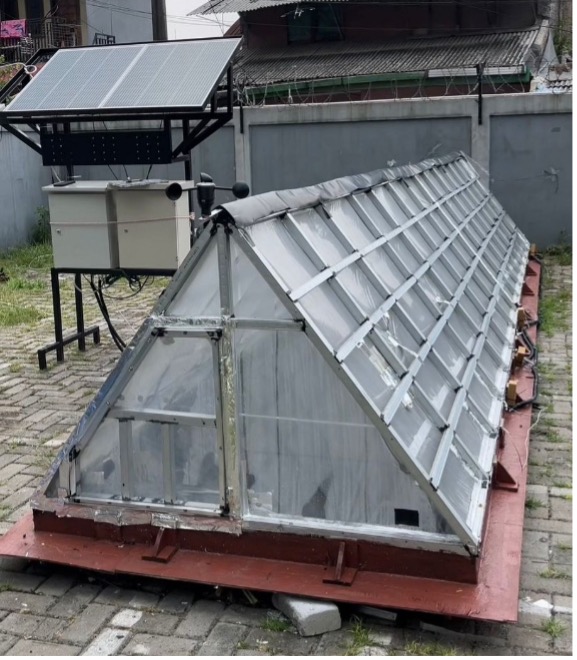
This study investigates the effect of low partial vacuum on the evaporation and condensation performance in a solar still system. The tests were conducted using three variations: non-vacuum (101325 Pa), vacuum 1 (101313 Pa), and vacuum 2 (101309 Pa) using an exhaust system. The observed parameters included water temperature, pressure, vapor pressure difference (ΔP), evaporation mass, and condensation yield. The results showed that low partial vacuum increased the vapor pressure difference, thereby enhancing the driving force for evaporation. The highest maximum ΔP value was obtained at vacuum 2, at 1278.48 Pa. However, water temperature had a more dominant influence on total evaporation, so the highest cumulative evaporation mass was obtained under non-vacuum conditions at 8750 g due to better thermal energy retention. Meanwhile, vacuum 1 produced the highest condensation yield of 7641 g, indicating a balance between vapor formation and vapor distribution within the system. These findings suggest that the optimization of a solar still based on low partial vacuum is determined not only by an increase in vapor pressure difference but also by the system’s ability to retain thermal energy and the effectiveness of the condensation process .Downloads
References
Agustina, D.N.U., Sudarti and Yushardi (2020) ‘Analisis Potensi Pengembangan Teknologi Desalinasi Air Laut Sebagai Penyedia Air Bersih di Desa Watukarung Kabupaten Pacitan’, Jurnal PHI : Jurnal Pendidikan Fisika dan Fisika Terapan, 6(2), pp. 7–14. Available at: https://doi.org/10.22373/p-jpft.v6i2.9531.
Alamsyach, R. et al. (2024) ‘Laju Penguapan Pada Forced Flow Solar Still’, Jurnal Mesin Nusantara, 7(2), pp. 255–268. Available at: https://doi.org/10.29407/jmn.v7i2.22887.
Al-Obaidi, M.A. et al. (2025) ‘A Review of Vacuum-Enhanced Solar Stills for Improved Desalination Performance’, Sustainability, 17(21), p. 9535. Available at: https://doi.org/10.3390/su17219535.
Ambarita, H. (2018) ‘Study of Evaporation Numerical in Seawater Desalination Evaporator using Natural Vacuum Systems’, Talenta Conference Series: Energy and Engineering (EE). Seminar Ilmiah Nasional Dies Natalis USU-64, Sumatera Utara, Indonesia: Talenta, pp. 095–103. Available at: https://doi.org/10.32734/ee.v1i1.117.
Andrés-Mañas, J.A. et al. (2020) ‘Application of Solar Energy to Seawater Desalination in a Pilot System Based on Vacuum Multi-Effect Membrane Distillation’, Applied Energy, 258, p. 114068. Available at: https://doi.org/10.1016/j.apenergy.2019.114068.
Ayoobi, A. and Ramezanizadeh, M. (2022) ‘A Detailed Review Investigating the Mathematical Modeling of Solar Stills’, Frontiers in Energy Research, 10, pp. 1–18. Available at: https://doi.org/10.3389/fenrg.2022.879591.
Curto, D., Franzitta, V. and Guercio, A. (2021) ‘A Review of the Water Desalination Technologies’, Applied Sciences, 11(2), pp. 1–36. Available at: https://doi.org/10.3390/app11020670.
Dina, S.F. et al. (2017) ‘Pengaruh Tekanan Vakum Pada Proses Desalinasi Air Laut Menggunakan Tenaga Surya Tipe Kolektor Tabung Vakum’, Jurnal Teknik dan Teknologi, 12(24), pp. 16–20.
Dwibowo, D.A. et al. (2025) ‘Effect of Water Pressure and Temperature on The Perform-Ance of a Desalination Reactor’, Jurnal Polimesin, 23(6), pp. 837–846. Available at: https://doi.org/10.30811/jpl.v23i6.7867.
Elazab, M.A., Elshaarawy, M.K. and Dahab, H.A. (2026) ‘Optimization of Aspect Ratio for Enhanced Thermal and Exergy Efficiency in Conical Solar Distillers: A Thermodynamic And AI-Driven Study for Sustainable Freshwater Production’, Journal of Thermal Analysis and Calorimetry, 151(7), pp. 6079–6101. Available at: https://doi.org/10.1007/s10973-026-15372-z.
Feria-Díaz, J.J. et al. (2022) ‘Performance Evaluation of Solar Still in Veracruz, Mexico Gulf Coastline’, Water, 14(10), pp. 1–20. Available at: https://doi.org/10.3390/w14101567.
Gaur, M.K. et al. (2021) ‘Heat Transfer Analysis of Hybrid Active Solar Still with Water Flowing Over Glass Cover’, Journal of Thermal Engineering, 7(6), pp. 1329–1343. Available at: https://doi.org/10.18186/thermal.989993.
Gkountas, A. et al. (2022) ‘Modelling and Parametric Analysis of a Brine Treatment Unit Using a High-Temperature Heat Pump and a Vacuum Evaporator’, Applied Sciences, 12(9), p. 4542. Available at: https://doi.org/10.3390/app12094542.
Haji, A.T.S., Wirosoedarmo, R. and Tyas, M.W. (2018) ‘Analisis Nomografi Suhu, Laju Penguapan dan Tekanan Udara untuk Perancangan Alat Desalinasi Tenaga Surya Dengan Pengaturan Vakum’, Jurnal Sumberdaya Alam dan Lingkungan, 4(2), pp. 1–6. Available at: https://doi.org/10.21776/ub.jsal.2017.004.02.1.
Ismail, N.R. et al. (2023) ‘Pemanfaatan Dinding Sebagai Permukaan Kondensasi Untuk Meningkatkan Kinerja Solar Still Double Slope’, TURBO: Jurnal Program Studi Teknik Mesin, 12(1). Available at: https://doi.org/10.24127/trb.v12i1.2439.
Lubis, A.M. and Munawar, M. (2019) ‘Desalinasi Air Payau Dengan Teknik Evaporasi Surya dan Biomassa’, Prosiding Seminar Nasional Politeknik Negeri Lhokseumawe. Proceeding Seminar Nasional Politeknik Negeri Lhokseumawe, Lhokseumawe, Indonesia: Politeknik Negeri Lhokseumawe, pp. A117–A120. Available at: https://e-jurnal.pnl.ac.id/semnaspnl/article/view/1674.
Mugisidi, D. et al. (2021) ‘Determination of The Convective Heat Transfer Constant (C and N) in a Solar Still’, Jurnal Teknosains, 11(1), pp. 1–12. Available at: https://doi.org/10.22146/teknosains.50908.
Mugisidi, D. et al. (2023) ‘Solar Still with an Integrated Conical Condenser’, CFD letters, 15(8), pp. 122–134. Available at: https://doi.org/10.37934/cfdl.15.8.122134.
Munawar, M. et al. (2022) ‘Produksi Kondensat pada Sistem Desalinasi Air Asin Berbasis Energi Surya’, Prosiding Seminar Nasional Politeknik Negeri Lhokseumawe, 6(1), pp. 44–48.
Oktavian, A. et al. (2024) ‘Convective Coefficient and Evaporative in Forced Flow Solar Still’, Jurnal Asiimetrik: Jurnal Ilmiah Rekayasa Dan Inovasi, 6(2), pp. 351–360. Available at: https://doi.org/10.35814/asiimetrik.v6i2.6937.
Pratama, A.C.P., Mugisidi, D. and Heriyani, O. (2026) ‘Seawater Evaporation Using Natural Flow Solar Still’, TEKNOSAINS : Jurnal Sains, Teknologi dan Informatika, 13(1), pp. 137–143. Available at: https://doi.org/10.37373/tekno.v13i1.1664.
Sachidananda, H.K. et al. (2025) ‘Impact of Rotating Fan and Ultrasonic Humidifier on The Thermal Performance of Pyramidal Solar Still’, Scientific Reports, 15(1), p. 38021. Available at: https://doi.org/10.1038/s41598-025-21863-0.
Sayuti, A.T. et al. (2023) ‘The Influence of Water Temperature on Seawater Evaporation in the Desalination Process’, SINTEK JURNAL: Jurnal Ilmiah Teknik Mesin, 17(2), pp. 113–119. Available at: https://doi.org/10.24853/sintek.17.2.113-119.
Shareef, A.S., Kurji, H.J. and Hamzah, A.H. (2024) ‘Modifying Performance of Solar Still, By Using Slices Absorber Plate and New Design of Glass Cover, Experimental and Numerical Study’, Heliyon, 10(1), pp. 1–18. Available at: https://doi.org/10.1016/j.heliyon.2024.e24021.
Susanto, S. et al. (2024) ‘Pengaruh Perubahan Vakum dan Temperatur Pemanas Fresh Water Generator terhadap Produksi Air Tawar di MT. PM REGENT’, Saintara: Jurnal Ilmiah Ilmu-Ilmu Maritim, 8(2), pp. 97–103. Available at: https://doi.org/10.52475/saintara.v8i2.343.
Tanusekar, H.H. and Sutanhaji, A.T. (2014) ‘Rancang Bangun dan Uji Kinerja Alat Desalinasi Sistem Penyulingan menggunakan Panas Matahari dengan Pengaturan Tekanan Udara’, Jurnal Keteknikan Pertanian Tropis dan Biosistem, 2(1), pp. 1–8. Available at: https://jkptb.ub.ac.id/index.php/jkptb/article/view/163.
Tarif, A. et al. (2025) ‘Solar Desalination: Current Technological Status and Future Directions’, Advances in Industrial and Engineering Chemistry, 1(1), pp. 1–17. Available at: https://doi.org/10.1007/s44405-025-00027-8.
Wirangga, R. et al. (2023) ‘The Impact of Wind Speed on the Rate of Water Evaporation in a Desalination Chamber’, Journal of Advanced Research in Fluid Mechanics and Thermal Sciences, 106(1), pp. 39–50. Available at: https://doi.org/10.37934/arfmts.106.1.3950.
Yan, T. et al. (2021) ‘Experimental Study on Three-Effect Tubular Solar Still Under Vacuum and Immersion Cooling’, Desalination, 515, p. 115211. Available at: https://doi.org/10.1016/j.desal.2021.115211.
Yusuf, A.M. et al. (2023) ‘Effect of Vacuum on Evaporation of Seawater: Pengaruh Vakum Pada Penguapan Air Laut’, R.E.M. (Rekayasa Energi Manufaktur) Jurnal, 8(2), pp. 55–62. Available at: https://doi.org/10.21070/r.e.m.v8i2.1672.
Downloads
Published
Issue
Section
License
Copyright (c) 2026 Jurnal Asiimetrik: Jurnal Ilmiah Rekayasa Dan Inovasi

This work is licensed under a Creative Commons Attribution-NonCommercial 4.0 International License.