Investigation of Bluff Body Shape Variation on Enhancing Heat Transfer Performance of Backward-Facing Step Flow
DOI:
https://doi.org/10.35814/asiimetrik.v8i2.10260Keywords:
backward-facing, cube, cylinder, diamond, heat-transferAbstract
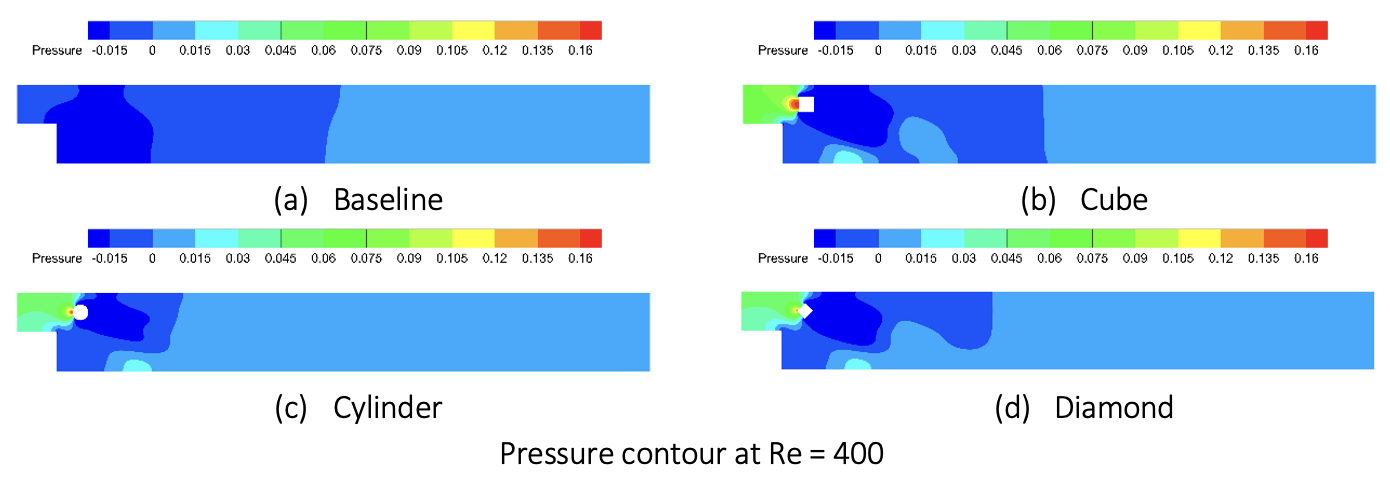
The control of flow separation phenomenon is a challenge that has attracted much attention from researchers in the context of heat and mass transfer. This phenomenon negatively affects heat transfer performance in thermal management applications. Flow control devices play a crucial role in minimizing the effects of flow separation. One of the fundamental geometries that supports understanding in flow separation control is the backward-facing step. Therefore, this study aims to investigate the utilization of bluff body shape variations, including cube, cylinder, and diamond shapes, as passive flow control devices on heat transfer performance in backward-facing step flow. The present study used a Computational Fluid Dynamics solver, followed by a variation of the Reynolds number, 50 ≤ Re ≤ 400. Computational results show that the bluff body significantly reduces the primary recirculation zone and compresses the thermal boundary layer, strengthening the temperature gradient and improving the heat transfer rate. The cube variation demonstrates the optimal thermal performance, exhibiting an augmentation in the average Nusselt number of up to 28.15% at Re = 400, resulting the highest overall Performance Evaluation Criterion.Downloads
References
Armaly, B.F. et al. (1983) ‘Experimental And Theoretical Investigation Of Backward-Facing Step Flow’, Journal of Fluid Mechanics, 127, pp. 473–496. Available at: https://doi.org/10.1017/S0022112083002839.
Bayraktar, S. (2020) ‘Laminar Flow Over Sloped Downstream Heated Bottom Wall Behind A Backward-Facing Step’, Sigma Journal of Engineering and Natural Sciences, 38(3), pp. 1555–1566.
Chen, L. et al. (2018) ‘A Review Of Backward-Facing Step (BFS) Flow Mechanisms, Heat Transfer And Control’, Thermal Science and Engineering Progress, 6, pp. 194–216. Available at: https://doi.org/10.1016/j.tsep.2018.04.004.
Coskun, U.C., Cadirci, S. and Gunes, H. (2020) ‘Numerical Investigation of Active Flow Control on Laminar Forced Convection over a Backward Facing Step Surrounded by Multiple Jets’, Journal of Applied Fluid Mechanics, 14(2), pp. 447–458. Available at: https://doi.org/10.47176/jafm.14.02.31680.
Hilo, A.K. et al. (2020) ‘Effect Of Corrugated Wall Combined With Backward-Facing Step Channel On Fluid Flow And Heat Transfer’, Energy, 190, p. 116294. Available at: https://doi.org/10.1016/j.energy.2019.116294.
Hu, R., Wang, L. and Fu, S. (2015) ‘Review Of Backward-Facing Step Flow And Separation Reduction’, Scientia Sinica Physica Mechanica & Astronomica, 45(12), p. 124704. Available at: https://doi.org/10.1360/SSPMA2015-00450.
Issakhov, Alibek et al. (2021) ‘Mixed Convection In A Channel With Buoyancy Force Over Backward And Forward Facing Steps: The Effects Of Inclination And Geometry’, Case Studies in Thermal Engineering, 26, p. 101152. Available at: https://doi.org/10.1016/j.csite.2021.101152.
Julian, J. et al. (2024) ‘Passive Flow Control Effect Using Micro-Cylinder On Airfoil NACA 4415’, AIP Conference Proceedings, 3090(1), p. 040005. Available at: https://doi.org/10.1063/5.0231137.
Julian, J., Anggara, R.A. and Wahyuni, F. (2023) ‘The Influence of Fillet Step on Backward-Facing Step Flow Characteristics’, Infotekmesin, 14(2), pp. 318–326. Available at: https://doi.org/10.35970/infotekmesin.v14i2.1919.
Julian, J., Anggara, R.A. and Wahyuni, F. (2024) ‘Numerical Study On Characteristics Of The Backward-Facing Step Flow With Variations Of The Slope Angle Of The Step’, Jurnal Polimesin, 22(1), pp. 6–14. Available at: https://doi.org/10.30811/jpl.v22i1.4052.
Kumar, A. and Dhiman, A.K. (2012) ‘Effect Of A Circular Cylinder On Separated Forced Convection At A Backward-Facing Step’, International Journal of Thermal Sciences, 52, pp. 176–185. Available at: https://doi.org/10.1016/j.ijthermalsci.2011.09.014.
McQueen, T. et al. (2022) ‘Active Control Of Flow Over A Backward-Facing Step At High Reynolds Numbers’, International Journal of Heat and Fluid Flow, 93, p. 108891. Available at: https://doi.org/10.1016/j.ijheatfluidflow.2021.108891.
Roache, P.J. (1994) ‘Perspective: A Method for Uniform Reporting of Grid Refinement Studies’, Journal of Fluids Engineering, 116(3), pp. 405–413. Available at: https://doi.org/10.1115/1.2910291.
Selimefendigil, F. and Öztop, H.F. (2015) ‘Numerical Investigation And Reduced Order Model Of Mixed Convection At A Backward Facing Step With A Rotating Cylinder Subjected To Nanofluid’, Computers & Fluids, 109, pp. 27–37. Available at: https://doi.org/10.1016/j.compfluid.2014.12.007.
Selimefendigil, F. and Öztop, H.F. (2016) ‘Numerical Study of Forced Convection of Nanofluid Flow Over a Backward Facing Step With a Corrugated Bottom Wall in the Presence of Different Shaped Obstacles’, Heat Transfer Engineering, 37(15), pp. 1280–1292. Available at: https://doi.org/10.1080/01457632.2015.1119617.
Velazquez, A., Arias, J.R. and Mendez, B. (2008) ‘Laminar Heat Transfer Enhancement Downstream Of A Backward Facing Step By Using A Pulsating Flow’, International Journal of Heat and Mass Transfer, 51(7), pp. 2075–2089. Available at: https://doi.org/10.1016/j.ijheatmasstransfer.2007.06.009.
Downloads
Published
Issue
Section
License
Copyright (c) 2026 Jurnal Asiimetrik: Jurnal Ilmiah Rekayasa Dan Inovasi

This work is licensed under a Creative Commons Attribution-NonCommercial 4.0 International License.