Evaluating the Role of Personality in Task Performance Across Varying Mental Workload Levels
DOI:
https://doi.org/10.35814/asiimetrik.v8i1.8651Keywords:
EPI, response, time, n-back, taskAbstract
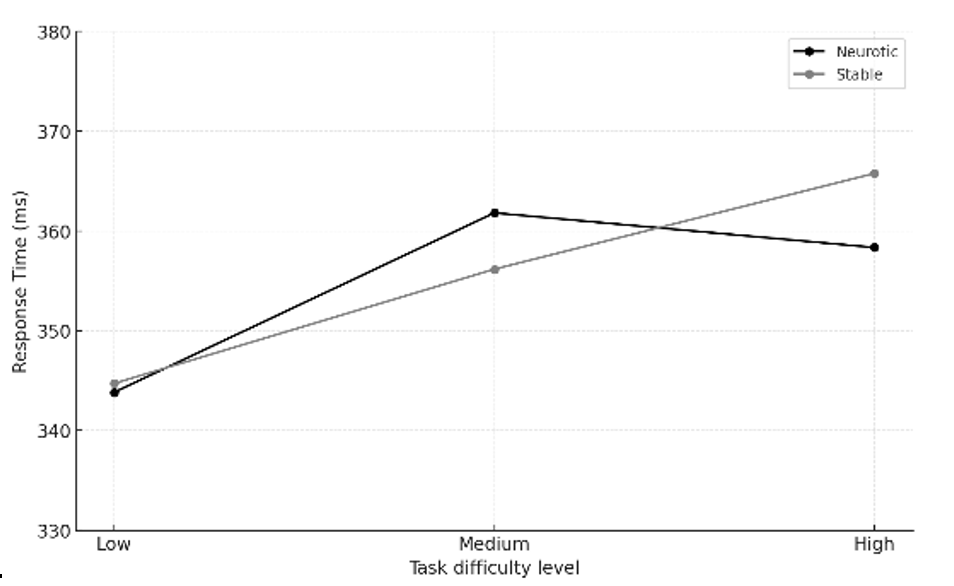
Variations in task performance under different cognitive demands are often interpreted as indicating mental workload. Prior research has identified a link between personality and task performance. This study investigates whether personality traits influence performance under varying levels of mental workload in working memory tasks. Personality traits were assessed using the Eysenck Personality Inventory. Participants completed n-back tasks at three levels of difficulty to induce different levels of mental workload. The findings reveal significant differences in response times between extroverts and introverts across all task difficulties (p < 0.05), with introverts responding more quickly. A significant difference between neurotic and stable individuals emerged only at the medium difficulty level (p < 0.05), with stable individuals performing faster. Additionally, response times varied significantly across personality quadrants, with introvert-neurotic individuals showing faster responses at both low and high difficulty levels.Downloads
References
Ali, U., Ali, A. and Ahmed, F. (2024) ‘Big Five Personality Traits and Life Satisfaction related Gender Differences in the Context of Ice Hockey Team Sports’, Pakistan Social Sciences Review, 8(2), pp. 215–225. Available at: https://doi.org/10.35484/pssr.2024(8-II-S)18.
Alimohammadi, I., Sandrock, S. and Gohari, M.R. (2013) ‘The effects of low frequency noise on mental performance and annoyance’, Environmental Monitoring and Assessment, 185(8), pp. 7043–7051. Available at: https://doi.org/10.1007/s10661-013-3084-8.
Ashton, M.C. (2013) ‘Personality Traits and the Inventories that Measure Them’, in Individual Differences and Personality. 2nd edn. Academic Press, pp. 27–55. Available at: https://doi.org/10.1016/B978-0-12-416009-5.00002-5.
Beauducel, A., Brocke, B. and Leue, A. (2006) ‘Energetical bases of extraversion: Effort, arousal, EEG, and performance’, International Journal of Psychophysiology, 62(2), pp. 212–223. Available at: https://doi.org/10.1016/j.ijpsycho.2005.12.001.
Biernacki, M.P. and Lewkowicz, R. (2020) ‘Evidence for the role of personality in the cognitive performance of older male drivers’, Transportation Research Part F: Traffic Psychology and Behaviour, 69, pp. 385–400. Available at: https://doi.org/10.1016/j.trf.2020.02.005.
Bjarnadóttir, E.K. and Óskarsdóttir, H. (2022) Extraversion and cognitive performance on working memory tasks : does speed matter? Thesis. University of Akureyri. Available at: https://skemman.is/handle/1946/41959 (Accessed: 10 February 2026).
Chamorro-Premuzic, T. (2015) Personality and Individual Differences. John Wiley & Sons, Incorporated. [Print].
Cowell, M.D. and Entwistle, N.J. (1971) ‘The Relationships Between Personality, Study Attitudes and Academic Performance in a Technical College’, British Journal of Educational Psychology, 41(1), pp. 85–90. Available at: https://doi.org/10.1111/j.2044-8279.1971.tb00661.x.
Cox-Fuenzalida, L.-E. et al. (2006) ‘Extraversion and task performance: A fresh look through the workload history lens’, Journal of Research in Personality, 40(4), pp. 432–439. Available at: https://doi.org/10.1016/j.jrp.2005.02.003.
Cox-Fuenzalida, L.-E., Swickert, R. and Hittner, J.B. (2004) ‘Effects of neuroticism and workload history on performance’, Personality and Individual Differences, 36(2), pp. 447–456. Available at: https://doi.org/10.1016/S0191-8869(03)00108-9.
Crofton, A., Ferraro, J.C. and Mouloua, M. (2023) ‘Individual differences in personality factors as predictors of performance and situation awareness in Stealth Adapt simulated search and rescue missions’, Proceedings of the Human Factors and Ergonomics Society Annual Meeting, 67(1), pp. 2281–2284. Available at: https://doi.org/10.1177/21695067231192517.
Damos, D.L. and Bloem, K.A. (1985) ‘Type A behavior pattern, multiple-task performance, and subjective estimation of mental workload’, Bulletin of the Psychonomic Society, 23(1), pp. 53–56. Available at: https://doi.org/10.3758/BF03329777.
Doucet, C. and Stelmack, R.M. (1997) ‘Movement time differentiates extraverts from introverts’, Personality and Individual Differences, 23(5), pp. 775–786. Available at: https://doi.org/10.1016/S0191-8869(97)00104-9.
Eysenck, H.J. (1977) Manual of the Eysenck Personality Inventory. Hodder & Stoughton. [Print].
Feist, J., Feist, G.J. and Roberts, T.-A. (2017) Theories of Personality. McGraw-Hill Education. [Print].
Fujii, T. and Kida, M. (1999) ‘Type A behavior and cognitive processings reflected in event-related brain potentials to concurrent tasks’, The Japanese journal of psychology, 70(4), pp. 293–300. Available at: https://doi.org/10.4992/jjpsy.70.293.
Gabrys, J.B. (1982) ‘Validity and Reliability of the Eysenck Personality Inventory with Outpatients’, Psychological Reports, 51(2), pp. 541–542. Available at: https://doi.org/10.2466/pr0.1982.51.2.541.
Gao, Q. et al. (2013) ‘Mental workload measurement for emergency operating procedures in digital nuclear power plants’, Ergonomics, 56(7), pp. 1070–1085. Available at: https://doi.org/10.1080/00140139.2013.790483.
Golmohammadi, R. et al. (2021) ‘Role of individual and personality traits in occupational noise-induced psychological effects’, Applied Acoustics, 173, p. 107699. Available at: https://doi.org/10.1016/j.apacoust.2020.107699.
Grassmann, M. et al. (2017) ‘Individual differences in cardiorespiratory measures of mental workload: An investigation of negative affectivity and cognitive avoidant coping in pilot candidates’, Applied Ergonomics, 59, pp. 274–282. Available at: https://doi.org/10.1016/j.apergo.2016.09.006.
Gray, J.E. and McLean, P.D. (1973) ‘Performance on an Intelligence Test as a Function of Personality’, British Journal of Social and Clinical Psychology, 12(1), pp. 46–49. Available at: https://doi.org/10.1111/j.2044-8260.1973.tb00844.x.
Hall, C.S. and Lindzey, G. (1978) Theories of Personality. United Kingdom: Wiley. [Print].
Hung, W.-T. (2020) ‘Revisiting relationships between personality and job performance: working hard and working smart’, Total Quality Management & Business Excellence, 31(7–8), pp. 907–927. Available at: https://doi.org/10.1080/14783363.2018.1458608.
Kane, M.J. et al. (2007) ‘Working memory, attention control, and the n-back task: A question of construct validity’, Journal of Experimental Psychology: Learning, Memory, and Cognition, 33(3), pp. 615–622. Available at: https://doi.org/10.1037/0278-7393.33.3.615.
LeMonda, B.C. et al. (2015) ‘The Association between High Neuroticism-Low Extraversion and Dual-Task Performance during Walking While Talking in Non-demented Older Adults’, Journal of the International Neuropsychological Society, 21(7), pp. 519–530. Available at: https://doi.org/10.1017/S1355617715000570.
Mehri, A. et al. (2018) ‘Effect of traffic noise on mental performance with regard to introversion and task complexity’, Applied Acoustics, 132, pp. 118–123. Available at: https://doi.org/10.1016/j.apacoust.2017.11.019.
Newton, T. et al. (1992) ‘Personality and performance on a simple visual search task’, Personality and Individual Differences, 13(3), pp. 381–382. Available at: https://doi.org/10.1016/0191-8869(92)90119-A.
Owen, A.M. et al. (2005) ‘N‐back working memory paradigm: A meta‐analysis of normative functional neuroimaging studies’, Human Brain Mapping, 25(1). Available at: https://doi.org/10.1002/hbm.20131.
Reynolds, J., McClelland, A. and Furnham, A. (2014) ‘An investigation of cognitive test performance across conditions of silence, background noise and music as a function of neuroticism’, Anxiety, Stress, & Coping, 27(4), pp. 410–421. Available at: https://doi.org/10.1080/10615806.2013.864388.
Riana, F.D., Toiba, H. and Rahman, M.S. (2024) ‘Are There Variations in Personality Traits Between Men and Women? The Evidence is from Indonesian Residents’, HABITAT, 35(1), pp. 106–113. Available at: https://doi.org/10.21776/ub.habitat.2024.035.1.10.
Rothstein, M.G. and Goffin, R.D. (2006) ‘The use of personality measures in personnel selection: What does current research support?’, Human Resource Management Review, 16(2), pp. 155–180. Available at: https://doi.org/10.1016/j.hrmr.2006.03.004.
Rubio-Valdehita, S. et al. (2024) ‘Burnout among Retail Workers in Spain: The Role of Gender, Personality and Psychosocial Risk Factors’, Social Sciences, 13(5), p. 264. Available at: https://doi.org/10.3390/socsci13050264.
Rusnock, C.F. and Borghetti, B.J. (2018) ‘Workload profiles: A continuous measure of mental workload’, International Journal of Industrial Ergonomics, 63, pp. 49–64. Available at: https://doi.org/10.1016/j.ergon.2016.09.003.
Schmitt, D.P. et al. (2008) ‘Why can’t a man be more like a woman? Sex differences in Big Five personality traits across 55 cultures’, Journal of Personality and Social Psychology, 94(1), pp. 168–182. Available at: https://doi.org/10.1037/0022-3514.94.1.168.
Simpson, R. (2018) Young Adult Development Project, Worklife. Harvard-MIT Division of Health Sciences & Technology. Available at: https://hr.mit.edu/static/worklife/youngadult/changes.html (Accessed: 10 February 2025).
Smillie, L.D. et al. (2006) ‘Benefits of all work and no play: The relationship between neuroticism and performance as a function of resource allocation’, Journal of Applied Psychology, 91(1), pp. 139–155. Available at: https://doi.org/10.1037/0021-9010.91.1.139.
Thackray, R.I., Jones, K.N. and Touchstone, R.M. (1974) ‘Personality and Physiological Correlates of Performance Decrement on a Monotonous Task Requiring Sustained Attention’, British Journal of Psychology, 65(3), pp. 351–358. Available at: https://doi.org/10.1111/j.2044-8295.1974.tb01409.x.
Weisberg, Y.J., DeYoung, C.G. and Hirsh, J.B. (2011) ‘Gender Differences in Personality across the Ten Aspects of the Big Five’, Frontiers in Psychology, 2. Available at: https://doi.org/10.3389/fpsyg.2011.00178.
Wiediartini, Ciptomulyono, U. and Dewi, R.S. (2024) ‘Evaluation of physiological responses to mental workload in n-back and arithmetic tasks’, Ergonomics, 67(8), pp. 1121–1133. Available at: https://doi.org/10.1080/00140139.2023.2284677.
Youssef, M.H. and Sayour, N. (2025) ‘Exploring Gendered Perspectives on Personality Traits and Entrepreneurial Performance in Lebanon during the COVID-19 Crisis’, Gender Issues, 42(1), p. 8. Available at: https://doi.org/10.1007/s12147-025-09350-2.
Downloads
Published
Issue
Section
License
Copyright (c) 2026 Jurnal Asiimetrik: Jurnal Ilmiah Rekayasa & Inovasi

This work is licensed under a Creative Commons Attribution-NonCommercial 4.0 International License.