The Influence of Bluff Body Shape Variations on Aerodynamic Characteristics in Flow Around a Cylinder
DOI:
https://doi.org/10.35814/asiimetrik.v8i1.9429.2Keywords:
bluffAbstract
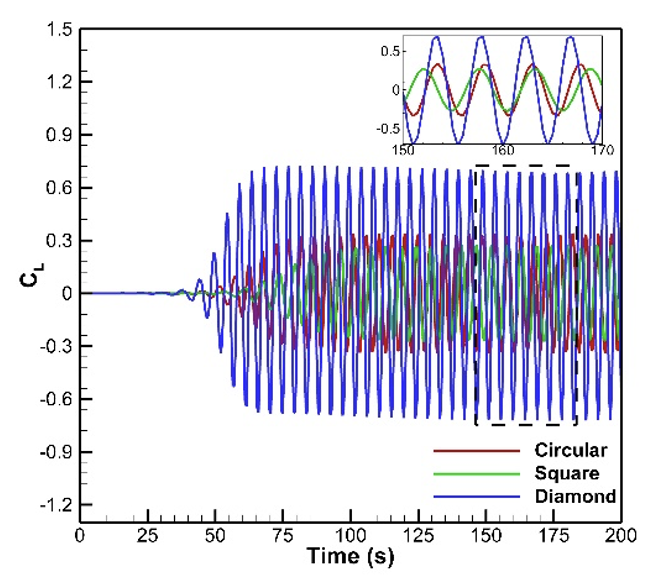
Fluid flow around an object plays an important role in various fields, including aerodynamics, building design, and transportation. This study examines the effect of three two-dimensional bluff body shapes, including Circular, Square, and Diamond, on the flow pattern, drag and lift coefficients, and vortex shedding characteristics. The methodology used is Computational Fluid Dynamics (CFD) simulation for incompressible flow with a Reynolds number of 100. The results show that variations in geometric shapes significantly affect the shape formation, flow stability, and aerodynamic force response. The three bluff body variations were found to produce fluctuating aerodynamic characteristics due to the influence of the von Kármán vortex phenomenon. In the diamond cylinder variation, it was found to be the configuration with the widest shape, having the highest average drag coefficient value of 1.84, and exhibiting the most significant force amplification, with an average lift coefficient value of 0.36 and a Strouhal number (St) of 0.18. Overall, variations in bluff body shapes significantly affect the flow pattern, Vortex Shedding frequency, and the total aerodynamic force acting on the objectDownloads
References
Alam, M.M. (2021) ‘Effects of Mass and Damping on Flow-Induced Vibration of a Cylinder Interacting with the Wake of Another Cylinder at High Reduced Velocities’, Energies, 14(16), p. 5148. Available at: https://doi.org/10.3390/en14165148.
Al-Haboobi, A., Al-Juaifri, G.A. and Al-Muslimawi, A.H. (2024) ‘Numerical study of Newtonian laminar Flow around circular and square cylinders’, Results in Control and Optimization, 14, p. 100328. Available at: https://doi.org/10.1016/j.rico.2023.100328.
Anderson, J.D. (2017) Fundamentals of Aerodynamics. United Kingdom: McGraw-Hill Education. [Print].
Braza, M., Chassaing, P. and Minh, H.H. (1986) ‘Numerical study and physical analysis of the pressure and velocity fields in the near wake of a circular cylinder’, Journal of Fluid Mechanics, 165, pp. 79–130. Available at: https://doi.org/10.1017/S0022112086003014.
Cao, Y. and Tamura, T. (2016) ‘Large-eddy simulations of flow past a square cylinder using structured and unstructured grids’, Computers & Fluids, 137, pp. 36–54. Available at: https://doi.org/10.1016/j.compfluid.2016.07.013.
Ding, H. et al. (2007) ‘Numerical simulation of flows around two circular cylinders by mesh-free least square-based finite difference methods’, International Journal for Numerical Methods in Fluids, 53(2), pp. 305–332. Available at: https://doi.org/10.1002/fld.1281.
Harichandan, A.B. and Roy, A. (2010) ‘Numerical investigation of low Reynolds number flow past two and three circular cylinders using unstructured grid CFR scheme’, International Journal of Heat and Fluid Flow, 31(2), pp. 154–171. Available at: https://doi.org/10.1016/j.ijheatfluidflow.2010.01.007.
Hishikar, P. et al. (2022) ‘Analysis of flow characteristics of two circular cylinders in cross-flow with varying Reynolds number: a review’, Journal of Thermal Analysis and Calorimetry, 147(10), pp. 5549–5574. Available at: https://doi.org/10.1007/s10973-021-10933-w.
Jiang, H. (2021) ‘Three-dimensional wake transition of a diamond-shaped cylinder’, Journal of Fluid Mechanics, 918, p. A35. Available at: https://doi.org/10.1017/jfm.2021.354.
Lekkala, M.R. et al. (2022) ‘Recent advances in understanding the flow over bluff bodies with different geometries at moderate Reynolds numbers’, Ocean Engineering, 261, p. 111611. Available at: https://doi.org/10.1016/j.oceaneng.2022.111611.
Liu, Z. and Kopp, G.A. (2011) ‘High-resolution vortex particle simulations of flows around rectangular cylinders’, Computers & Fluids, 40(1), pp. 2–11. Available at: https://doi.org/10.1016/j.compfluid.2010.07.011.
Mathupriya, P. et al. (2018) ‘Numerical Study of Flow Characteristics Around Confined Cylinder using OpenFOAM’, International Journal of Engineering and Technology, 7(4.35), pp. 617–623. Available at: https://doi.org/10.14419/ijet.v7i4.35.22925.
Mehdipour, I. et al. (2022) ‘Comprehensive experimental study on bluff body shapes for vortex-induced vibration piezoelectric energy harvesting mechanisms’, Energy Conversion and Management: X, 13, p. 100174. Available at: https://doi.org/10.1016/j.ecmx.2021.100174.
Norberg, C. (2003) ‘Fluctuating lift on a circular cylinder: review and new measurements’, Journal of Fluids and Structures, 17(1), pp. 57–96. Available at: https://doi.org/10.1016/S0889-9746(02)00099-3.
Onel, H.C. et al. (2025) ‘Wake flow characteristics of diamond-shaped cylinder with splitter plate’, Ocean Engineering, 326, p. 120933. Available at: https://doi.org/10.1016/j.oceaneng.2025.120933.
Roache, P.J. (1994) ‘Perspective: A Method for Uniform Reporting of Grid Refinement Studies’, Journal of Fluids Engineering, 116(3), pp. 405–413. Available at: https://doi.org/10.1115/1.2910291.
Singh, I.S. et al. (2025) ‘Assessment of Existing OpenFOAM Solvers for Incompressible Flow over a 2D Prism’, CFD Letters, 17(10), pp. 184–197. Available at: https://doi.org/10.37934/cfdl.17.10.184197.
Singh, R. et al. (2025) ‘Computational fluid dynamics of flow over a cylindrical tube for steady and transient flow conditions’, International Journal on Interactive Design and Manufacturing (IJIDeM), 19(4), pp. 2925–2935. Available at: https://doi.org/10.1007/s12008-024-01970-4.
Soyler, M. et al. (2022) ‘Experimental and numerical investigation of flow structure of grooved cylinder’, Ocean Engineering, 264, p. 112478. Available at: https://doi.org/10.1016/j.oceaneng.2022.112478.
Versteeg, H.K. and Malalasekera, W. (2011) An Introduction to Computational Fluid Dynamics: The Finite Volume Method. United Kingdom: Pearson Education, Limited. [Print].
Wang, J., Fan, D. and Lin, K. (2020) ‘A review on flow-induced vibration of offshore circular cylinders’, Journal of Hydrodynamics, 32(3), pp. 415–440. Available at: https://doi.org/10.1007/s42241-020-0032-2.
Yadav, P.K. et al. (2021) ‘Flow around a diamond-section cylinder at low Reynolds numbers’, Physics of Fluids, 33(5), p. 053611. Available at: https://doi.org/10.1063/5.0049811.
Downloads
Published
Issue
Section
License
Copyright (c) 2026 Jurnal Asiimetrik: Jurnal Ilmiah Rekayasa Dan Inovasi

This work is licensed under a Creative Commons Attribution-NonCommercial 4.0 International License.