Solar Energy Integration for Liquid Palm Sugar Processing in Rural Home-Industry
DOI:
https://doi.org/10.35814/asiimetrik.v8i1.9450.2Keywords:
palm, sugar, photovoltaic, LiFePO₄, home-industryAbstract
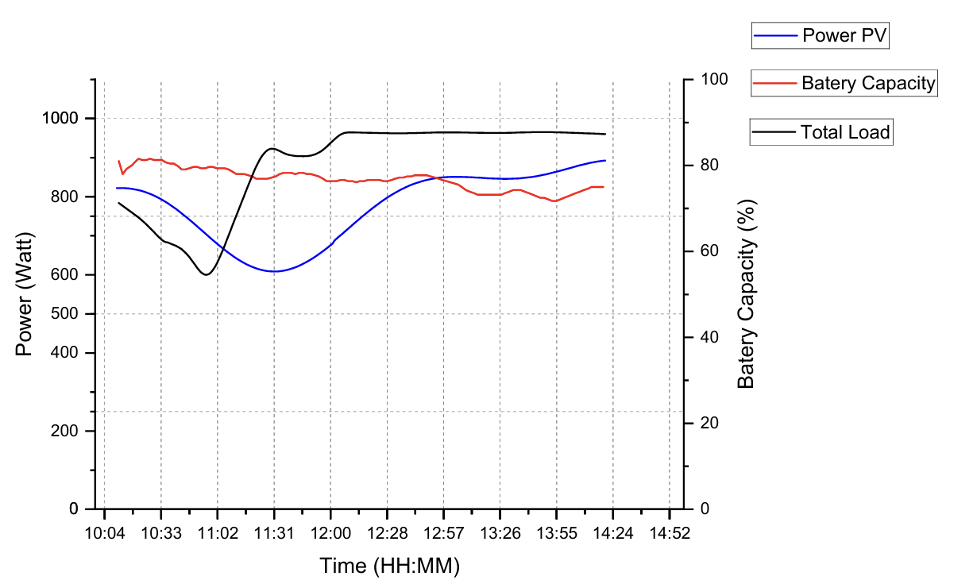
This study explicitly aims to evaluate the technical performance and feasibility of a photovoltaic (PV)–battery system in supplying the energy requirements of a liquid palm sugar production machine for rural home-industry applications. Electricity instability in rural areas often disrupts production activities, and although previous studies have demonstrated the potential of solar energy, real-world evaluations for palm sugar processing remain limited. In this research, two 565 Wp solar modules integrated with a 2.2 kW inverter and a LiFePO₄ battery were experimentally tested under actual operating conditions. Real-time data of PV output, irradiance, load demand, and battery condition were recorded. The results show that the PV system consistently supplied 950–1050 W under clear skies and 600–800 W during cloudy conditions, while the battery maintained a stable state of charge (SoC) of 71–85%, ensuring uninterrupted operation. Daily PV energy generation (4.2–4.6 kWh) exceeded load consumption (3.2–3.6 kWh), confirming a positive energy balance. Overall, the system demonstrated stable and reliable performance, indicating that PV–battery integration is feasible for rural MSME-scale liquid palm sugar production.Downloads
References
Asbanu, H. et al. (2025) ‘Application of Solar Energy for Coconut Grating Machine in Rural Areas’, Jurnal Teknik Pertanian Lampung (Journal of Agricultural Engineering), 14(5), pp. 1767–1777. Available at: https://doi.org/10.23960/jtepl.v14i5.1767-1777.
Bhattacharyya, S.C. (2012) ‘Review of alternative methodologies for analysing off-grid electricity supply’, Renewable and Sustainable Energy Reviews, 16(1), pp. 677–694. Available at: https://doi.org/10.1016/j.rser.2011.08.033.
Campen, B. van, Guidin, D. and Best, G. (2020) Solar photovoltaics for sustainable agriculture and rural development. Rome: FAO. [Print].
Duffie, J.A. and Beckman, W.A. (2013) Solar Engineering of Thermal Processes. John Wiley & Sons. [Print].
Erwin, E. et al. (2018) ‘Design optimization of hybrid biomass and wind turbine for minapolitan cluster in Domas, Serang, Banten, Indonesia’, IOP Conference Series: Earth and Environmental Science, 105(1), p. 012010. Available at: https://doi.org/10.1088/1755-1315/105/1/012010.
Gulkowski, S., Zdyb, A. and Dragan, P. (2019) ‘Experimental Efficiency Analysis of a Photovoltaic System with Different Module Technologies under Temperate Climate Conditions’, Applied Sciences, 9(1). Available at: https://doi.org/10.3390/app9010141.
Huld, T. and Amillo, A.M.G. (2015) ‘Estimating PV Module Performance over Large Geographical Regions: The Role of Irradiance, Air Temperature, Wind Speed and Solar Spectrum’, Energies, 8(6), pp. 5159–5181. Available at: https://doi.org/10.3390/en8065159.
Iksan, N., Purwanto, P. and Sutanto, H. (2024) ‘Real-Time Monitoring of Photovoltaic Systems and Control of Electricity Supply for Smart Micro Grid-PV using IoT’, TEM Journal, 13(1), pp. 514–523. Available at: https://doi.org/10.18421/TEM131-53.
Kamil, M.I., Arifin, F. and Dewi, T. (2024) ‘Design and Implementation of Solar Energy in ATG, CCDS and Pantry Maintenance Monitoring Systems’, International Journal of Research in Vocational Studies (IJRVOCAS), 4(3), pp. 08–16. Available at: https://doi.org/10.53893/ijrvocas.v4i3.295.
Khatib, T., Mohamed, A. and Sopian, K. (2013) ‘A review of photovoltaic systems size optimization techniques’, Renewable and Sustainable Energy Reviews, 22, pp. 454–465. Available at: https://doi.org/10.1016/j.rser.2013.02.023.
Perez, R. et al. (2002) ‘A new operational model for satellite-derived irradiances: description and validation’, Solar Energy, 73(5), pp. 307–317. Available at: https://doi.org/10.1016/S0038-092X(02)00122-6.
Shahsavari, A. and Akbari, M. (2018) ‘Potential of solar energy in developing countries for reducing energy-related emissions’, Renewable and Sustainable Energy Reviews, 90, pp. 275–291. Available at: https://doi.org/10.1016/j.rser.2018.03.065.
Silalahi, D.F. et al. (2021) ‘Indonesia’s Vast Solar Energy Potential’, Energies, 14(17). Available at: https://doi.org/10.3390/en14175424.
Sulistiyono, A., Rifai, H. and Sudiar, N.Y. (2025) ‘Literature Review: Solar Energy for Alternative Renewable Energy and Potential Application in Indonesia’, Journal of Renewable Energy, Electrical, and Computer Engineering, 5(1), pp. 59–66. Available at: https://doi.org/10.29103/jreece.v5i1.16143.
Syahputra, R. et al. (2019) ‘Performance of A Standalone Solar Photovoltaic System’, International Journal of Recent Technology and Engineering (IJRTE), 8(4), pp. 9436–9441. Available at: https://doi.org/10.35940/ijrte.D9730.118419.
Wang, C. et al. (2017) ‘Resilience Enhancement with Sequentially Proactive Operation Strategies’, IEEE Transactions on Power Systems, 32(4), pp. 2847–2857. Available at: https://doi.org/10.1109/TPWRS.2016.2622858.
Winati, F.D. et al. (2023) ‘Implementation of Clustering Analysis on Solar Panels Adoption by MSMEs in Banyumas Regency’. 6th Mechanical Engineering, Science and Technology International conference (MEST 2022), Atlantis Press, pp. 24–35. Available at: https://doi.org/10.2991/978-94-6463-134-0_4.
Downloads
Published
Issue
Section
License
Copyright (c) 2026 Jurnal Asiimetrik: Jurnal Ilmiah Rekayasa & Inovasi

This work is licensed under a Creative Commons Attribution-NonCommercial 4.0 International License.