Process Performance of the Arenga Sap Vacuum Evaporator using a Solar Panel as a Single Power Source
DOI:
https://doi.org/10.35814/asiimetrik.v8i1.9468Keywords:
vacuum, evaporator, Arenga, efficiency, thermalAbstract
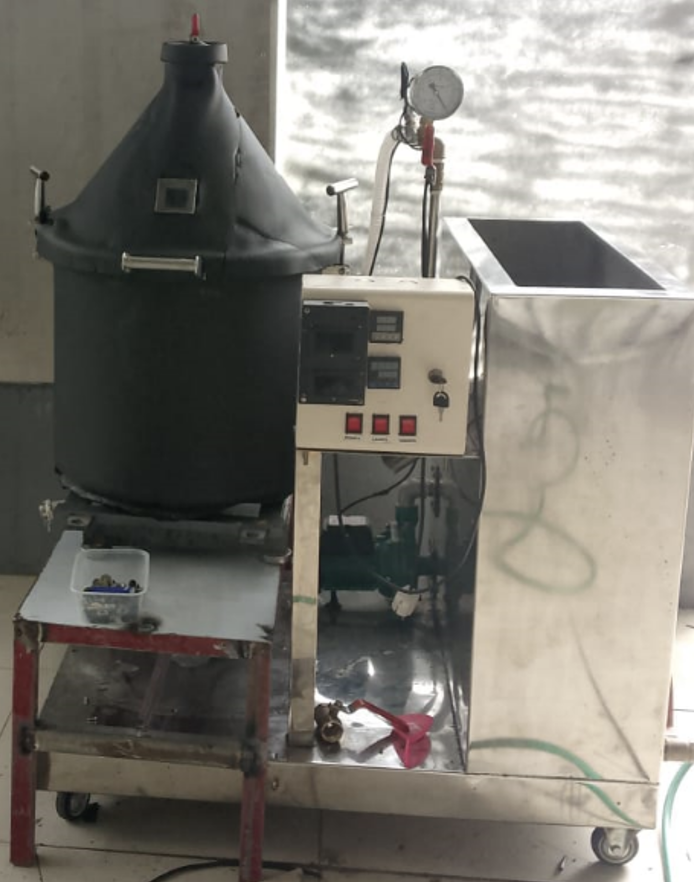
Traditional processing of Arenga sap still faces significant challenges, particularly long heating duration and high energy consumption. This study aims to evaluate the performance and energy efficiency of a solar-powered vacuum evaporator for the concentration of Arenga sap. The solar energy system consists of monocrystalline panels, an MPPT charge controller, a deep-cycle battery, and an inverter as the primary power source for the vacuum pump and induction heater, while thermal insulation is applied to minimize heat loss during evaporation. The performance test was conducted using 40 kg of fresh Arenga sap under a vacuum pressure of –0.71 to –0.73 bar and an operating temperature of 34–41°C for 150 minutes, resulting in 1.10 kg of evaporated mass. Based on the corrected and consistent dataset, the evaporation rate was calculated as 0.44 kg/hour, and the energy analysis using the latent heat of vaporization yielded an overall system efficiency of 83%. The novelty of this research lies in the implementation of a fully solar-powered low-pressure vacuum evaporator equipped with thermal insulation to enhance thermal stability. The findings indicate that this system can operate independently and offers a practical solution for small-scale Arenga sap producers, especially those located in remote or off-grid areas.Downloads
References
Al-Obaidi, M.A. et al. (2025) ‘A Review of Vacuum-Enhanced Solar Stills for Improved Desalination Performance’, Sustainability, 17(21). Available at: https://doi.org/10.3390/su17219535.
Ambarita, H. (2016) ‘Study on the performance of natural vacuum desalination system using low grade heat source’, Case Studies in Thermal Engineering, 8, pp. 346–358. Available at: https://doi.org/10.1016/j.csite.2016.09.005.
Aripin, H. et al. (2018) ‘Automated Temperature Control with Adjusting Outlet Valve of Fuel in the Process of Cooking Palm Sugar’, IOP Conference Series: Materials Science and Engineering, 336(1), p. 012018. Available at: https://doi.org/10.1088/1757-899X/336/1/012018.
Asghar, M.T. et al. (2020) ‘Processing of coconut sap into sugar syrup using rotary evaporation, microwave, and open-heat evaporation techniques’, Journal of the Science of Food and Agriculture, 100(10), pp. 4012–4019. Available at: https://doi.org/10.1002/jsfa.10446.
Chantasiriwan, S. (2020) ‘Increased Energy Efficiency of a Backward-Feed Multiple-Effect Evaporator Compared with a Forward-Feed Multiple-Effect Evaporator in the Cogeneration System of a Sugar Factory’, Processes, 8(3), p. 324. Available at: https://doi.org/10.3390/pr8030342.
Djohan, Y.A. and Meenune, M. (2021) ‘Effect of heating conditions on physical and chemical characteristics of sugar syrup’, Asia-Pacific Journal of Science and Technology, 26(01), pp. 26–01. Available at: https://doi.org/10.14456/apst.2021.9.
Ekka, J.P. and Kumar, D. (2023) ‘A review of industrial food processing using solar dryers with heat storage systems’, Journal of Stored Products Research, 101, p. 102090. Available at: https://doi.org/10.1016/j.jspr.2023.102090.
Erwin, E., Wiyono, S. and Maulana Yusuf, H. (2024) ‘Investigation Effect of Liquid Arenga Sugar’s Evaporation Temperature under Vacuum Pressure’, Research and Innovation in Food Science and Technology, 13(2), pp. 95–100. Available at: https://doi.org/10.22101/JRIFST.2023.382932.1432.
Jayanudin, Kurniawan, T. and Kustiningsih, I. (2019) ‘Phenolic Analysis and Characterization of Palm Sugar (Arenga pinnata) Produced by The Spray dryer’, Oriental Journal Of Chemistry, 35(1), pp. 150–156. Available at: https://doi.org/10.13005/ojc/350116.
Listijorini, E. and Wiyono, S. (2019) ‘Rice husk gasification performance to decrease water content in liquid palm sugar’, IOP Conference Series: Materials Science and Engineering, 673(1), p. 012121. Available at: https://doi.org/10.1088/1757-899X/673/1/012121.
Lourentius, S. and Ayucitra, A. (2023) ‘Optimization of Heat Transfer Area and Steam Requirement in Multiple Effects Evaporator for Concentration of Juice in Sugar Factory’, Equilibrium Journal of Chemical Engineering, 7(2), pp. 123–136. Available at: https://doi.org/10.20961/equilibrium.v7i2.73569.
Nursalam, S. (2024) Rancang Bangun Alat Pemantau Laju Penurunan Massa Larutan dan Kadar Brix Pada Proses Pembuatan Gula Aren Cair dengan Teknologi Vacuum Evaporator. Thesis. Fakultas Teknik Universitas Sultan Ageng Tirtayasa. [Print].
Puspitasari, N., Nurhalisah, S. and Sugmawati, D. (2025) ‘Proses Produksi Gula Aren Cetak (Arenga pinnata, Merr) di Indonesia’, KAPATU: Jurnal Pendidikan Dasar, 2(1), pp. 19–25. Available at: https://doi.org/10.33627/kjpd.v2i1.3331.
Sarkar, T. et al. (2023) ‘Palm sap sugar an unconventional source of sugar exploration for bioactive compounds and its role on functional food development’, Heliyon, 9(4), p. e14788. Available at: https://doi.org/10.1016/j.heliyon.2023.e14788.
Sun, W. et al. (2023) ‘Enhancing freshwater production with a high-performance solar interface evaporator and in low-vacuum environment: A solar-driven low-vacuum interfacial distillation system’, Desalination, 568, p. 117014. Available at: https://doi.org/10.1016/j.desal.2023.117014.
Victor, I.R.M. (2015) Processing of Arenga Pinnata (Palm) Sugar. Department of Bioresource Engineering Faculty of Agricultural and Environmental Sciences Macdonald Campus of McGill University Sainte-Anne-De-Bellevue. [Print].
Vondra, M., Máša, V. and Bobák, P. (2018) ‘The energy performance of vacuum evaporators for liquid digestate treatment in biogas plants’, Energy, 146, pp. 141–155. Available at: https://doi.org/10.1016/j.energy.2017.06.135.
Wang, W. et al. (2025) ‘Solar-Driven Interfacial Evaporation: Material Types, Structural Strategies, and Emerging Applications’, Langmuir, 41(36), pp. 24097–24134. Available at: https://doi.org/10.1021/acs.langmuir.5c02382.
Wiyono, S. et al. (2022) ‘The Effect of Vacuum Pressure on the Quality of Liquid Palm Sugar Resulting From the Vacuum Evaporation Process’, Proceedings of the Conference on Broad Exposure to Science and Technology 2021 (BEST 2021). Conference on Broad Exposure to Science and Technology 2021 (BEST 2021), Atlantis Press, pp. 453–455. Available at: https://doi.org/10.2991/aer.k.220131.070.
Wiyono, S., Erwin, E. and Abdullah, S. (2021) ‘Pengolahan Air Nira dengan Vacuum Evaporasi Menjadi Gula Aren Cair’, TEKNIKA: Jurnal Teknik, 8(2), pp. 122–130. Available at: https://doi.org/10.35449/teknika.v8i2.196.
Yusuf, A.M. et al. (2023) ‘Effect of Vacuum on Evaporation of Seawater: Pengaruh Vakum Pada Penguapan Air Laut’, R.E.M. (Rekayasa Energi Manufaktur) Jurnal, 8(2), pp. 55–62. Available at: https://doi.org/10.21070/r.e.m.v8i2.1672.
Downloads
Published
Issue
Section
License
Copyright (c) 2026 Jurnal Asiimetrik: Jurnal Ilmiah Rekayasa & Inovasi

This work is licensed under a Creative Commons Attribution-NonCommercial 4.0 International License.