A Conceptual Framework for Technology Integration in Residential Architecture
DOI:
https://doi.org/10.35814/asiimetrik.v8i1.9475Keywords:
architecture, BIM, DSS, conceptual, frameworkAbstract
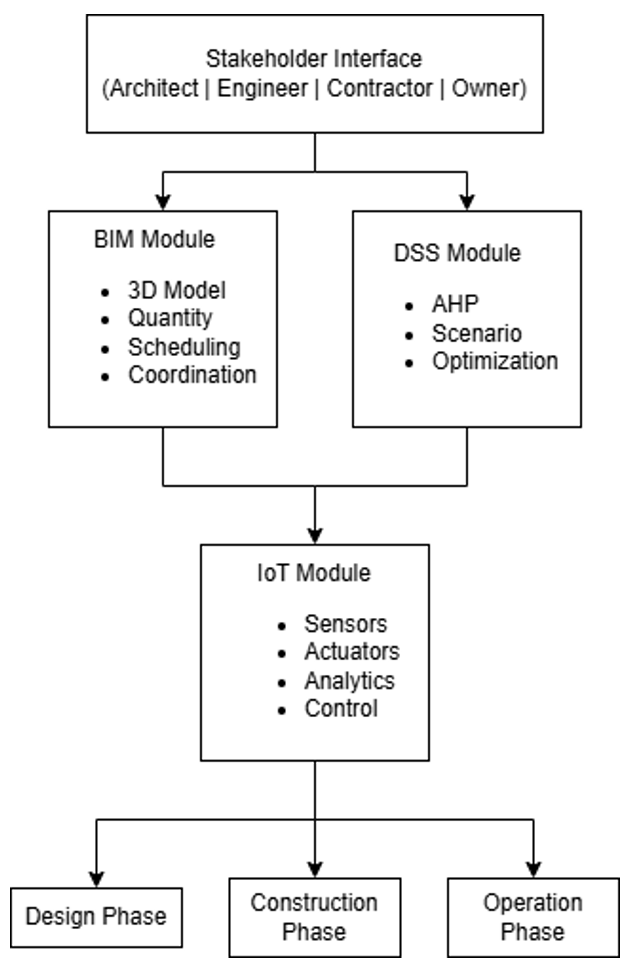
Modern residential housing planning faces substantial complexity, spanning regulatory compliance, diverse user preferences, and demands for resource efficiency and sustainability. These challenges are often magnified by insufficient coordination, resulting in inefficiencies and potential errors. Through a purposive literature review, this study addresses a critical gap in the literature regarding conceptual frameworks that integrate architecture and information systems, particularly during the residential planning phase. Information System (IS) integration has become essential, enabling holistic building data management, analysis, and design optimization. Although technologies such as Building Information Modeling (BIM) and Decision Support Systems (DSS) are widely recognized for their potential, existing studies emphasize specific technologies or practical implementations, leaving a need for a more abstract and foundational integrative model. This study develops an innovative conceptual framework model depicting the essential synergy between architectural design principles and information systems capabilities to optimize the planning process. The proposed model positions information systems as the main enabler, supporting data management, analysis, and visualization through an Integrated System that combines BIM, DSS, and the Internet of Things (IoT), producing data-driven, collaborative, and optimized planning outputs. This framework provides a theoretical foundation for future interdisciplinary research in technology-driven residential planning.Downloads
References
Abdelalim, A.M. et al. (2024) ‘Digital Trio: Integration of BIM–EIR–IoT for Facilities Management of Mega Construction Projects’, Sustainability, 16(15), p. 6348. Available at: https://doi.org/10.3390/su16156348.
Adham, M.F. (2024) ‘Analisis Implementasi Sistem Informasi: Studi Literatur’, Jurnal Teknologi Sistem Informasi, 5(1), pp. 264–275. Available at: https://doi.org/10.35957/jtsi.v5i1.7815.
Amirullah, A.H. and Anis, Y. (2025) ‘Design and Development of a Data Warehouse for PT. CMS Using the Nine-Step Kimball Method’, International Journal Software Engineering and Computer Science (IJSECS), 5(1), pp. 141–153. Available at: https://doi.org/10.35870/ijsecs.v5i1.3453.
Antunes, P., Johnstone, D. and Thuan, N.H. (2025) ‘Construction of Conceptual Frameworks in Research: An Information Systems Design Perspective’, Communications of the Association for Information Systems, 57(1), pp. 53–84. Available at: https://doi.org/10.17705/1CAIS.05703.
Beck, F., Borrmann, A. and Kolbe, T.H. (2020) ‘The Need for a Differentiation Between Heterogeneous Information Integration Approaches in The Field of “BIM-GIS Integration: A Literature Review’, ISPRS Annals of the Photogrammetry, Remote Sensing and Spatial Information Sciences, VI-4-W1-2020, pp. 21–28. Available at: https://doi.org/10.5194/isprs-annals-VI-4-W1-2020-21-2020.
Bidgoli, H. (2023) MIS: Management Information Systems. Boston, Massachusetts, United States: Cengage Learning. [Print].
Cucuzza, M. et al. (2022) ‘A BIM-enabled Decision Support System to support large-scale energy retrofitting processes and off-site solutions for envelope insulation’, IOP Conference Series: Earth and Environmental Science, 1101(4), p. 042031. Available at: https://doi.org/10.1088/1755-1315/1101/4/042031.
Gorgorova, Y.V. and Sarkisyants, M.G. (2018) ‘Dynamic Architecture as Reflection of a Modern Information Society’, Materials Science Forum, 931, pp. 699–704. Available at: https://doi.org/10.4028/www.scientific.net/MSF.931.699.
Hu, J. and Xu, Z. (2023) ‘Leveraging Information Systems, Big Data Analytics, andAI for Energy-Efficient Design of Rural Residences’, Journal of Information Systems Engineering and Management, 8(4), p. 23205. Available at: https://doi.org/10.55267/iadt.07.14037.
Iqbal, F. and Mirzabeigi, S. (2025) ‘Digital Twin-Enabled Building Information Modeling–Internet of Things (BIM-IoT) Framework for Optimizing Indoor Thermal Comfort Using Machine Learning’, Buildings, 15(10), p. 1584. Available at: https://doi.org/10.3390/buildings15101584.
Jensen et al. (2018) Informing Sustainable Architecture. Lyngby, Denmark: Polyteknisk Boghandel og Forlag.
Kamari, A. et al. (2018) ‘A BIM-based decision support system for the evaluation of holistic renovation scenarios’, Journal of Information Technology in Construction (ITcon), 23(18), pp. 354–380.
Lambrix, S. et al. (2024) ‘Towards a residential socio-physical framework: positioning subjective experiences in physical environments’, Architecture_MPS, 28(1), pp. 1–14. Available at: https://doi.org/10.14324/111.444.amps.2024v28i1.005.
Masuda, Y. and Viswanathan, M. (2025) Enterprise Architecture for Global Companies in a Digital IT Era: Adaptive Integrated Digital Architecture Framework (AIDAF). Singapore: Springer Nature. Available at: https://doi.org/10.1007/978-981-96-6724-6.
Naeem, N., Rana, I.A. and Nasir, A.R. (2023) ‘Digital real estate: a review of the technologies and tools transforming the industry and society’, Smart Construction and Sustainable Cities, 1(1), p. 15. Available at: https://doi.org/10.1007/s44268-023-00016-0.
Nurnaningsih, D. (2017) ‘Enterprise Architecture Planning Untuk Pengembangan Sistem Informasi Akademik Menggunakan Zachman Framework’, Jurnal Teknik, 6(2). Available at: https://doi.org/10.31000/jt.v6i2.454.
Ohize, H.O. et al. (2024) ‘Blockchain for securing electronic voting systems: a survey of architectures, trends, solutions, and challenges’, Cluster Computing, 28(2), p. 132. Available at: https://doi.org/10.1007/s10586-024-04709-8.
Rahayu, S. and Hadiana, A. (2017) ‘Perancangan Enterprise Architecture Berbasis Service Menggunakan Zachman Framework: Studi Kasus PDAM Kota Sukabumi’, JTERA (Jurnal Teknologi Rekayasa), 1(1), pp. 59–66. Available at: https://doi.org/10.31544/jtera.v1.i1.2016.59-66.
Ramonell, C., Chacón, R. and Posada, H. (2023) ‘Knowledge graph-based data integration system for digital twins of built assets’, Automation in Construction, 156, p. 105109. Available at: https://doi.org/10.1016/j.autcon.2023.105109.
Supriadi, H. and Amalia, E. (2019) ‘University’s Enterprise Architecture Design Using Enterprise Architecture Planning (EAP) Based on the Zachman’s Framework Approach’, International Journal of Higher Education, 8(3), pp. 13–28. Available at: https://doi.org/10.5430/ijhe.v8n3p13.
Suroso, J.S., Mauritsius, T. and Setyawan, A. (2018) ‘Information System Strategic Planning for Department of Housing and Settlement Region in the Jakarta Provincial Government - Indonesia’, MATEC Web of Conferences, 164, p. 01018. Available at: https://doi.org/10.1051/matecconf/201816401018.
Taherdoost, H. and Madanchian, M. (2023) ‘Multi-Criteria Decision Making (MCDM) Methods and Concepts’, Encyclopedia, 3(1), pp. 77–87. Available at: https://doi.org/10.3390/encyclopedia3010006.
Downloads
Published
Issue
Section
License
Copyright (c) 2026 Jurnal Asiimetrik: Jurnal Ilmiah Rekayasa Dan Inovasi

This work is licensed under a Creative Commons Attribution-NonCommercial 4.0 International License.