Predicting Graduation Timeliness: A Multidisciplinary Study on Logistic Mobility, Psychosomatic Fatigue, and AI-Assistance Dependency among Information Systems Students
DOI:
https://doi.org/10.35814/asiimetrik.v8i2.9876Keywords:
prediction, mobility, psychosomatic, AI-assistant, SVMAbstract
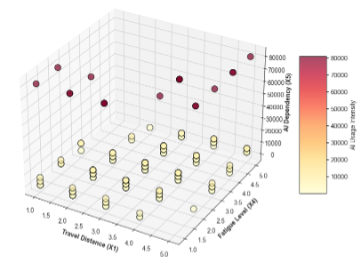
Timely graduation is now being impacted by non-academic stressors and technology use. This study goes beyond traditional models that rely solely on administrative data by incorporating physical and psychological dimensions, specifically Logistics Mobility (distance and duration of commute), Psychosomatic Fatigue, and AI Assistant Dependence. The data of 292 final year Information Systems students was balanced using Random Over Sampler. Models were compared between Random Forest and Support Vector Machine. Psychosomatic tiredness and AI assistant Dependence was the best predictive factor of delayed graduation, particularly for students commuting more than 25 km, who show more fatigue and higher AI reliance. In terms of algorithmic performance, Random Forest achieved an exceptional accuracy of 100%, while SVM followed closely with 98.28%. The results show the importance of physical exhaustion and digital dependency to identify students at risk of delay. The study finds that a student’s environment, in addition to cognitive ability, is a factor in whether or not they graduate on time. High reliance on AI indicates burnout, underscoring the importance of hybrid mentoring and AI literacy programs, particularly for commuting students.Downloads
References
An, R. et al. (2025) ‘Digital Fatigue And Academic Resilience Among University Students With Grit And Flexibility As Mediators’, Scientific Reports, 15(1), p. 45407. Available at: https://doi.org/10.1038/s41598-025-29313-7.
Cox, D.R. and Wermuth, N. (2014) Multivariate Dependencies: Models, Analysis and Interpretation. New York: Chapman and Hall/CRC. Available at: https://doi.org/10.1201/9781498710398.
Indah, M.F. et al. (2026) ‘The Impact of Fatigue on Academic Performance and Well Being in Undergraduate Medical Students: a Systematic Literature Review’, Proceedings of International Conference on Health Science, Practice, and Education 2026. International Conference on Health Science, Practice, and Education (ICOHESPE) 2026, Semarang, Indonesia: Universitas Negeri Semarang, pp. 270–305. Available at: https://proceeding.unnes.ac.id/icohespe/article/view/5224.
Keles, M.N., Yesiloglu, A. and Inal Ozun, O. (2025) ‘The Role Of Demographic And Psychosocial Factors In Academic Achievement: Insights From A Cross-Sectional Study On Physiotherapy And Rehabilitation Students’, BMC Medical Education, 25(1), p. 361. Available at: https://doi.org/10.1186/s12909-025-06958-6.
Khammissa, R.A.G. et al. (2022) ‘Burnout Phenomenon: Neurophysiological Factors, Clinical Features, And Aspects Of Management’, Journal of International Medical Research, 50(9), p. 03000605221106428. Available at: https://doi.org/10.1177/03000605221106428.
Khosravi, H. et al. (2022) ‘Explainable Artificial Intelligence In Education’, Computers and Education: Artificial Intelligence, 3, p. 100074. Available at: https://doi.org/10.1016/j.caeai.2022.100074.
Kondekar, V. and Bade, T. (2025) ‘Between Tracks and Minds: Psychological Adaptation and Fatigue in Daily Commuting among Student Commuters in Mumbai’, International Journal of Indian Psychology, 13(3), pp. 3930–3943. Available at: https://doi.org/10.25215/1303.358.
Krisnawan, M.A. et al. (2025) ‘Factors Influencing Burnout Among University Students: Systematic Review and Synthesis (2020–2025)’. Preprints. Available at: https://doi.org/10.20944/preprints202512.2828.v1.
Lazaros, K., Vrahatis, A.G. and Kotsiantis, S. (2026) ‘Human-in-the-Loop Artificial Intelligence: A Systematic Review of Concepts, Methods, and Applications’, Entropy, 28(4), pp. 1–50. Available at: https://doi.org/10.3390/e28040377.
Li, D. and Sullivan, W.C. (2016) ‘Impact Of Views To School Landscapes On Recovery From Stress And Mental Fatigue’, Landscape and Urban Planning, 148, pp. 149–158. Available at: https://doi.org/10.1016/j.landurbplan.2015.12.015.
Li, X. et al. (2026) ‘Mapping The Psychophysiological Geography Of Campus Commutes: A Dose-Response Analysis Of Route Environments’, Building and Environment, 301, p. 114756. Available at: https://doi.org/10.1016/j.buildenv.2026.114756.
Macqueen, S. et al. (2025) ‘University Student Anticipation And Experience Of Challenges And Support During Compulsory Work Integrated Learning Components’, The Australian Educational Researcher, 52(3), pp. 2779–2796. Available at: https://doi.org/10.1007/s13384-025-00836-2.
Noorbehbahani, F. and Oyibo, K. (2026) ‘AI-Overdependence And Human Cognitive Decline: Hazards, Evidence, And Mitigation Strategies’, Computers in Human Behavior Reports, 22, p. 101102. Available at: https://doi.org/10.1016/j.chbr.2026.101102.
Palma-Leal, X. et al. (2022) ‘Commuting to University: Self-Reported and Device-Measured Physical Activity and Sedentary Behaviour’, Sustainability, 14(22), p. 14818. Available at: https://doi.org/10.3390/su142214818.
Papakostas, M. et al. (2019) ‘Physical Fatigue Detection Through EMG Wearables And Subjective User Reports: A Machine Learning Approach Towards Adaptive Rehabilitation’, Proceedings of the 12th ACM International Conference on PErvasive Technologies Related to Assistive Environments. the 12th ACM International Conference on PErvasive Technologies Related to Assistive Environments, New York, NY, USA: Association for Computing Machinery (PETRA ’19), pp. 475–481. Available at: https://doi.org/10.1145/3316782.3322772.
Porter, Z. et al. (2026) ‘Bridging The Gap: A Biology Bridging Resource Supporting First-Year Academic Preparedness In Higher Education’, Currents in Pharmacy Teaching and Learning, 18(9), p. 102680. Available at: https://doi.org/10.1016/j.cptl.2026.102680.
Ramadani, M., Yarta, E.A. and Pratiwi, R. (2025) ‘Burnout in Final Year Students: A Review from a Human Resource Management Perspective’, International Conference On Research And Development (ICORAD), 4(2), pp. 126–131. Available at: https://doi.org/10.47841/icorad.v4i2.356.
Romiaty, R., Sendayu, F.S. and Putri, W.M. (2026) ‘Digital Innovation in Early Detection of Student Burnout: Development and Validation of the Android-Based Assessment Application BURNTES’, EDUKASIA Jurnal Pendidikan dan Pembelajaran, 7(1), pp. 125–138. Available at: https://doi.org/10.62775/edukasia.v7i1.1797.
Santos, F. (2020) ‘Modern Methods For Old Data: An Overview Of Some Robust Methods For Outliers Detection With Applications In Osteology’, Journal of Archaeological Science: Reports, 32, p. 102423. Available at: https://doi.org/10.1016/j.jasrep.2020.102423.
Sathe, Y.V. (2026) ‘Digital Behavior Profiling of Students to Measure Academic Performance Using Machine Learning’, International Journal of Advanced Research in Science, Communication and Technology, 6(7), pp. 630–646. Available at: https://doi.org/10.48175/IJARSCT-36886.
Shan, K. (2026) ‘The Influence Of Commuting Time On Students’ Academic Performance And Its Internal Mechanism: An Empirical Analysis Based On CEPS Data’, Frontiers in Psychology, 17, pp. 1–17. Available at: https://doi.org/10.3389/fpsyg.2026.1672841.
Suharti, S., Hutabarat, I. and Llamas, D.C. (2024) ‘Adaptive Learning Analytics for Tracking Student Performance and Predicting Academic Success in Digital Classrooms’, International Journal of Educational Technology and Society, 1(3), pp. 34–43. Available at: https://doi.org/10.61132/ijets.v1i3.411.
Syarip, D.I., Notodiputro, K.A. and Sartono, B. (2025) ‘Comparison Of Random Forest And Support Vector Machine Classification Methods For Predicting The Accuracy Level Of Madrasah Data’, MEDIA STATISTIKA, 18(1), pp. 37–48. Available at: https://doi.org/10.14710/medstat.18.1.37-48.
Tun, H.Z. and Aye, T.S. (2026) ‘Predictive Modeling for Career and University Pathway Recommendation Using Small-Scale Student Datasets’, 2026 IEEE Conference on Computer Applications (ICCA). 2026 IEEE Conference on Computer Applications (ICCA), Yangon, Myanmar: IEEE, pp. 1–8. Available at: https://doi.org/10.1109/ICCA69280.2026.11485824.
Zheng, J., Cheung, K. and Sit, P. (2024) ‘Identifying Key Features Of Resilient Students In Digital Reading: Insights From A Machine Learning Approach’, Education and Information Technologies, 29(2), pp. 2277–2301. Available at: https://doi.org/10.1007/s10639-023-11908-0.
Downloads
Published
Issue
Section
License
Copyright (c) 2026 Jurnal Asiimetrik: Jurnal Ilmiah Rekayasa Dan Inovasi

This work is licensed under a Creative Commons Attribution-NonCommercial 4.0 International License.