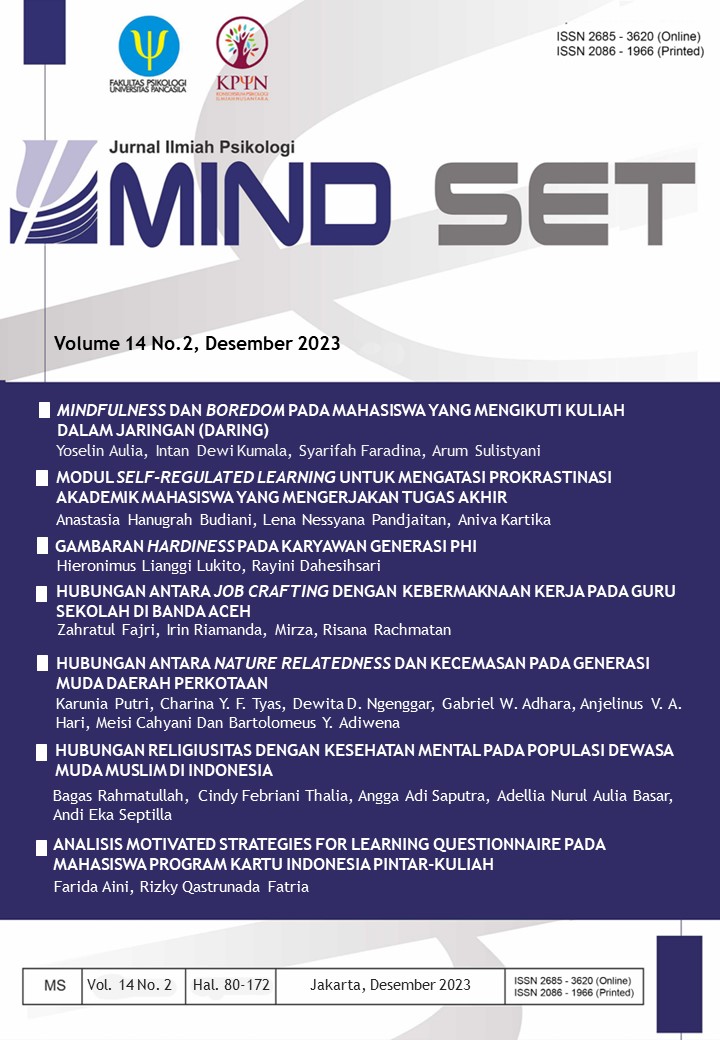
Hubungan Religiusitas dengan Kesehatan Mental pada Populasi Dewasa Muda Muslim di Indonesia
DOI:
https://doi.org/10.35814/mindset.v14i02.4895Kata Kunci:
dewasa awal, kesehatan mental, muslim, ReligiusitasAbstrak
Religiusitas kerap disangkutpautkan dengan baik buruknya kondisi kesehatan mental individu sehingga banyak stigma negatif muncul terhadap isu kesehatan mental. Penelitian ini bertujuan untuk membuktikan secara ilmiah mengenai hubungan religiusitas dengan kesehatan mental. Metode penelitian ini menggunakan metode kuantitatif dengan teknik accidental sampling. Untuk mengukur religiusitas digunakan Skala Religiusitas Muslim dan untuk mengukur kesehatan mental menggunakan Depression, Anxiety, Stress Scale 21 (DASS-21). Penelitian ini melibatkan 133 partisipan dari 13 provinsi di Indonesia yang terdiri atas 19,50% partisipan laki-laki dan 80,50% partisipan perempuan. Berdasarkan hasil uji analisis korelasi T-test didapatkan hasil tidak ada hubungan signifikan antara religiusitas dengan setiap gejala gangguan kesehatan mental, yaitu korelasi religiusitas depresi dengan r = -0,42; p > 0,05; dengan kecemasan r = -0,29; p > 0,05; dan dengan stress r = -0,36; p > 0,05. Berdasarkan hasil penelitian dapat kita artikan bahwa aspek kesehatan mental individu tidak memiliki hubungan yang signifikan dengan tinggi atau rendahnya tingkat religiusitas yang dimilikinya.
Referensi
Addy, N. D., Agbozo, F., Runge-Ranzinger, S., & Grys, P. (2021). Mental health difficulties, coping mechanisms and support systems among school-going adolescents in Ghana: A mixed-methods study. Plos One, 16(4), e0250424. https://doi.org/10.1371/journal.pone.0250424
Aditya, Y., Martoyo, I., Nurcahyo, F. A., Ariela, J., Pramono, R., Aditya, Y., Martoyo, I., Nurcahyo, F. A., & Ariela, J. (2021). Factorial structure of the four basic dimensions of religiousness ( 4-BDRS ) among Muslim and Christian college students in Indonesia Factorial structure of the four basic dimensions of religiousness ( 4-BDRS ) among Muslim and Christian college students . Cogent Psychology, 8(1). https://doi.org/10.1080/23311908.2021.1974680
Amir, Y. (2021). Pengembangan skala religiusitas untuk subyek Muslim. Indonesian Journal for The Psychology of Religion, 1(1). https://doi.org/10.24854/ijpr403
Azman, Ö., Mauz, E., Reitzle, M., Geene, R., Hölling, H., & Rattay, P. (2021). Associations between parenting style and mental health in children and adolescents aged 11–17 Years: Results of the KiGGS cohort study (Second follow-up). Children, 8(8), 672. https://doi.org/10.3390/children8080672
Banerjee, D., Rabheru, K., & Ivbijaro, G. (2021). Dignity of older persons with mental health conditions : why should clinicians care ? 12(November), 1–9. https://doi.org/10.3389/fpsyt.2021.774533
Bjørlykhaug, K. I., Karlsson, B., Hesook, S. K., & Kleppe, L. C. (2022). Social support and recovery from mental health problems: A scoping review. Nordic Social Work Research, 12(5), 666–697. https://doi.org/10.1080/2156857X.2020.1868553
Bushong, E. C. (2018). The relationship between religiosity and mental illness stigma in the Abrahamic religions.
Cui, M., Fincham, F. D., & Durtschi, J. A. (2011). The effect of parental divorce on young adults ’ romantic relationship dissolution: What makes a difference ? 18, 410–426. https://doi.org/10.1111/j.1475-6811.2010.01306.x
Daulay, N., Darmayanti, N., Harahap, A. C. P., Wahyuni, S., Mirza, R., Dewi, S. S., Hardjo, S., Indrawan, Y. F., Aisyah, S., Harahap, D. P., & Munisa, M. (2022). Religiosity as moderator of stress and well-being among Muslim students during the pandemic in Indonesia. Islamic Guidance and Counseling Journal, 5(2), 88–103. https://doi.org/10.25217/igcj.v5i2.2696
Diana, N., Mahudin, M., Noor, N. M., Dzulkifli, M. A., & Shari, N. (2016). Religiosity among Muslims : A scale development and validation study (Religiusitas pada Muslim : Pengembangan Skala dan Validasi Studi). Makara Hubs-Asia, 20(2), 109–120. https://doi.org/10.7454/mssh.v20i2.3492
El Hafiz, S. (2021). Skala religiusitas Muslim Indonesia: Mencari pengukuran aspek beragama yang valid (Scales of Indonesian Muslim religiosity: Looking for valid measurements of religious aspects). Jurnal Psikologi Islam, 8(1), 9–16. https://doi.org/10.47399/jpi.v8i1.131s
Fasihi-Harandi, T., Taghinasab, M. M., & Nayeri, D. T. (2017). The correlation of social support with mental health: A meta-analysis. Electronic Physician, 9(9), 5212–5222. https://doi.org/10.19082/5212
Ferreira, S., Magalhães, E., & Prioste, A. (2019). Social support and mental health of young people in residential care: A qualitative study. Annual Review of Legal Psychology, 30, 29–34. https://doi.org/https://doi.org/10.5093/apj2019a12
George, L. K., Ellison, C. G., & Larson, D. B. (2002). Target article: Explaining the relationships between religious involvement and health. Psychological Inquiry, 13(3), 190–200. https://doi.org/10.1207/S15327965PLI1303_04
Gialluisi, A., Bonaccio, M., Di Castelnuovo, A., Costanzo, S., De Curtis, A., Sarchiapone, M., Cerletti, C., Donati, M. B., de Gaetano, G., & Iacoviello, L. (2020). Lifestyle and biological factors influence the relationship between mental health and low-grade inflammation. Brain, Behavior, and Immunity, 85, 4–13. https://doi.org/10.1016/j.bbi.2019.04.041
Gupta, S., Avasthi, A., & Kumar, S. (2011). Relationship between religiosity and psychopathology in patients with depression. Indian Journal of Psychiatry, 53(4), 330. https://doi.org/10.4103/0019-5545.91907
Ha, O. (2019). Health risks associated with social isolation in general and in young , middle and old age.
Hong, Y., Zhang, Y., Xue, P., Fang, X., Zhou L.,Wei, F., Lou, X., & Zhu, H. (2022). The influence of long working hours , occupational stress , and well-being on depression among couriers in Zhejiang , China. Frontiers in Psychology, 13. https://doi.org/10.3389/fpsyg.2022.928928
Huber, S., & Huber, O. W. (2012). The Centrality of Religiosity Scale (CRS). Religions,3(3), 710–724. https://doi.org/10.3390/rel3030710
Jokela, M. (2022). Religiosity, Psychological distress, and well-being: Evaluating familial confounding with multicohort sibling data. American Journal of Epidemiology, 191(4), 584–590. https://doi.org/10.1093/aje/kwab276
Kathryn, S. E. V. Æ., Mcnulty, C., & Iii, F. J. F. (2009). The recovery process utilizing Erikson ’ s stages of human development. Community Mental Health Journal, 405–414. https://doi.org/10.1007/s10597-009-9189-4
Kaufman, C. C., Berlin, K., Okwumabua, T., & Thurston, I. (2022). Spirituality and religiosity profiles among diverse young adults: The relationship with meaning making. Journal of Spirituality in Mental Health. https://doi.org/https://doi.org/10.1080/19349637.2022.2074338
Khodayarifard, M., Abdollahi, A., Akbari-zardkhaneh, S., Afrooz, G., Rahiminezhad, A., Paknejad, M., Ghobary, B., Azarbayejani, M., Brinthaupt, T., & Jr, R. W. H. (2018). Abrahamic religiosity scale : Development and initial validation. Mental Health, Religion, and Culture, 21(9-10), 899-909. https://doi.org/10.1080/13674676.2018.1434495
Koenig, H. G. (2012). Religion, Spirituality, and health: The research and clinical implications. ISRN Psychiatry, 2012, 1–33. https://doi.org/10.5402/2012/278730
Leblanc, N. J., Dixon, L., Robinaugh, D. J., Valentine, S. E., Bosley, H. G., Gerber, M. W., & Marques, L. (2016). PTSD and romantic relationship satisfaction : Cluster and Symptom-level analyses. Journal of Traumatic Stress, 29(3), 259-267. https://doi.org/10.1002/jts.
Lee, B. H. J., Pearce, L. D., & Schorpp, K. M. (2018). Religious pathways from adolescence. J Sci Study Relig, 56(2017), 678–689.
Leguizamo, F., Olmedilla, A., Núñez, A., Verdaguer, F. J. P., Gómez-Espejo, V., Ruiz-Barquín, R., & Garcia-Mas, A. (2021). Personality, coping strategies, and mental health in high-performance athletes during confinement derived from the COVID-19 Pandemic. Frontiers in Public Health, 8. https://doi.org/10.3389/fpubh.2020.561198
Li, F., Luo, S., Mu, W., Li, Y., Ye, L., Zheng, X., Xu, B., Ding, Y., Ling, P., Zhou, M., & Chen, X. (2021). Effects of sources of social support and resilience on the mental health of different age groups during the COVID-19 pandemic. BMC Psychiatry, 21(1), 16. https://doi.org/10.1186/s12888-020-03012-1
Lovibond, S. H. & Lovibond, P. F. (1995). Manual for the Depression Anxiety & Stress Scales. (2nd Ed.). Psychology Foundation.
Malinakova, K., Tavel, P., Meier, Z., van Dijk, J. P., & Reijneveld, S. A. (2020). Religiosity and mental health: A contribution to understanding the heterogeneity of research findings. International Journal of Environmental Research and Public Health, 17(2), 494. https://doi.org/10.3390/ijerph17020494
Miller, L., Wickramaratne, P., Gameroff, M. J., Sage, M., Tenke, C. E., & Weissman, M. M. (2012). Religiosity and major depression in adults at high risk: A ten-year prospective study. American Journal of Psychiatry, 169(1), 89–94. https://doi.org/10.1176/appi.ajp.2011.10121823
Misran, R. N., Khaiyom, J. H. A., & Razali, Z. A. (2021). The Role of religiosity to address the mental health crisis of students: A study on three parameters (Anxiety, depression, and stress). Pertanika Journal of Social Sciences and Humanities, 29(4). https://doi.org/10.47836/pjssh.29.4.40
Paine, D. R., & Sandage, S. J. (2017). Religious involvement and depression: The mediating effect of relational spirituality. Journal of Religion and Health, 56(1), 269–283. https://doi.org/10.1007/s10943-016-0282-z
Peng, B., Hu, N., Yu, H., Xiao, H., & Luo, J. (2021). Parenting style and adolescent mental health: The chain mediating effects of self-esteem and psychological inflexibility. Frontiers in Psychology, 12. https://doi.org/10.3389/fpsyg.2021.738170
Purborini, N., Lee, M., Mazarina, H., & Chang, H. (2021). ScienceDirect Associated factors of depression among young adults in Indonesia : A population- based longitudinal study. Journal of the Formosan Medical Association, xxxx. https://doi.org/10.1016/j.jfma.2021.01.016
Reyes-Ortiz, C. A., Berges, I. M., Raji, M. A., Koenig, H. G., Kuo, Y.-F., & Markides, K. S. (2008). Church attendance mediates the association between depressive symptoms and cognitive functioning among older Mexican Americans. The Journals of Gerontology Series A: Biological Sciences and Medical Sciences, 63(5), 480–486. https://doi.org/10.1093/gerona/63.5.480
Schlack, R., Peerenboom, N., Neuperdt, L., Junker, S., & Beyer, A.-K. (2021). The effects of mental health problems in childhood and adolescence in young adults: Results of the KiGGS cohort. Journal of Health Monitoring, 6(4), 3–19. https://www.ncbi.nlm.nih.gov/pmc/articles/PMC8734087/
Schrempft, S., Jackowska, M., Hamer, M., & Steptoe, A. (2019). Associations between social isolation, loneliness , and objective physical activity in older men and women. BMC Public Health, 7, 1–10.
Singh, V., Gera, T., & Behmani, K. R. (2021). Parenting styles and mental health of adolescents. Journal of Psychology and Behavior Studies, 1(1), 41–46. https://doi.org/10.32996/jpbs.2021.1.1.6
Stoewen, D. L. (2022). Nature, nurture, and mental health Part 1: The influence of genetics, psychology, and biology. The Canadian Veterinary Journal = La Revue Veterinaire Canadienne, 63(4), 427–430. http://www.ncbi.nlm.nih.gov/pubmed/35368400
Sugiyono. (2018). Metode penelitian kuantitatif R&D. Alfabeta.
Sun, L., Canevello, A., Lewis, K. A., Li, J., Crocker, J., Schmidt, R. E., & Fitzgerald, M. (2021). Childhood emotional maltreatment and romantic relationships : The role of compassionate goals. Frontiers in Psychology, 12, 1–12. https://doi.org/10.3389/fpsyg.2021.723126
Suryadi, B., Hayat, B., Dwirifqi, M., & Putra, K. (2020). Evaluating psychometric properties of the Muslim Daily Religiosity Assessment Scale ( MUDRAS ) in Indonesian samples using the Rasch model evaluating psychometric properties of the Muslim daily. Mental Health, Religion & Culture, 0(0), 1–16. https://doi.org/10.1080/13674676.2020.1795822
VanderWeele, T. J., Li, S., Tsai, A. C., & Kawachi, I. (2016). Association between religious service attendance and lower suicide rates among US Women. JAMA Psychiatry, 73(8), 845. https://doi.org/10.1001/jamapsychiatry.2016.1243
Yonker, J. E., Schnabelrauch, C. A., & DeHaan, L. G. (2012). The relationship between spirituality and religiosity on psychological outcomes in adolescents and emerging adults: A meta‐analytic review. Journal of Adolescence, 35(2), 299–314. https://doi.org/10.1016/j.adolescence.2011.08.010