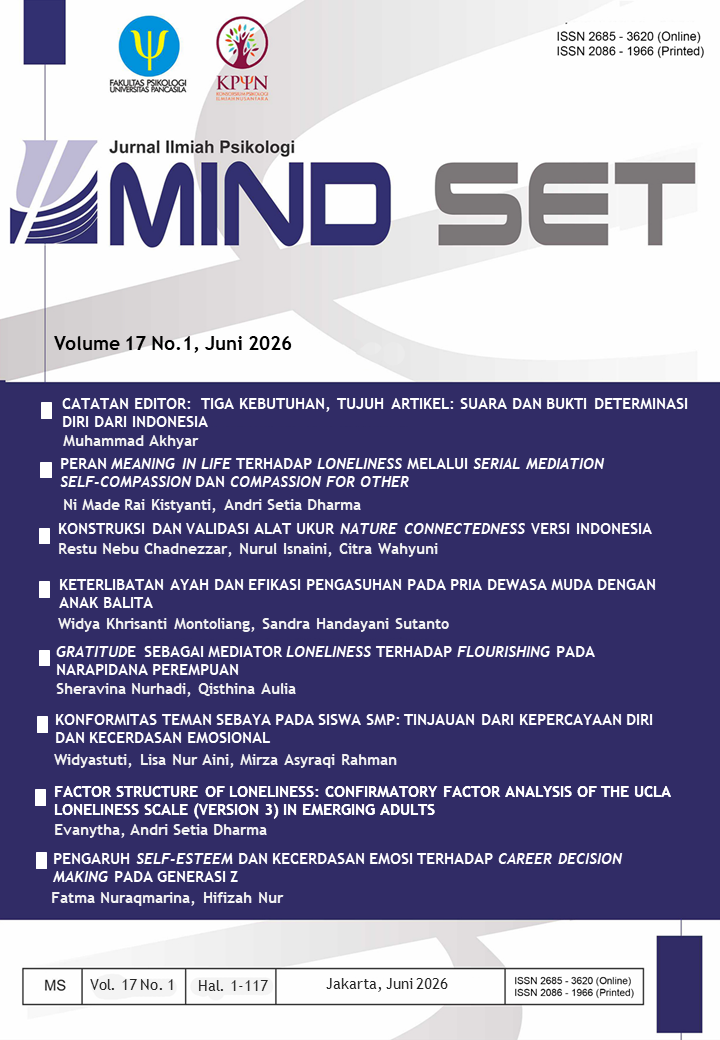
Peran Meaning in Life terhadap Loneliness melalui Serial Mediation Self-Compassion dan Compassion for Other
DOI:
https://doi.org/10.64228/sn7dn491Keywords:
compassion for others, emerging adulthood, loneliness, meaning in life , self-compassionAbstract
Loneliness is a common issue experienced by individuals in emerging adulthood and can negatively impact both physical and psychological health. Previous studies have highlighted the important role of meaning in life in reducing loneliness; however, the mechanisms underlying this relationship require further examination. This study aims to investigate the role of meaning in life on loneliness through the serial mediation of self-compassion and compassion for others. A total of 396 participants aged 18–29 years were recruited using a convenience sampling technique, and data were analyzed using Model 6 with the classical process model module in JASP. Mediation analysis revealed that meaning in life significantly reduced loneliness, both directly and indirectly through self-compassion. In contrast to self-compassion, compassion for others did not mediate the relationship between meaning in life and loneliness. Furthermore, compassion for others was also not found to play a role as the second mediator in the serial mediation model (self-compassion and compassion for others). These findings suggest that internal processes, particularly self-compassion, play a more dominant role in bridging the relationship between meaning in life and loneliness compared to interpersonal factors such as compassion for others. This study provides practical implications regarding the importance of strengthening meaning in life and cultivating self-compassion to reduce loneliness among individuals in emerging adulthood.
References
Akin, A. (2010). Self-compassion and loneliness. International Online Journal of Educational Sciences, 2(3), 702–718.
Arnett, J. J. (2000). Emerging adulthood: A theory of development from the late teens through the twenties. American Psychologist, 55(5), 469–480. https://doi.org/10.1037/0003-066X.55.5.469
Baek, E. C., Hyon, R., López, K., Du, M., Porter, M. A., & Parkinson, C. (2023). Lonely individuals process the world in idiosyncratic ways. Psychological Science, 34(6), 683–695. https://doi.org/10.1177/09567976221145316
Banerjee, A., & Kohli, N. (2022). Prevalence of loneliness among young adults during COVID-19 lockdown in India. Journal of Positive School Psychology, 6(4), 7797 – 7805.
Baumeister, R. F., & Leary, M. R. (1995). The need to belong: Desire for interpersonal attachments as a fundamental human motivation. Psychological Bulletin, 117(3), 497–529. https://doi.org/10.1037/0033-2909.117.3.497
Boffo, M., Mannarini, S., & Munari, C. (2012). Exploratory structure equation modeling of the UCLA loneliness scale: A contribution to the Italian adaptation. TPM: Testing, Psychome-trics, Methodology in Applied Psychology, 19(4), 345–363. https://doi.org/10.4473/TPM19.4.7
Bryman, A. (2016). Social Research Methods (5th ed.). Oxford University Press.
Cacioppo, J. T., Hawkley, L. C., Crawford, L. E., Ernst, J. M., Burleson, M. H., Kowalewski, R. B., & Berntson, G. G. (2002). Loneliness and health: Potential mechanisms. Psychosomatic Medicine, 64(3), 407-417. https://doi.org/10.1097/00006842-200205000-00005
Christiansen, J., Lund, R., Qualter, P., Andersen, C. M., Pedersen, S. S., & Lasgaard, M. (2021). Loneliness, social isolation, and chronic disease outcomes. Annals of Behavioral Medicine, 55(3), 203–215. https://doi.org/10.1093/abm/kaaa044
Cohen, R. J., & Swerdlik, M. E. (2018). Psychological Testing and Assessment (9th ed.). McGraw-Hill Education.
D’Hombres, B., Şylke, S., Barjaková, M., & Mendonça, F. T. (2018). Loneliness: An unequally shared burden in Europe [Technical report]. European Commission, Joint Research Centre. https://doi.org/10.13140/RG.2.2.21745.33128
Daikin, B. C., Tan, N. P., Conner, T. S., & Bastian, B. (2022). The relationship between prosociality, meaning, and happiness in everyday life. Journal of Happiness Studies, 23, 2787–2804. https://doi.org/10.1007/s10902-022-00526-1
Dharma, A.S., Sahrani, R., & Kistyanti, N. M. R. (2025). Validasi struktur faktor meaning in life pada emerging adulthood: Pengujian struktur faktor Meaning in Life Questionnaire (MLQ) dalam konteks Indonesia. Jurnal Fenomena, 34(2), 162-178. https://doi.org/10.30996/fn.v34i2.132448
Diehl, K., Jansen, C., Ishchanova, K., & Hilger-Kolb, J. (2018). Loneliness at universities: Determinants of emotional and social loneliness among students. International Journal of Environmental Research and Public Health, 15(9), 1865. https://doi.org/10.3390/ijerph15091865
DiJulio, B., Hamel, L., Muñana, C., & Brodie, M. (2018). Loneliness and social isolation in the United States, the United Kingdom, and Japan: An international survey. San Francisco, CA: Kaiser Family Foundation.
Durkin, M., Beaumont, E., Martin, C. J. H., & Carson, J. (2016). A pilot study exploring the relationship between self-compassion, self-judgment, self-kindness, compassion, professional quality of life, and wellbeing among UK community nurses. Nurse Education Today, 46, 109–114. https://doi.org/10.1016/j.nedt.2016.08.030
Dyal, S. R., & Valente, T. W. (2015). A systematic review of loneliness and smoking: Small effects, big implications. Substance Use & Misuse, 50(13), 1697–1716. https://doi.org/10.3109/10826084.2015.1027933
Frankl, V. (1985). Man’s search for meaning: An introduction to logotherapy. Pocket Books.
Frankl, V. (1963). Man's search for meaning. Washington Square Press.
Goetz, J. L., Keltner, D., & Simon-Thomas, E. (2010). Compassion: An evolutionary analysis and empirical review. Psychological Bulletin, 136(3), 351–374. https://doi.org/10.1037/a0018807
Hawkley, L. C., Browne, M. W., & Cacioppo, J. T. (2005). How can I connect with thee? Let me count the ways. Psychological Science, 16(10), 798–804. https://doi.org/10.1111/j.1467-9280.2005.01617.x
Hayes, A. F. (2022). Introduction to mediation, moderation, and conditional process analysis: A regression-based approach (3rd ed.). Guilford Press.
Hewitt, D. & Cramer, D. (2020). Research methods in psychology (6th ed.). Pearson
JASP Team (2024). JASP (Version 0.95.0) [Computer software].
Karnaze, M., & Bloss, C. (2023). Protective roles of empathy and compassion against loneliness early in the SARS-CoV-2 pandemic. Current Research in Behavioral Sciences, 5, 100130. https://doi.org/10.1016/j.crbeha.2023.100130
Kirwan, E. M., Burns, A., O’Súilleabháin, P. S., Summerville, S., McGeehan, M., McMahon, J., Gowda, A., & Creaven, A.-M. (2025). Loneliness in emerging adulthood: A scoping review. Adolescent Research Review, 10, 47–67. https://doi.org/10.1007/s40894-024-00240-4
Leary, M. R., Tate, E. B., Adams, C. E., Allen, A. B., & Hancock, J. (2007). Self-compassion and reactions to unpleasant self-relevant events: The implications of treating oneself kindly. Journal of Personality and Social Psychology, 92(5), 887–904. https://doi.org/10.1037/0022-3514.92.5.887
Liebe, A., & Olofsson, C. (2022). The role of compassion for meaning in life and life satisfaction [Bachelor’s thesis, Lund University]. Lund University Publications. https://lup.lub.lu.se/luur/download?func=downloadFile&recordOId=9108303&fileOId=9108304
López, A., Sanderman, R., Ranchor, A. V., & Schroevers, M. J. (2018). Compassion for others and self-compassion: Levels, correlates, and relationship with psychological well-being. Mindfulness, 9, 325–331. https://doi.org/10.1007/s12671-017-0777-z
Lyon, T. A. (2015). Self-compassion as a predictor of loneliness: The relationship between self-evaluation processes and perceptions of social connection [Undergraduate honors thesis, Southeastern University]. Selected Honors Theses.
Ma, J., & Xiao, Q. (2024). Relationship between self-compassion and compassion for others: The mediated effect of perceived social support and psychological resilience. Psychological Reports, Advance online publication. https://doi.org/10.1177/00332941241226906
Macià, D., Cattaneo, G., Solana, J., Tormos, J. M., Pascual-Leone, A., & Bartrés-Faz, D. (2021). Meaning in life: A major predictive factor for loneliness comparable to health status and social connectedness. Frontiers in Psychology, 12, Article 627547. https://doi.org/10.3389/fpsyg.2021.627547
Mwilambwe-Tshilobo, L., Ge, T., Chong, M., Ferguson, M. A., Misic, B., Burrow, A. L., Leahy, R. M., & Spreng, R. N. (2019). Loneliness and meaning in life are reflected in the intrinsic network architecture of the brain. Social Cognitive and Affective Neuroscience, 14(4), 423–433. https://doi.org/10.1093/scan/nsz021
Neff, K. D. (2003). Self-compassion: An alternative conceptualization of a healthy attitude toward oneself. Self and Identity, 2(2), 85–101. https://doi.org/10.1080/15298860309032
Neff, K. D., & Pommier, E. (2013). The relationship between self-compassion and other-focused concern among college undergraduates, community adults, and practicing meditators. Self and Identity, 12(2), 160–176. https://doi.org/10.1080/15298868.2011.649546
Neff, K. D. (2023). Self-Compassion: Theory, Method, Research, and Intervention. Annual Review of Psychology. 74, 193- 218. https://doi.org/10.1146/annurev-psych-032420-031047
Pinquart, M., & Sörensen, S. (2001). Influences on loneliness in older adults: A meta-analysis. Basic and Applied Social Psychology, 23(4), 245–266. https://doi.org/10.1207/S15324834BASP2304_2
Pommier, E., Neff, K. D., & Tóth-Király, I. (2019). The development and validation of the compassion scale. Assessment, 27(1), 1-19. https://doi.org/10.1177/1073191119874108
Qualter, P., Vanhalst, J., Harris, R., Van Roekel, E., Lodder, G., Bangee, M., Maes, M., & Verhagen, M. (2015). Loneliness across the life span. Perspectives on Psychological Science, 10(2), 250–264. https://doi.org/10.1177/1745691615568999
Rashid, S., Jehan, N., Khan, N. A., Gul, S., & Khan, H. M. (2020). Relationship between self-compassion and compassion for others. İlköğretim Online, 19(4), 5193–5200. https://doi.org/10.17051/ilkonline.2020.04.764928
Russell, D. W. (1996). UCLA loneliness scale (Version 3): Reliability, validity, and factor structure. Journal of personality assessment, 66(1), 20-40. https://doi.org/10.1207/s15327752jpa6601_2
Snell, K. D. M. (2017). The rise of living alone and loneliness in history. Social History, 42(1), 2–28. https://doi.org/10.1080/03071022.2017.1256093
Spector, P. E. (2019). Do not cross me: Optimizing the use of cross-sectional designs. Journal of Business and Psychology, 34(2), 125–137. https://doi.org/10.1007/s10869-018-09613-8
Steger, M. F. (2012). Making meaning in life. Psychological Inquiry, 23(4), 381–385. https://doi.org/10.1080/1047840X.2012.720832
Steger, M. F., Frazier, P., Oishi, S., & Kaler, M. (2006). The Meaning in Life Questionnaire: Assessing the presence of and search for meaning in life. Journal of Counseling Psychology, 53(1), 80–93. https://doi.org/10.1037/0022-0167.53.1.80
Steptoe, A., & Fancourt, D. (2019). Leading a meaningful life at older ages and its relationship with social engagement, prosperity, health, biology, and time use. Proceedings of the National Academy of Sciences, 116(4), 1207–1212. https://doi.org/10.1073/pnas.1814723116
Stillman, T. F., & Lambert, N. M. (2013). The bidirectional relationship of meaning and belonging. In J. A. Hicks & C. Routledge (Eds.), The experience of meaning in life: Classical perspectives, emerging themes, and controversies (pp. 305–315). Springer Science + Business Media. https://doi.org/10.1007/978-94-007-6527-6_23.
Suh, H., & Chong, S. (2022). What predicts meaning in life? The role of perfectionistic personality and self-compassion. Journal of Constructivist Psychology, 35(2), 719–733. https://doi.org/10.1080/10720537.2020.1865854
Sutin, A. R., Stephan, Y., Luchetti, M., & Terracciano, A. (2018). Loneliness and risk of dementia. Innovation in Aging, 2(Suppl 1), 966–967. https://doi.org/10.1093/geroni/igy031.3581
Tabue Teguo, M., Simo-Tabue, N., Stoykova, R., Meillon, C., Cogne, M., Amieva, H., & Dartigues, J-F. (2016). Feelings of loneliness and living alone as predictors of mortality in the elderly: The PAQUID study. Psychosomatic Medicine, 78(8), 904–909. https://doi.org/10.1097/PSY.0000000000000386
Vancampfort, D., Ashdown-Franks, G., Smith, L., Firth, J., Van Damme, T., Christiaansen, L., Stubbs. B., & Koyanagi, A. (2019). Leisure-time sedentary behavior and loneliness among 148,045 adolescents aged 12–15 years from 52 low- and middle-income countries. Journal of Affective Disorders, 251, 149–155. https://doi.org/10.1016/j.jad.2019.03.076
Welp, L. R., & Brown, C. M. (2014). Self-compassion, empathy, and helping intentions. The Journal of Positive Psychology, 9(1), 54–65. https://doi.org/10.1080/17439760.2013.831465
Witters, D. (2023, November 15). Loneliness in U.S. subsides from pandemic high. Gallup. https://news.gallup.com/poll/473057/loneliness-subsides-pandemic-high.aspx
Yuningsih, S. D. R., & Primanita, R. Y. (2020). Hubungan antara self-compassion dengan meaning in life pada mantan penyalahguna NAPZA di Sumatera Barat. Jurnal Pendidikan Tambusai, 4(3), 2276–2282. https://doi.org/10.31004/jptam.v4i3.707
Zhang, J. W., Chen, S., & Shakur, T. K. T. (2020). From me to you: Self-compassion predicts acceptance of own and others’ imperfections. Personality and Social Psychology Bulletin, 46(2), 228–242. https://doi.org/10.1177/0146167219853846
Downloads
Published
Issue
Section
License
Copyright (c) 2026 Jurnal Ilmiah Psikologi MIND SET

This work is licensed under a Creative Commons Attribution 4.0 International License.